

The strange business of hole-in-one insurance

The strange business of hole-in-one insurance

On a warm day in September 2009, Jason Hargett, a 35-year-old restaurant manager and father of 4, stepped up to the tee at Red Ledges golf resort in Heber City, Utah.

It was the end of a charity tournament and a big prize was on the line: Anyone who sunk a hole-in-one would win $1m.

Hargett took a swing.

The ball careened 150 yards through the air, plopped onto the green, and slowly rolled back into the hole. Cheers erupted from the small crowd as Hargett sprinted down the fairway in disbelief.

But one entity wasn’t celebrating: the insurance firm that had been hired by the organizers.

***

If you’ve ever watched a golf tournament or charity event, you’ve probably seen some kind of prize (a cash payout, a flashy car, a vacation package) for acing a specified hole.

The chances of this happening for an amateur golfer are minuscule (~1 in 12.5k). But most organizers can’t risk getting stuck with the bill.

Instead, they turn to hole-in-one insurance firms that assume the risk for a small fee.

A brief history of ‘unlucky’ golfers

The hole-in-one insurance business dates back nearly 100 years — but it was originally intended for a different purpose.

Enjoying this article?

Get the Hustle’s 5-minute weekday roundup that keeps you hip to happenings in tech, business, and internet… things.

In many golf circles, it was (and still is) customary for the lucky golfer to buy drinks for everyone in the clubhouse after landing a hole-in-one. This often resulted in prohibitively expensive bar tabs.

And an industry sprouted up to protect these golfers.
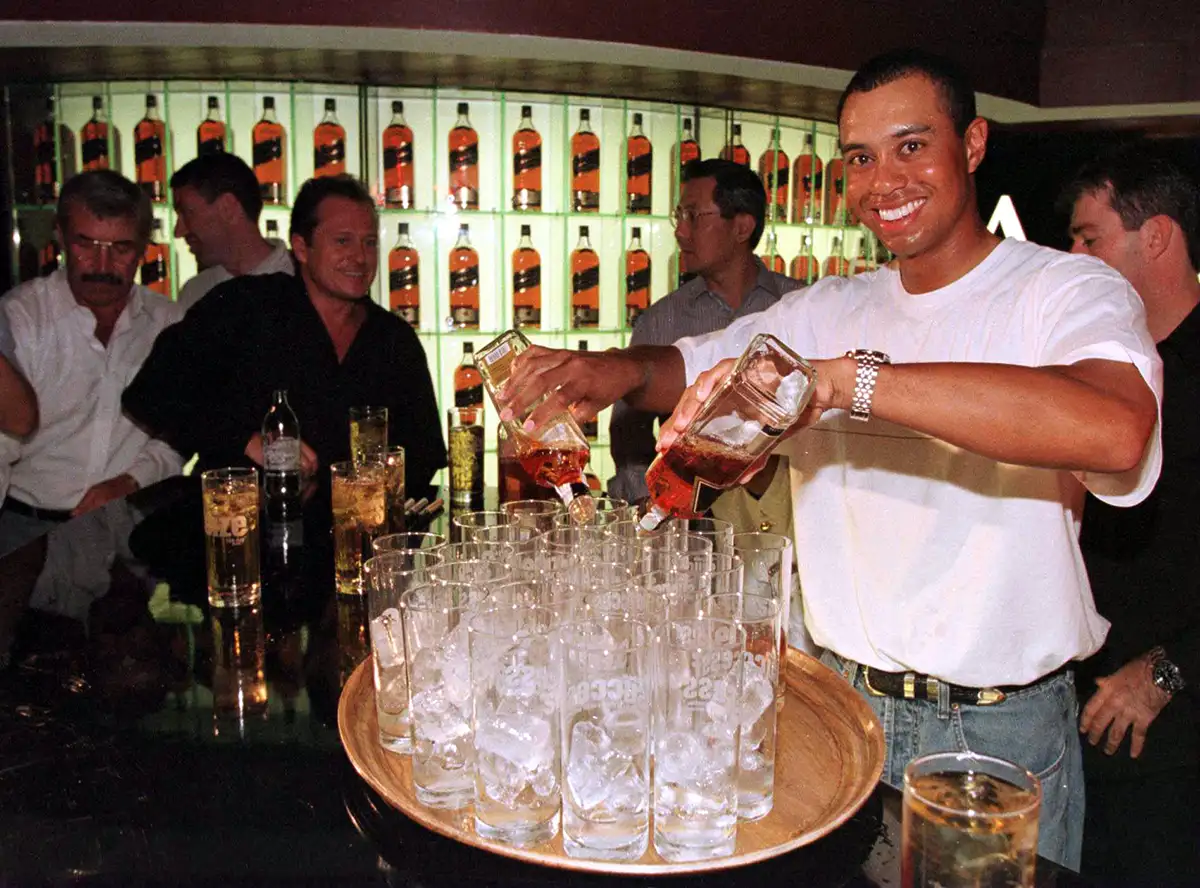
Tiger Woods serves drinks during the Johnnie Walker Classic in 2000 (David Cannon/ALLSPORT)

A newspaper archive analysis by The Hustle revealed that hole-in-one insurance firms sprouted up as early as 1933.

Under this model, golfers could pay a fee — say, $1.50 (about $35 today) — to cover a $25 (~$550) bar tab. And as one paper noted in 1937: “The way some of the boys have been bagging the dodos, it might not be a bad idea.”

Though the concept largely faded away in the US, it became a big business in Japan, where golfers who landed a hole-in-one were expected to throw parties “comparable to a small wedding,” including live music, food, drinks, and commemorative tree plantings.

By the 1990s, the hole-in-one insurance industry had a total market value of $220m. An estimated 30{1b90e59fe8a6c14b55fbbae1d9373c165823754d058ebf80beecafc6dee5063a} of all Japanese golfers shelled out $50-$70/year to insure themselves against up to $3.5k in expenses.

Around the same time, golf tournaments began offering increasingly large prizes for holes-in-one as a way to drum up press.

And hole-in-one insurance began to make a comeback in the US — not for individual golfers, but for the event organizers putting up the money.

How hole-in-one insurance works

Mark Gilmartin runs Hole In One International, one of the oldest hole-in-one insurance companies in the US.

The idea first struck in 1991, when Gilmartin, then 29 and the proprietor of a golf club repair company, saw a burgeoning need for prize coverage at charity events.

Since 1991, his Reno-based firm has paid out ~$56m in insurance claims — including Jason Hargett’s $1m prize.

Mark Gilmartin (photo illustration: The Hustle)

Today’s hole-in-one-insurance landscape, Gilmartin says, is ripe with competition: More than 2 dozen companies specialize in the niche field, vying for Google search keywords and golf tournament dollars.

The process generally works like so:

  1. A golf tournament decides to give away a prize — say, a $60k Mercedes — to anyone who gets a hole-in-one at the event.
  2. They partner with a sponsor (in this example, a dealership) that offers the prize.
  3. The sponsor pays Hole In One International a relatively small fee ($200 to $1k+); if someone gets a hole-in-one, Gilmartin covers the cost of the prize.

Gilmartin says the cost to insure against a hole-in-one is dependent on 3 factors:

  1. The number of golfers in the tournament
  2. The length (yardage) of the contest hole
  3. The cash value of the hole-in-one prize

Once a client provides this information, Gilmartin plugs it into an algorithm that computes the odds, factors in his risk and margins, and spits out a dollar amount per golfer.

A standard tournament with 100 golfers playing a 165-yard hole with a $10k prize sets an event back ~$235.
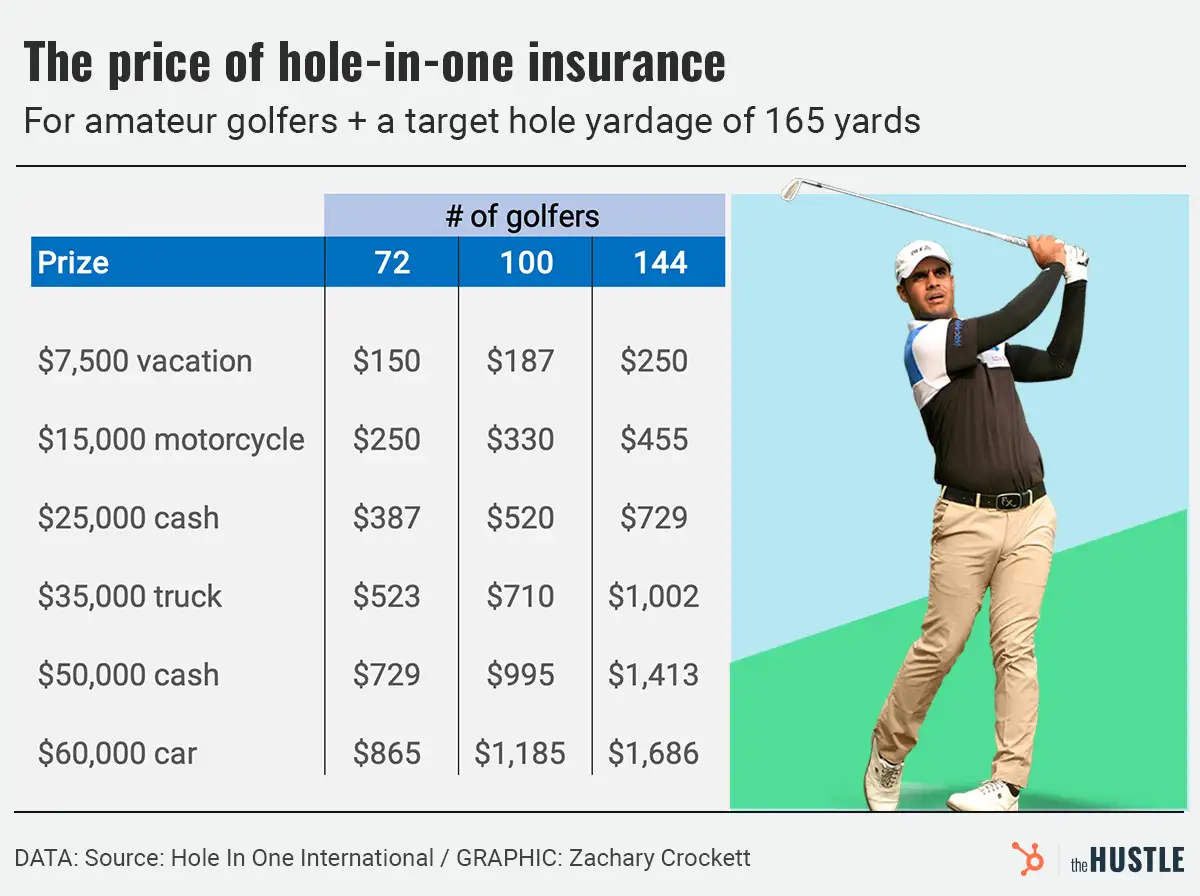
Zachary Crockett / The Hustle

Insurance firms operate on the premise that the odds of something happening are small enough to assume a repeated risk — and in Gilmartin’s case, this holds true.

The chances of someone getting a hole-in-one are fairly small:

  • 1 in 12.5k for amateur golfers
  • 1 in 3k for pro golfers

But ~450m rounds of golf are played every year. And because of the scale and popularity of the sport, the feat happens on a daily basis.

The National Hole-In-One Registry — the preeminent record-keeper of aces — estimates that 128k holes-in-one are achieved internationally every year by professionals and amateurs.

In other words, Gilmartin is no stranger to opening up his pockets.

What happens when someone wins?

Every year, Gilmartin says he insures ~15k events and pays out “hundreds and hundreds” of holes-in-one.

Most of those prizes are under $100k in value. But sometimes, he gets dinged up pretty bad.

In November 2021, for instance, 3 LPGA golfers got a hole-in-one in the same week, each winning a 2-year lease on a Lamborghini Huracán. The tournament’s sponsor, Morgan Auto Group, purchased hole-in-one insurance from Gilmartin, and the winning shots set him back ~$300k.

“Yeah, those women are pretty damn good,” he says. “That one still stings.”

Over the past 30 years, Gilmartin has also had to pay out at least 4 $1m prizes, which are typically awarded in annuities. Hargett, who landed that shot in Utah, got $25k/year for 40 years — a steep cost for Gilmartin, who charged a total of ~$1.1k to insure the 6 contestants at that event.

Pro golfer Austin Ernst with her Lamborghini Huracán after sinking a hole-in-one at the LPGA’s Pelican Women’s Championship in November 2021 (Austin Ernst / Instagram)

Before paying out a prize, Gilmartin requires a few proof-points:

  • A sworn affidavit from an unbiased, non-participatory witness at the event.
  • A “gentle investigation” of the hole-in-one’s legitimacy (verifying the tee position wasn’t changed, that the yardage was consistent with the contract, etc.).

Fraud does happen in the business.

In 1998, for instance, a man got a hole-in-one at an event and won a choice between a 1931 Cadillac or $40k in cash. But it turned out that the event organizer owed the winner a favor and had staged the whole thing. The organizer was convicted of fraud, and the prize was nullified. 

But Gilmartin says prizes are rarely denied — and despite forking over $2-$4m in claims in any given year, he always ends up in the black.

“You’re going to get hit in this business, but hopefully it all comes out in the wash at the end of the year,” he says.

Cow poop, frisbee tosses, and half-court shots

Hole-in-one insurance is only one facet of a broader industry called prize indemnity insurance — the coverage of any promotional event in which a large prize is offered.

Gilmartin runs a second company, Odds On Promotions, that covers much weirder stuff than holes-in-one.

“If you can dream it, I’ll insure it,” he says.

Among the many events Gilmartin has insured prizes for:

  • Half-court shots during halftime at basketball games
  • Guessing the number of jelly beans in a jar
  • Guessing the exact weight of a giant pumpkin
  • Throwing a frisbee through the sunroof of a car
  • Making a 7-10 split in bowling
  • Rubber duck races
  • Tossing a cookie into a bowl of milk
  • Guessing the Dow Jones average on a set day in the future
  • Tossing an olive into a martini glass from across a bar

Among the weirder things he’s insured? Cow patty bingo (video here).

“It’s big in the Midwest,” says Gilmartin. “You divide a big field into, say, 100 squares, give each one a number, then let a cow loose. If the cow poops on a preselected number, the person wins a prize.”
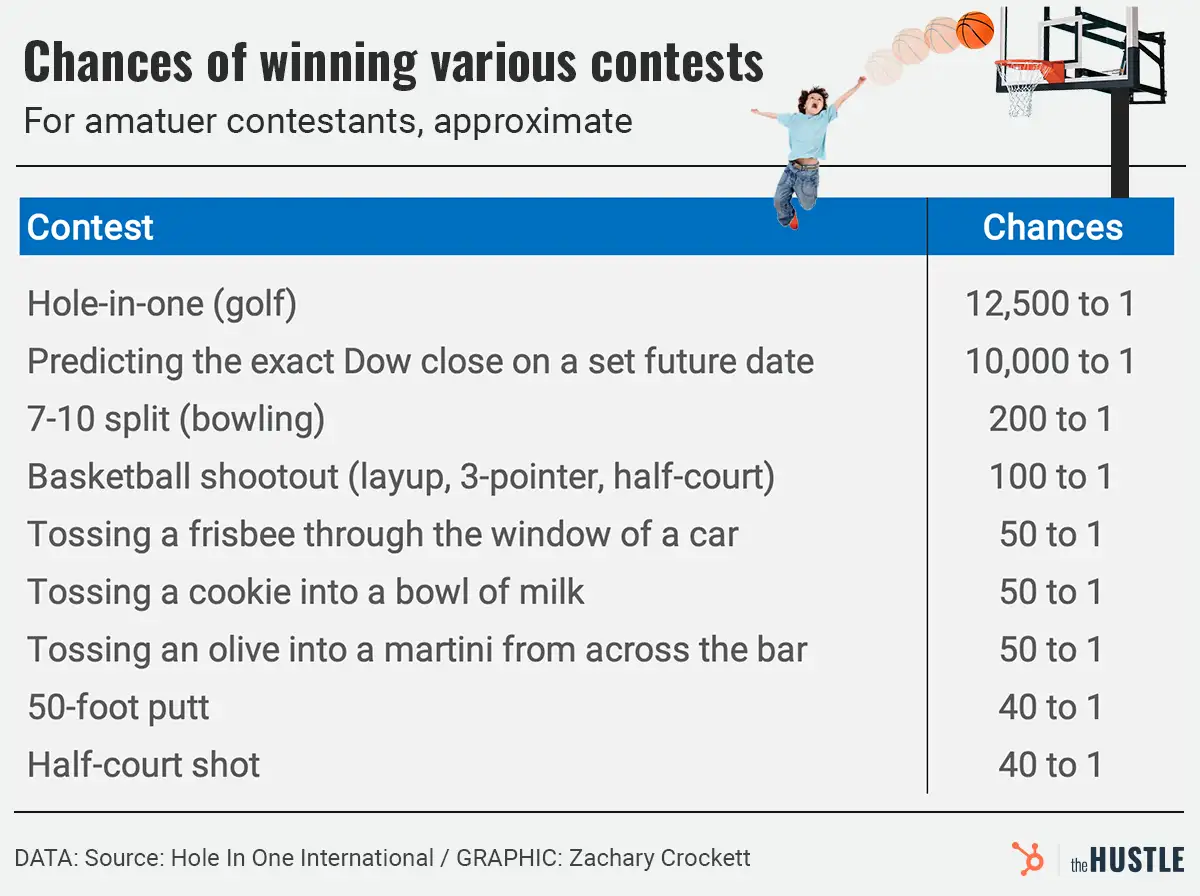
Zachary Crockett / The Hustle

All of these things are insurable, he says, because they fall into one of 3 categories of risk:

  1. Mathematical (like flipping a coin)
  2. Skill-based (a half-court shot)
  3. Odds-based (a sports team winning a game)

In most cases, Gilmartin can calculate the rough chances of something happening and use the data to compute his premiums. 

But sometimes, he has to insure things for which data doesn’t exist. And in those cases, he re-creates the scenario himself.

If a sponsor wants contestants to throw a ping-pong ball through a hole in a watermelon, he’ll go outside with his employees and re-create it himself, recording the results.

“It keeps things exciting,” he says. “By insurance standards, at least.”

Get the 5-minute roundup you’ll actually read in your inbox​

Business and tech news in 5 minutes or less​

Asian Shares Decline, Echoing Broad Slump on Wall Street | Business News

Asian Shares Decline, Echoing Broad Slump on Wall Street | Business News

By YURI KAGEYAMA, AP Organization Author

TOKYO (AP) — Asian shares retreated on Wednesday, echoing a broad decline on Wall Street and pushed by worries about how the war in Ukraine may well thrust prices for oil and other commodities higher.

Tokyo’s benchmark rose just after Primary Minister Fumio Kishida introduced actions to aid weak people and compact enterprises as the nation copes with increasing costs and a weakening currency.

Japan’s benchmark Nikkei 225 dropped 1.9{1b90e59fe8a6c14b55fbbae1d9373c165823754d058ebf80beecafc6dee5063a} in early morning investing to 26,200.26.

The Financial institution of Japan is keeping a two-day coverage board meeting. The central bank has despatched a clear concept about preserving fascination rates extremely-minimal to enable stimulate shelling out and financial investment and has purchased Japanese governing administration bonds periodically, aiming to preserve 10-year-bond yields in just a array of moreover or minus .25{1b90e59fe8a6c14b55fbbae1d9373c165823754d058ebf80beecafc6dee5063a}.

Political Cartoons

Elsewhere in the location, South Korea’s Kospi slipped 1.1{1b90e59fe8a6c14b55fbbae1d9373c165823754d058ebf80beecafc6dee5063a} to 2,638.93. Australia’s S&P/ASX 200 get rid of .7{1b90e59fe8a6c14b55fbbae1d9373c165823754d058ebf80beecafc6dee5063a} to 7,267.30. Hong Kong’s Dangle Seng dropped .9{1b90e59fe8a6c14b55fbbae1d9373c165823754d058ebf80beecafc6dee5063a} to 19,762.57 and the Shanghai Composite index fell .6{1b90e59fe8a6c14b55fbbae1d9373c165823754d058ebf80beecafc6dee5063a} to 2,869.05.

Anxieties about constraints on motion and enterprise action in Beijing, Shanghai and other Chinese cities to fight a increase in coronavirus conditions are weighing on trader sentiment.

So are the ramifications of the war in Ukraine, which apart from the threats of broader conflict has pushed presently inflated price ranges for numerous commodities and merchandise nevertheless bigger, complicating the financial outlook and posing hardships for quite a few organizations and people.

“After seemingly taking much more of a backseat with the onset of earnings time, renewed tensions in the Ukraine-Russia conflict serves as a reminder that geopolitical chance is significantly from more than,” claimed Yeap Jun Rong, industry strategist with IG in Singapore.

On Tuesday, U.S. benchmarks have been weighed down by sharp declines in Major Tech stocks that took the Nasdaq to its worst fall due to the fact September 2020. The S&P 500 fell 2.8{1b90e59fe8a6c14b55fbbae1d9373c165823754d058ebf80beecafc6dee5063a} to 4,175.20. The benchmark index closed the day with 95{1b90e59fe8a6c14b55fbbae1d9373c165823754d058ebf80beecafc6dee5063a} of its shares dropping floor. The Dow Jones Industrial Regular shed 2.4{1b90e59fe8a6c14b55fbbae1d9373c165823754d058ebf80beecafc6dee5063a} to 33,240.18.

The tech-weighty Nasdaq bore the brunt of the day’s losses. It tumbled 4{1b90e59fe8a6c14b55fbbae1d9373c165823754d058ebf80beecafc6dee5063a}, to 12,490.74, its worst drop considering the fact that Sept. 8, 2020. The index is now down 20{1b90e59fe8a6c14b55fbbae1d9373c165823754d058ebf80beecafc6dee5063a} this calendar year as investors shun the extremely-expensive tech sector, which built gangbuster gains for a lot of the pandemic.

With the Federal Reserve established to aggressively raise interest fees as it techniques up its fight versus inflation, traders are fewer and fewer prepared to endure the lofty prices they had been paying for Microsoft, Facebook’s father or mother enterprise and other tech giants.

Microsoft fell 3.7{1b90e59fe8a6c14b55fbbae1d9373c165823754d058ebf80beecafc6dee5063a}. Google’s parent company, Alphabet, fell 3.6{1b90e59fe8a6c14b55fbbae1d9373c165823754d058ebf80beecafc6dee5063a} in regular trading and misplaced an additional 6{1b90e59fe8a6c14b55fbbae1d9373c165823754d058ebf80beecafc6dee5063a} in soon after-hrs investing just after reporting effects that fell limited of analysts’ estimates.

Far more major know-how companies are on deck to report earnings this week, together with Facebook parent’s enterprise, Meta, on Wednesday, and Apple on Thursday.

Tesla slumped 12.2{1b90e59fe8a6c14b55fbbae1d9373c165823754d058ebf80beecafc6dee5063a} above fears that CEO Elon Musk will be distracted and less engaged in jogging the electrical motor vehicle maker as he purchases social media firm Twitter, which fell 3.9{1b90e59fe8a6c14b55fbbae1d9373c165823754d058ebf80beecafc6dee5063a}.

Suppliers and other firms that rely on immediate shopper expending also fell broadly. Common Motors fell 4.5{1b90e59fe8a6c14b55fbbae1d9373c165823754d058ebf80beecafc6dee5063a} when Nike slipped 5.8{1b90e59fe8a6c14b55fbbae1d9373c165823754d058ebf80beecafc6dee5063a}.

Typical Electric fell 10.3{1b90e59fe8a6c14b55fbbae1d9373c165823754d058ebf80beecafc6dee5063a} for one of the sharpest losses in the sector after telling buyers that inflation and other pressures are weighing on its financial gain forecast for the year.

Bond yields fell. The produce on the 10-12 months Treasury fell to 2.73{1b90e59fe8a6c14b55fbbae1d9373c165823754d058ebf80beecafc6dee5063a} from 2.82{1b90e59fe8a6c14b55fbbae1d9373c165823754d058ebf80beecafc6dee5063a} late Monday.

Energy organizations eked out a attain, the only just one of the 11 sectors in the S&P 500 to do so.

In energy investing, benchmark U.S. crude additional 77 cents to $102.47 a barrel. The price of benchmark U.S. crude oil rose 3.2{1b90e59fe8a6c14b55fbbae1d9373c165823754d058ebf80beecafc6dee5063a} Tuesday. Brent crude, the global normal, received 83 cents to $105.82 a barrel.

Soon after rallying the 2nd half of March, U.S. shares have been on shaky ground in April. The S&P 500 has fallen for a few straight weeks.

“It’s the marketplace finding a minor more comfortable with a slowdown at best and recessionary fears at worst,” said Ross Mayfield, financial investment technique analyst at Baird.

Earnings for industrial and retail providers are a key aim for the rest of the week. Plane maker Boeing reviews its results on Wednesday. Industrial bellwether Caterpillar announces earnings on Thursday, along with McDonald’s and Amazon.

In economics information, the Convention Board described that customer self-confidence weakened a bit in April but stays substantial. And on Friday the Commerce Division releases its private money and spending report for March.

Economists and traders are involved that the U.S. economic system may well slow sharply or even slide into a recession since of the large curiosity-fee improves the Fed is anticipated to press by way of.

In forex trading, the U.S. dollar edged up to 127.46 Japanese yen from 127.23 yen The euro expense $1.0650, up from $1.0639.

AP Company Author Damian J. Troise contributed.

Copyright 2022 The Related Press. All rights reserved. This material may well not be revealed, broadcast, rewritten or redistributed.

Stocks sink as Amazon, Apple shares decline after quarterly reports

Stocks sink as Amazon, Apple shares decline after quarterly reports

U.S. stock declines accelerated into the close on Friday as the major equity indexes ended a volatile month lower.

The S&P 500, Dow Jones Industrial Average and Nasdaq Composite each sank. The S&P 500 ended Friday’s session lower by 3.6{1b90e59fe8a6c14b55fbbae1d9373c165823754d058ebf80beecafc6dee5063a}, and dropped about 8.8{1b90e59fe8a6c14b55fbbae1d9373c165823754d058ebf80beecafc6dee5063a} for April to post its worst monthly performance since March 2020. The Dow dropped 4.9{1b90e59fe8a6c14b55fbbae1d9373c165823754d058ebf80beecafc6dee5063a} for the month. The Nasdaq Composite was the biggest laggard, sliding by more than 13{1b90e59fe8a6c14b55fbbae1d9373c165823754d058ebf80beecafc6dee5063a} in April alone in the index’s worst month since October 2008.

Treasury yields climbed, and the benchmark 10-year yield rose above 2.9{1b90e59fe8a6c14b55fbbae1d9373c165823754d058ebf80beecafc6dee5063a}. Shares of tech juggernaut Amazon slid after the company unexpectedly posted a quarterly loss and offered a weaker-than-expected current-quarter forecast. Apple’s stock also declined even after the iPhone-maker exceeded quarterly sales and profit estimates, though the company still cited ongoing supply chain constraints.

A day earlier earlier, the S&P 500 closed out Thursday’s session sharply higher, gaining 2.5{1b90e59fe8a6c14b55fbbae1d9373c165823754d058ebf80beecafc6dee5063a}, while the Nasdaq Composite rose by 3.1{1b90e59fe8a6c14b55fbbae1d9373c165823754d058ebf80beecafc6dee5063a} in its best day since March 16. Still, the S&P 500 still posted its third monthly decline so far in 2022, even during a month that is typically seasonally solid for equities.

Volatility has resurged in recent weeks amid concerns over whether tighter monetary policies from the Federal Reserve might derail the economy. And these fears compounded with lingering jitters over persistent inflation, geopolitical turmoil and an ongoing COVID outbreak in China. The S&P 500 was on track for an about 5{1b90e59fe8a6c14b55fbbae1d9373c165823754d058ebf80beecafc6dee5063a} drop in April, based on Thursday’s closing level.

“There’s a lot of rerating going on, whether it’s the rerating of equity valuations, the rerating of interest rate expectations, or the rerating of inflation expectations, against tightening happening at the Fed,” Todd Jablonski, Principal Global Asset Allocation chief investment officer, told Yahoo Finance Live. “The threats of a slower economy, the threats of inflation, and the threats of higher energy prices out of the conflict in Ukraine [are] all sort of coming together to really stymie investor confidence and sentiment.”

Plus, the data this week on corporate profits and the broad economy have shown signs of decelerating growth. Results from Big Tech companies including Alphabet and Twitter pointed to a slowdown in online ad businesses as companies pull back on marketing spending in the wake of moderating consumer demand. And throughout this earnings season, a plethora of companies across industries have pointed to elevated input and labor costs, as well as ongoing supply chain disruptions.

Against this backdrop, the U.S. economy contracted for the first time since the second quarter of 2020 at the start of this year, government data Thursday showed. The 1.4{1b90e59fe8a6c14b55fbbae1d9373c165823754d058ebf80beecafc6dee5063a} annualized contraction in first-quarter U.S. GDP came as net trade, inventories and government investment each weighed on overall domestic output, and as consumer spending came in less robustly than expected.

However, the weaker-than-expected GDP print may also bolster the case for members of the Federal Reserve to exercise more caution as they prepare to raise interest rates further and begin rolling assets off the central bank’s balance sheet. These moves would raise borrowing costs and help bring down demand to stem inflation — but also risk tipping the economy into a deeper downturn if financial conditions tighten too quickly.

“There’s just so much concern around, do we go into a recession in the next 24 months because the Fed may just raise interest rates too much?” Ryan Payne, Payne Capital Management president, told Yahoo Finance Live. “I think that’s what’s really weighing on the markets, and more so than the fact that we have a war in Ukraine and these inflationary numbers have just been through the roof.”

4:12 p.m. ET: Stocks slide, ending April with steep declines

Here were the main moves in markets as of 4:12 p.m. ET:

  • S&P 500 (^GSPC): -155.57 (-3.63{1b90e59fe8a6c14b55fbbae1d9373c165823754d058ebf80beecafc6dee5063a}) to 4,131.93

  • Dow (^DJI): -939.18 (-2.77{1b90e59fe8a6c14b55fbbae1d9373c165823754d058ebf80beecafc6dee5063a}) to 32,977.21

  • Nasdaq (^IXIC): -536.89 (-4.17{1b90e59fe8a6c14b55fbbae1d9373c165823754d058ebf80beecafc6dee5063a}) to 12,334.64

  • Crude (CL=F): -$1.03 (-0.98{1b90e59fe8a6c14b55fbbae1d9373c165823754d058ebf80beecafc6dee5063a}) to $104.33 a barrel

  • Gold (GC=F): +$6.80 (+0.36{1b90e59fe8a6c14b55fbbae1d9373c165823754d058ebf80beecafc6dee5063a}) to $1,898.10 per ounce

  • 10-year Treasury (^TNX): +2.4 bps to yield 2.8870{1b90e59fe8a6c14b55fbbae1d9373c165823754d058ebf80beecafc6dee5063a}

10:15 a.m. ET: Consumer sentiment revised down slightly for April, but still leaps compared to March: U. Michigan

The University of Michigan’s closely watched consumer sentiment index was revised down slightly in the final April print, though the index still held well above March’s levels.

The headline consumer sentiment index from the university’s Surveys of Consumers came in at 65.2 in April, according to the final monthly print released Friday. This compared to the 65.7 reported previously. In March, the consumer sentiment index had been at 59.4, or the lowest since 2011.

“The downward slide in confidence represents the impact of uncertainty, which began with the pandemic and was reinforced by cross-currents, including the negative impact of inflation and higher interest rates, and the positive impact of a persistently strong labor market and rising wages,” Richard Curtin, Surveys of Consumer chief economist, wrote in a press statement Friday. “The global economy has added even more uncertainties about prospects for the U.S. economy, including the growing involvement in the military support for Ukraine, and renewed supply line disruptions from the COVID crisis in China.”

“Moreover, consumers have lost confidence in economic policies, with fiscal actions increasingly hampered by partisanship in the run-up to the Congressional elections,” he added.

A subindex tracking consumers’ 1-year inflation expectations held steady at 5.4{1b90e59fe8a6c14b55fbbae1d9373c165823754d058ebf80beecafc6dee5063a}, which matched March’s level for the highest since 1981.

9:31 a.m. ET: Stocks open sharply lower

Here were the main moves in markets as of 9:31 a.m. ET:

  • S&P 500 (^GSPC): -48.99 (-1.14{1b90e59fe8a6c14b55fbbae1d9373c165823754d058ebf80beecafc6dee5063a}) to 4,238.51

  • Dow (^DJI): -169.33 (-0.50{1b90e59fe8a6c14b55fbbae1d9373c165823754d058ebf80beecafc6dee5063a}) to 33,747.06

  • Nasdaq (^IXIC): -192.56 (-1.50{1b90e59fe8a6c14b55fbbae1d9373c165823754d058ebf80beecafc6dee5063a}) to 12,678.97

  • Crude (CL=F): +$1.10 (+1.04{1b90e59fe8a6c14b55fbbae1d9373c165823754d058ebf80beecafc6dee5063a}) to $106.46 a barrel

  • Gold (GC=F): +$18.60 (+0.98{1b90e59fe8a6c14b55fbbae1d9373c165823754d058ebf80beecafc6dee5063a}) to $1,909.90 per ounce

  • 10-year Treasury (^TNX): +4.9 bps to yield 2.9120{1b90e59fe8a6c14b55fbbae1d9373c165823754d058ebf80beecafc6dee5063a}

8:47 a.m. ET: Personal spending unexpectedly rose in March, even adjusted for inflation

Consumers continued to spend in March despite elevated inflation.

Personal spending rose 1.1{1b90e59fe8a6c14b55fbbae1d9373c165823754d058ebf80beecafc6dee5063a} last month, the Bureau of Economic Analysis said in a report Friday. This was well above the 0.6{1b90e59fe8a6c14b55fbbae1d9373c165823754d058ebf80beecafc6dee5063a} rate consensus economists were expecting, according to Bloomberg consensus data. And February’s spending rate was also revised higher to 0.6{1b90e59fe8a6c14b55fbbae1d9373c165823754d058ebf80beecafc6dee5063a}, from the 0.2{1b90e59fe8a6c14b55fbbae1d9373c165823754d058ebf80beecafc6dee5063a} previously reported.

Real personal spending, which adjusts for inflation, posted a surprise increase of 0.2{1b90e59fe8a6c14b55fbbae1d9373c165823754d058ebf80beecafc6dee5063a}, whereas consensus economists were looking for a decline of 0.1{1b90e59fe8a6c14b55fbbae1d9373c165823754d058ebf80beecafc6dee5063a} in March. February’s real personal spending was also upwardly revised to show a 0.1{1b90e59fe8a6c14b55fbbae1d9373c165823754d058ebf80beecafc6dee5063a} increase, from the 0.4{1b90e59fe8a6c14b55fbbae1d9373c165823754d058ebf80beecafc6dee5063a} drop previously reported.

Personal income edged higher by 0.5{1b90e59fe8a6c14b55fbbae1d9373c165823754d058ebf80beecafc6dee5063a} in March following a 0.7{1b90e59fe8a6c14b55fbbae1d9373c165823754d058ebf80beecafc6dee5063a} increase in February.

8:32 a.m. ET: PCE inflation accelerates to 6.6{1b90e59fe8a6c14b55fbbae1d9373c165823754d058ebf80beecafc6dee5063a} year-over-year rate in March

A closely watched measure of inflation ramped further in March, further underscoring the widespread inflationary pressures present across the U.S. economy.

The Bureau of Economic Analysis said Friday that personal consumption expenditures (PCE) increased at a 0.9{1b90e59fe8a6c14b55fbbae1d9373c165823754d058ebf80beecafc6dee5063a} monthly rate in March compared to a 0.5{1b90e59fe8a6c14b55fbbae1d9373c165823754d058ebf80beecafc6dee5063a} rate in February. On a year-over-year basis, PCE rose 6.6{1b90e59fe8a6c14b55fbbae1d9373c165823754d058ebf80beecafc6dee5063a}, also accelerating compared to the 6.3{1b90e59fe8a6c14b55fbbae1d9373c165823754d058ebf80beecafc6dee5063a} clip during the prior month.

However, excluding volatile food and energy prices, core PCE inflation showed some signs of moderating. Core PCE rose 0.3{1b90e59fe8a6c14b55fbbae1d9373c165823754d058ebf80beecafc6dee5063a} in March to match February’s rate. And over last year, the core PCE increased by 5.2{1b90e59fe8a6c14b55fbbae1d9373c165823754d058ebf80beecafc6dee5063a}, slowing from February’s downwardly revised rate of 5.3{1b90e59fe8a6c14b55fbbae1d9373c165823754d058ebf80beecafc6dee5063a}.

7:31 a.m. ET Friday: Stock futures hold overnight losses

Here’s where markets were trading Friday morning ahead of the opening bell:

  • S&P 500 futures (ES=F): -38.25 points (-0.89{1b90e59fe8a6c14b55fbbae1d9373c165823754d058ebf80beecafc6dee5063a}) to 4,245.25

  • Dow futures (YM=F): -153 points (-0.45{1b90e59fe8a6c14b55fbbae1d9373c165823754d058ebf80beecafc6dee5063a}) to 33,675.00

  • Nasdaq futures (NQ=F): -160.75 points (-1.19{1b90e59fe8a6c14b55fbbae1d9373c165823754d058ebf80beecafc6dee5063a}) to 13,294.00

  • Crude (CL=F): +$1.22 (+1.16{1b90e59fe8a6c14b55fbbae1d9373c165823754d058ebf80beecafc6dee5063a}) to $106.58 a barrel

  • Gold (GC=F): +$25.70 (+1.36{1b90e59fe8a6c14b55fbbae1d9373c165823754d058ebf80beecafc6dee5063a}) to $1,917.00 per ounce

  • 10-year Treasury (^TNX): +0.8 bps to yield 2.871{1b90e59fe8a6c14b55fbbae1d9373c165823754d058ebf80beecafc6dee5063a}

6:11 p.m. ET Thursday: Stock futures sink as Amazon, Apple shares decline

Here’s where stocks were trading Thursday evening:

  • S&P 500 futures (ES=F): -35.75 points (-0.83{1b90e59fe8a6c14b55fbbae1d9373c165823754d058ebf80beecafc6dee5063a}) to 4,247.75

  • Dow futures (YM=F): -62 points (-0.18{1b90e59fe8a6c14b55fbbae1d9373c165823754d058ebf80beecafc6dee5063a}) to 33,766.00

  • Nasdaq futures (NQ=F): -219.5 points (-1.63{1b90e59fe8a6c14b55fbbae1d9373c165823754d058ebf80beecafc6dee5063a}) to 13,235.25

NEW YORK, NEW YORK - APRIL 28: Traders work on the floor of the New York Stock Exchange (NYSE) on April 28, 2022 in New York City.  The Dow Jones Industrial Average was up in morning trading as markets continued to move through a period of volatility over inflation concerns and the war in Ukraine.  (Photo by Spencer Platt/Getty Images)

NEW YORK, NEW YORK – APRIL 28: Traders work on the floor of the New York Stock Exchange (NYSE) on April 28, 2022 in New York City. The Dow Jones Industrial Average was up in morning trading as markets continued to move through a period of volatility over inflation concerns and the war in Ukraine. (Photo by Spencer Platt/Getty Images)

Emily McCormick is a reporter for Yahoo Finance. Follow her on Twitter.

Read the latest financial and business news from Yahoo Finance

Follow Yahoo Finance on Twitter, Instagram, YouTube, Facebook, Flipboard, and LinkedIn

Why an Early Retirement Could Cost You Thousands | Smart Change: Personal Finance

Why an Early Retirement Could Cost You Thousands | Smart Change: Personal Finance

Retiring early is a dream for many people. Some want to spend more time with family, some want to travel the world, some want to knock things off their bucket list, and some just want to have the option to sit around and do nothing.

Whatever the case, having the opportunity to retire early should be celebrated. But like most things in life, there are pros and cons to retiring early — and one of the cons is that it could potentially cost you thousands.

Image source: Getty Images

Social Security benefits can be decreased

Working Americans spend years paying Social Security taxes with the plan of being able to receive Social Security benefits in retirement. For a lot of people, it plays a huge role in their retirement finances. You can begin receiving Social Security payments as early as age 62, but you will not receive your full benefits until you reach your full retirement age, either 66 or 67, depending on the year you were born.

People are also reading…

Here is how your full retirement age is calculated

Birth Year Full Retirement Age
1943 to 1954 66
1955 66 and 2 months
1956 66 and 4 months
1957 66 and 6 months
1958 66 and 8 months
1959 66 and 10 months
1960 or after 67

Data source: Social Security Administration.

If you’re considering early retirement, it’s important to understand how much your Social Security benefits will be reduced until you reach your full retirement age. Benefits are reduced by five-ninths of 1{1b90e59fe8a6c14b55fbbae1d9373c165823754d058ebf80beecafc6dee5063a} for each month, up to 36 months. If you retire more than 36 months before your full retirement age, any months exceeding 36 will be further reduced by five-twelfths of 1{1b90e59fe8a6c14b55fbbae1d9373c165823754d058ebf80beecafc6dee5063a} each month.

Assuming you retire at age 62, here’s how much your benefits will be reduced by the time you reach your respective full retirement age.

Birth Year Months Until Full Retirement Age Benefit Reduction
1943 to 1954 48 25{1b90e59fe8a6c14b55fbbae1d9373c165823754d058ebf80beecafc6dee5063a}
1955 50 25.83{1b90e59fe8a6c14b55fbbae1d9373c165823754d058ebf80beecafc6dee5063a}
1956 52 26.67{1b90e59fe8a6c14b55fbbae1d9373c165823754d058ebf80beecafc6dee5063a}
1957 54 27.50{1b90e59fe8a6c14b55fbbae1d9373c165823754d058ebf80beecafc6dee5063a}
1958 56 28.33{1b90e59fe8a6c14b55fbbae1d9373c165823754d058ebf80beecafc6dee5063a}
1959 58 29.17{1b90e59fe8a6c14b55fbbae1d9373c165823754d058ebf80beecafc6dee5063a}
1960 or after 60 30{1b90e59fe8a6c14b55fbbae1d9373c165823754d058ebf80beecafc6dee5063a}

Data source: Social Security Administration.

The average monthly Social Security retirement benefit is just over $1,600. If you were in a position to receive $1,600 monthly from Social Security but had your benefits reduced by 25{1b90e59fe8a6c14b55fbbae1d9373c165823754d058ebf80beecafc6dee5063a} to 30{1b90e59fe8a6c14b55fbbae1d9373c165823754d058ebf80beecafc6dee5063a}, you could lose out on thousands annually.

You miss out on a 401(k) employer match

One of the better benefits of having a 401(k) plan is the chance for an employer to match your contributions. Employers will generally match up to a certain percentage of your contributions, and this is essentially a guaranteed 100{1b90e59fe8a6c14b55fbbae1d9373c165823754d058ebf80beecafc6dee5063a} return on the money. If you earned $100,000 and contributed 4{1b90e59fe8a6c14b55fbbae1d9373c165823754d058ebf80beecafc6dee5063a} to your 401(k), you’d be saving $4,000 annually. If your employer matches your 4{1b90e59fe8a6c14b55fbbae1d9373c165823754d058ebf80beecafc6dee5063a}, your savings are up to $8,000.

An early retirement takes away time you could be earning an employer match on your contributions, and depending on how early you retire, it could easily add up to tens of thousands of dollars. Using our example above, even retiring five years early could mean missing out on $20,000 in “free” money from your employer.

Be knowledgeable regardless

If you’re in a position to retire early, chances are you’re not strapped for cash or wondering where your next meal is coming from (or else you likely wouldn’t be considering an early retirement). However, knowing the financial implications of early retirement is important. Even if reduced Social Security benefits or no company 401(k) plan match doesn’t hurt you, you should always try to be knowledgeable of your financial situation and how your income in retirement will be affected.

10 stocks we like better than Walmart

When our award-winning analyst team has an investing tip, it can pay to listen. After all, the newsletter they have run for over a decade, Motley Fool Stock Advisor, has tripled the market.*

They just revealed what they believe are the ten best stocks for investors to buy right now… and Walmart wasn’t one of them! That’s right — they think these 10 stocks are even better buys.

Stock Advisor returns as of 2/14/21

The Motley Fool has a disclosure policy.