
Career Advice For Fund Finance Professionals

Career Advice For Fund Finance Professionals

On Wednesday, 300+ attendees participated in FFA University 1.0, and I was fortunate to get to provide the Closing Remarks to the highly engaged group. Below is a rough summary of the remarks I provided, which focused on my longer term predictions for our market, along with some career development tactics aimed at young professionals in Fund Finance in light of the uncertainties in the current macroeconomic landscape.   

Introduction

Thank you all very much for attending FFA University today – we appreciate your support and hope the program was helpful. And thank you to all our presenters who gifted their time to help teach our attendees. Thanks to Conyers for sponsoring the market update session and special thanks to Michelle Bolingbroke of the FFA for all her work pulling today off for all of us. 

Coming off the pandemic, the Great Resignation, high inflation and rising interest rates, it is a really interesting time to be a young professional in Fund Finance. We are all bombarded with career advice, but none of it is tailored specifically to our industry, especially in the current ambiguous context. So with that in mind, I thought I would take our final moments to try and give you something different and share some predictions for our market and offer some unsolicited Fund Finance career advice.

Full disclosure: If you are part of the Quiet Quitter movement, I am probably not your people. I am just constitutionally incapable of understanding half-stepping and you will undoubtedly roll your eyes at everything I’m about to say. So you are free to go ahead and tune out. My thoughts are geared to those of you that are ambitious and want to level up your career.

Themes

Success Suggestions for Young Fund Finance Professionals. Two years ago at the first FFA U Europe event, I gave and published remarks titled “Success Suggestions for Young Fund Finance Professionals.” The article is the most-read thing I’ve ever published. Its central theme turned on the premise that Fund Finance is what I call “An Annuity Business with an Incumbency Advantage,” which continues to entirely hold true. What I mean by that is that our Fund GPs create successive Funds – Fund I, Fund II, Fund III, etc. And if you are the banker on Fund I, and you do a great job on Fund I, you are highly likely to get the mandate on Fund II. And this has a lot of industry structural implications you should mold into your career tactics. I’ve included that article in the materials (available electronically here), and I’d encourage you all to peruse it. It includes a number of the tactics I rode over the years to some significant successes, and I hope it might be of help to you.

New Themes. But today, I wanted to focus on two themes that are massively pressing right now in the Fall 2022, both of which I think are going to be highly relevant for the next three-to-five years of your career. Right now, we have a very cluttered macroeconomic environment, with high inflation exceeding anything we have seen during our professional lifetimes (No, I’m not old enough to remember Paul Volcker’s “Churchill moment” as Fed Chair). We’ve got rising interest rates; we have geopolitical uncertainties; we have decreasing bank reserves as the Fed slowly takes on Quantitative Tightening; and we anticipate higher bank capital requirements forthcoming. As a result, my first premise and theme is that The Rate of Change in Fund Finance Is Going to Accelerate Considerably. Maybe not as fast as change came in 2009, but certainly faster than what we have experienced the last decade. And, thus, tactically I believe we should all aim to position ourselves to be successful in a rapidly changing landscape.

Second, I think Fund Finance Is Going to Increasingly Intersect with the Capital Markets. If you look at the growth of private capital over the last decade, and the growth that’s forecasted, and the need for PE-like returns for pensions all over the world to meet their beneficiary obligations, I do not think bank capital can keep up. Many banks already have out-sized exposures to non-bank financials. We are starting to see and will continue to see insurance monies enter the space, but that simply won’t be enough. Thus my forecast to you is that Fund Finance will collide with the Capital Markets. I think a lot of Investment Banking products will move up from the corporate/portfolio company level to the Fund level. Think products maybe like these: High Yield and Investment Grade NAV Bonds, CLOs of Subscription Facilities, SCFs on a Loan Trading Market, maybe eventually NAV Bond Mutual Funds, IPOs of Funds themselves creating Berkshire Hathaway-type conglomerates, etc. 

So, if I’m right, and both the rate of change is going to materially accelerate and Fund Finance is going to increasingly intersect with Capital Markets, how do you all play your hand? I’ve got five tactics (along with one digression) to discuss that I invite you to consider for your arsenal.

Career Tactics

Recommit to Being Informed. The first thing I would suggest – and you know this, you’ve just neglected its execution – is recommitting to picking your head up and being informed. The Fund Finance markets were so full out during COVID, many of us just put our heads down to crank and focused exclusively on client service. It is time to get your head back up a good bit. The quality of your client service will increasingly turn on your ability to work a transaction in the greater context of the evolving macro environment. You need to be in The Wall Street Journal every day, Bloomberg, the Financial Times, etc. You need to be up on Preqin, Private Funds CFOThe Drawdown, etc. I read 2.5 hours a day and a ton on the weekends. My role is different and I get that – but I think young professionals should aim for 90 minutes a day. You should have CNBC on in the background a lot – your clients’ CEO’s are speaking every day and you want to hear what they think. If you are a lawyer, are you listening to your bank clients’ earnings calls? Your clients are. In a rapidly changing environment, your clients will increasingly be able to distinguish between those of us who are informed and those who are not. Be the former.

Today was FOMC day – the Fed raised rates by 75 basis points a couple of hours ago. A good litmus test for you is: Did you have a view on what you thought the Fed was going to do today and do you have an opinion on their decision? Should they have jumped all the way to a 4.5{1b90e59fe8a6c14b55fbbae1d9373c165823754d058ebf80beecafc6dee5063a} restrictive rate to tackle inflation head-on or do you think monetary policy works with a lag and they need to allow some time to pass to see if the prior three rate hikes will have the desired effect? If you don’t have an opinion, you should be honest with yourself; that’s probably a pretty good signal that you need to recommit to being informed.        

Recession. Here is my digression. One of the things you’ll immediately pick up in the press is an overriding media narrative around fears of “Recession.” It’s everywhere, so I want to address it. We should all remember: Recession is not a synonym for bankruptcy. It is not a synonym with your children starving. You are going to work through six recessions in your lifetime. I’ve made good money during recessions. Most of us remember 2021 and would probably appreciate a 7{1b90e59fe8a6c14b55fbbae1d9373c165823754d058ebf80beecafc6dee5063a} downshift. So don’t freak out. As I mentioned, I read a lot, and the 2021 Mike Mascia Business Book of the Year – if there was such a thing – was Inside Money: Brown Brothers Harriman and the American Way of Life by Zachary Karabell. I love this book; you’ve all got to read it. It’s basically the biography of the Brown Brothers Harriman firm. During what was probably the panic of 1869 or something, Alexander Brown, the Firm’s founder, had just handed off control of the Firm to his sons. A recession hit and they were freaking out about gold prices or the like. Grace, Alexander’s wife, is quoted as saying: “I should be ashamed if any son of mine were not man enough to bear misfortune, when it comes.” I love that quote – what a baller she must have been. It reminded me how badly I initially panicked during the 2009 financial crisis. Wachovia had just failed, and we had to lay off a couple of Associates, and I called my dad so depressed. And I said, “Dad, that is just awful, we just had to fire one of my guys, and it was terrible, and my big client just failed, and it’s getting acquired, and I’m not going to have any clients in Charlotte.” And my dad said something to the effect of: “Get your tail out from between your legs and cowboy up. Go see and service your clients better than your competitors. Or else you’re the one who is going to get laid off and frankly you’ll deserve it.” Ouch.

Smart people learn from the mistakes of others. Don’t get scolded by your parents. Do not panic.

So what are some of the things I did during the GFC: I picked up some hours from the litigation group to pad my billables. I knocked out a bunch of pro bono work and personal things the weeks I was slow, so when I was busy again I had no distractions. I committed to seeing, in person, 90 bankers in the next 90 days. In fact, I drew the right downward slash of 90 X’s on my paper calendar, and every time I saw a banker, I made the left slash to complete the X. I exceeded 90. And, we grew our practice every year through the GFC. In a recession, fall back on what made you great in the first place. For me, it was hustle, execution and maintaining personal relationships. 

At the moment, we are lucky and the economy is proving quite resilient. But if I were you, I’d want to prepare for “come what may,” and I’d really focus in the 4th quarter of this year on increasing my indispensability to my platform. I’d make some deposits in my hard work account so they’re there if I need to make a withdrawal. I’d volunteer for some additional opportunities. I’d try to take some administrative tasks off of my superiors and cover for them. I’d lean into providing an excellent customer experience so my clients are singing my praises.

Enough on recession; I still believe in “soft landings.”     

Expanding Your Capabilities. If things are going to change rapidly and Fund Finance is going to increasingly merge into Capital Markets and I-banking products, you need to expand your current capabilities. Jeff Johnston advises mentees: “You are the captain of your career,” and I really like it. A great boss will help you, but, ultimately, it is your own responsibility to prepare yourself for what’s on the horizon. You need substantive exposure to product adjacencies to expand your competencies. Be affirmative: Go seek them out. Go ask to work on a different product. If you just ask once and then wait for something to fall in your lap, when it doesn’t come, IT IS YOUR FAULT. Be accountable: you need to make things happen; you take ownership. While learning substantive adjacencies is fundamentally important, in a period of rapid change, far more important is learning to be comfortable stepping outside your comfort zone and doing new things. My themes suggest you are going to have to do many, many new things or you are ultimately going to be passed by and disintermediated. You have to build the skill of being comfortable operating through ambiguity; it is going to be an essential tool in the toolkit for all of you. I’m trying to put my money where my mouth is: I’ve given up the comfort and security of being a senior lawyer with 24 years’ experience to try my hand at being a banker and executive. You all can muster the gumption to take on new projects. 

Mentors Will Be Increasingly Important. You need to invest in your mentor relationships – that’s relationships, plural. One of the common requests seniors get is for more mentoring. Good leaders are all over the importance of mentoring and try to facilitate channels to encourage it. But it is very rare that mentees maximize the opportunity here. I was in New York over Labor Day weekend, and my wife was crossing the street, and a car came fast around the corner and I yelled, “Be careful,” and she responded: “Well, it was his fault.” And I gingerly replied, “From our family’s perspective, if you get hit by a car, it sorta doesn’t matter whose fault it was.” And mentoring is the same, if you don’t have productive relationships, it is you that loses. I’ve said this a lot: If you sit in your office and wait for your assigned formal mentor to come by and “drop some knowledge,” you’re going to be sorely disappointed. Your mentor wants to be a great mentor, but they have three deals closing, a sick nanny and an ophthalmologist appointment later this afternoon. They are busy. You need to take responsibility for ensuring a productive mentor relationship. Make it easy for them. Be affirmative. Go see them, schedule a coffee, forecast questions in advance so they have time to consider them thoughtfully, bring a proposed solution to your own problem and ask for their feedback on your solution. Send them a thank-you afterward to reinforce the relationship. 

You also need mentors outside of your practice area to give you a window into the wider capital markets. Over the next few years, you may face questions like: Who in the Firm can help me think about underwriting an energy company in a concentrated NAV deal? How do insurance company regulatory capital rules differ from bank reserve requirements? How much should I value an investment banking capability at the new bank I’m considering a job from? What are our SEC compliance obligations if we provide a loan in a bank/bond NAV deal? Having mentors in different product areas with fewer degrees of separation from your issue will get you to your answers far faster.

You also need mentors outside of your organization because there are certain career inquiries that just do not sync with an internal sounding board. The FFA has a mentor program that tries to help with this. Julian Black, a long-time partner at Walkers and Appleby in the Caymans was a great mentor and supporter for me (and for whose support and cheerleading I’ll always be grateful). I’ve informally mentored a good number of FFA U participants over the years, and I’m always here to help. Connect with me on LinkedIn and reach out – I always respond.

Work From Home. One of the biggest issues occupying everyone’s mind share right now is return to work policies, so I’d thought I would share some ideas in the Fund Finance context. I think WFH is a great development, but like everything, it has important nuances and a downside to balance. As a young professional in our space, I would embrace WFH as an additional tool to enhance your overall productivity. As an obvious example, if you have a credit memo to draft that’s going to take 14 hours and saving two hours of transit time will allow you to get it done tonight, it’s a positive IRR decision to WFH. And I would define your “productivity” in an expansive way: I loved the show The Sopranos. Tony Soprano was a mob boss − which is compelling TV in its own right − but what made The Sopranos groundbreaking was that the show followed Tony all the way home, where he not only had to deal with loan sharks but also with a son that got suspended from school for skipping class, a daughter who missed curfew, and a wife that was ticked off that he left the toilet seat up. We are all like Tony; we all have things waiting at home for us that are real and are important. If WFH can help you be more present in your home sphere − if it can help you not leave the toilet seat up − that’s great. Use it. But I would be super honest with myself in assessing whether I was using it to genuinely enhance my productivity or just to coddle my own lazy. In Fund Finance, personal relationships are the biggest thing; in some ways, the whole game. It’s unrealistic to expect to develop lifelong friendships and relationships with your clients and colleagues from your couch. And we just talked about mentors. It’s unrealistic to expect a mentor to be fully engaged if you are just a box on “Hollywood (Zoom) Squares.” So cut the right WFH balance.

And Finally, FeedbackFund Finance just endured a massive dose of Great Resignation. I had a ringside seat… And I am convinced that one of the fallouts from that is that your generation is going to miss out on several years’ worth of essential constructive criticism and feedback. Follow me here: I aspire to shoot straight with people on their performance – I feel I owe you that. But during 2021, virtually anyone you gave even a whiff of constructive criticism to had multiple job offers in their pocket and simply quit, almost immediately. When you gave negative feedback, if you kept score between those people who were completely defensive about it vs. those that were appreciative of the improvement suggestions, the game ended something like 10-1. Frankly, it got so embedded that I saw people refuse to even work with clients that gave them negative feedback. And thus, it immediately conditioned the behavior of every management chain: WRAP ALL YOUR FEEDBACK WITH SUGAR CANDY. With hiring and retention so difficult, the benefit of constructive feedback came nowhere close to its detriment, so it completely ceased (outside of extreme failings). That’s a profound change.

So where does that leave you? It leaves you with bosses that are going to reflexively tell you how awesome you are for the foreseeable future, even if they think your performance could improve. Is that really what you want? Do you want to be coddled? I doubt it. What I want is to have full visibility and transparency into my leadership’s honest assessment. That way, I can ensure my performance meets and exceeds expectations on the issues they actually care about, not just on my perception of what they care about. So what do you do? You need to go absolutely out of your way to make them comfortable giving you constructive criticism. Seek it: “Thanks for the great feedback. Can you give me several examples of how I could have done this even better?” “What would have been some additional things I could have done to next-level this project?” “I’d really like some tough love to get better – c’mon, be honest with me.” Be persistent and don’t accept a kind brush off. Very few people are approaching your boss like this and you will stand out (although that’s not the point: the point is to hear the feedback and incorporate it into your A game). Notice: a consistent theme repeats: you be affirmative, you make it happen. It is your career we are talking about. 

And speaking of feedback, if anyone has suggestions for how we can make FFA U better, I would welcome them.

Conclusion

Yes, there are uncertainties and challenges on the horizon. Yes, the landscape is going to shift, and you are going to need to be nimble to navigate the curveballs. But that’s business; that’s life. There is so much opportunity in our space: enough opportunity to excite me about reinventing my career and building something new again. I have a lot of conviction in the growth of private capital and the corresponding growth in fund finance. It won’t all be perfectly up and to the right like it was the last decade, but I really believe a decade from now our industry will have 3x’ed again. You all have really bright futures in the space. But they are your futures and it’s your responsibility to drive your own success. I appreciate you listening to me, I appreciate you all attending FFA U, and if I can do anything to help you, please don’t hesitate to reach out. 


© Copyright 2022 Cadwalader, Wickersham & Taft LLP
National Law Review, Volume XII, Number 266
The State Of Personal Finance In America 2022

The State Of Personal Finance In America 2022

Six months in and 2022 is shaping up to be a year of uncertainty and worry for Americans when it comes their personal finances. Money issues from the end of 2021 like rising inflation followed people into the first quarter of 2022. Then, in the second quarter, inflation climbed to 40-year highs while housing prices continued their rapid rise—fanning the flames of economic insecurity and putting pressure on Americans who were just trying to keep up with their bills.

The latest edition of The State of Personal Finance 2022 examines how Americans are handling their financial struggles and what they’re doing to change habits and brace for what they believe might come next. Based on research Ramsey Solutions has done over the last 18 months, we can see a definite upward trend in all the different ways Americans are struggling with money.

In connection with the theme of financial struggles, the study also looks at the fast-shifting job market (which is still feeling the effects of The Great Resignation), as well as people’s overall outlook on the real estate market, and perceptions of legislation for student loan debt.

The most recent information in this study, which pertains to the second quarter of 2022, will be featured first, followed by the first quarter findings.

Executive Summary

Section One: Q2 2022 Findings

  • We’re seeing a negative upward trend in many sectors of Americans’ financial state over the last 18 months.
  • One in three Americans said they are either struggling or in a crisis with their personal finances, and over half said they had difficulty paying their bills.
  • Gen X is struggling the most in the current economic situation.
  • Housing is another source of stress, with 64{1b90e59fe8a6c14b55fbbae1d9373c165823754d058ebf80beecafc6dee5063a} of renters finding it hard to cover their rent (up 15 points from 18 months ago).
  • When asked what their two biggest financial challenges were, 40{1b90e59fe8a6c14b55fbbae1d9373c165823754d058ebf80beecafc6dee5063a} of Americans reported inflation was their most pressing challenge, followed closely by cost of living (39{1b90e59fe8a6c14b55fbbae1d9373c165823754d058ebf80beecafc6dee5063a}).
  • Most Americans are cutting back on expenses to make ends meet, with most (70{1b90e59fe8a6c14b55fbbae1d9373c165823754d058ebf80beecafc6dee5063a}) cutting back on travel.
  • 59{1b90e59fe8a6c14b55fbbae1d9373c165823754d058ebf80beecafc6dee5063a} of Americans said they worry about their general finances daily (a 15{1b90e59fe8a6c14b55fbbae1d9373c165823754d058ebf80beecafc6dee5063a} increase from 18 months ago) and about half have lost sleep in the last three months due to financial worries.
  • 8 in 10 Americans (84{1b90e59fe8a6c14b55fbbae1d9373c165823754d058ebf80beecafc6dee5063a}) are concerned about how a recession will impact their household. 75{1b90e59fe8a6c14b55fbbae1d9373c165823754d058ebf80beecafc6dee5063a} said a recession would have a significant negative impact.
  • When it comes to the real estate market, most Americans were pessimistic—with only 24{1b90e59fe8a6c14b55fbbae1d9373c165823754d058ebf80beecafc6dee5063a} saying they’re optimistic about the market in their area.
  • The Great Resignation was still hanging over the job market, with 57{1b90e59fe8a6c14b55fbbae1d9373c165823754d058ebf80beecafc6dee5063a} of Americans considering changing jobs.

Section Two: Q1 2022 Findings

  • People were seeing the very real impact of inflation on their spending and adjusted accordingly—from groceries to summer vacation plans.
  • Despite the rise in inflation, more than a third of consumers admitted to making impulse purchases while shopping.
  • For those who expected to receive a refund from their 2021 tax return, half said they plan to use it to cover bills or debt.
  • People most often turned to family members and friends for financial advice (33{1b90e59fe8a6c14b55fbbae1d9373c165823754d058ebf80beecafc6dee5063a} and 25{1b90e59fe8a6c14b55fbbae1d9373c165823754d058ebf80beecafc6dee5063a}, respectively).
  • Interest in cryptocurrency continued to increase (up two percentage points from last quarter and 15 percentage points from the same time last year).
  • A majority of Americans with student loan debt (77{1b90e59fe8a6c14b55fbbae1d9373c165823754d058ebf80beecafc6dee5063a}) believe at least some of their debt will be forgiven by the federal government. But four in 10 said they were still extremely worried about having to make payments on their loans again.
  • Remote work has begun to affect the real estate market with more than one-third those who work remotely saying remote work gave them the flexibility to move to away from where their job is based.

SECTION ONE: Q2 2022 FINDINGS

Downloads

The Struggle with Finances is Real . . . and Increasing

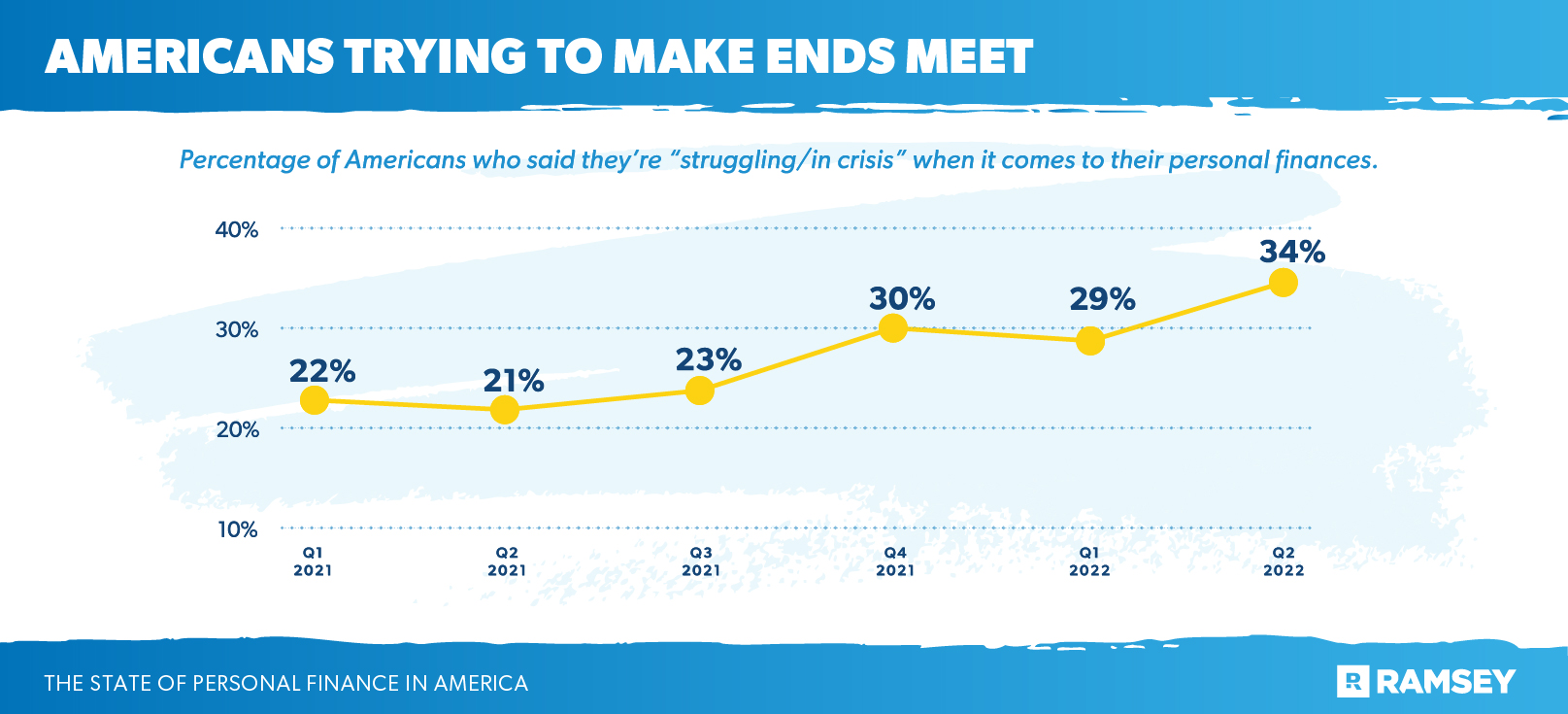
The daily struggle with money became more difficult for many Americans in the second quarter of 2022. One in three said they’re either struggling or in a crisis with their money. And the trend is moving steadily upward with a 12-point increase from the first quarter of 2021.

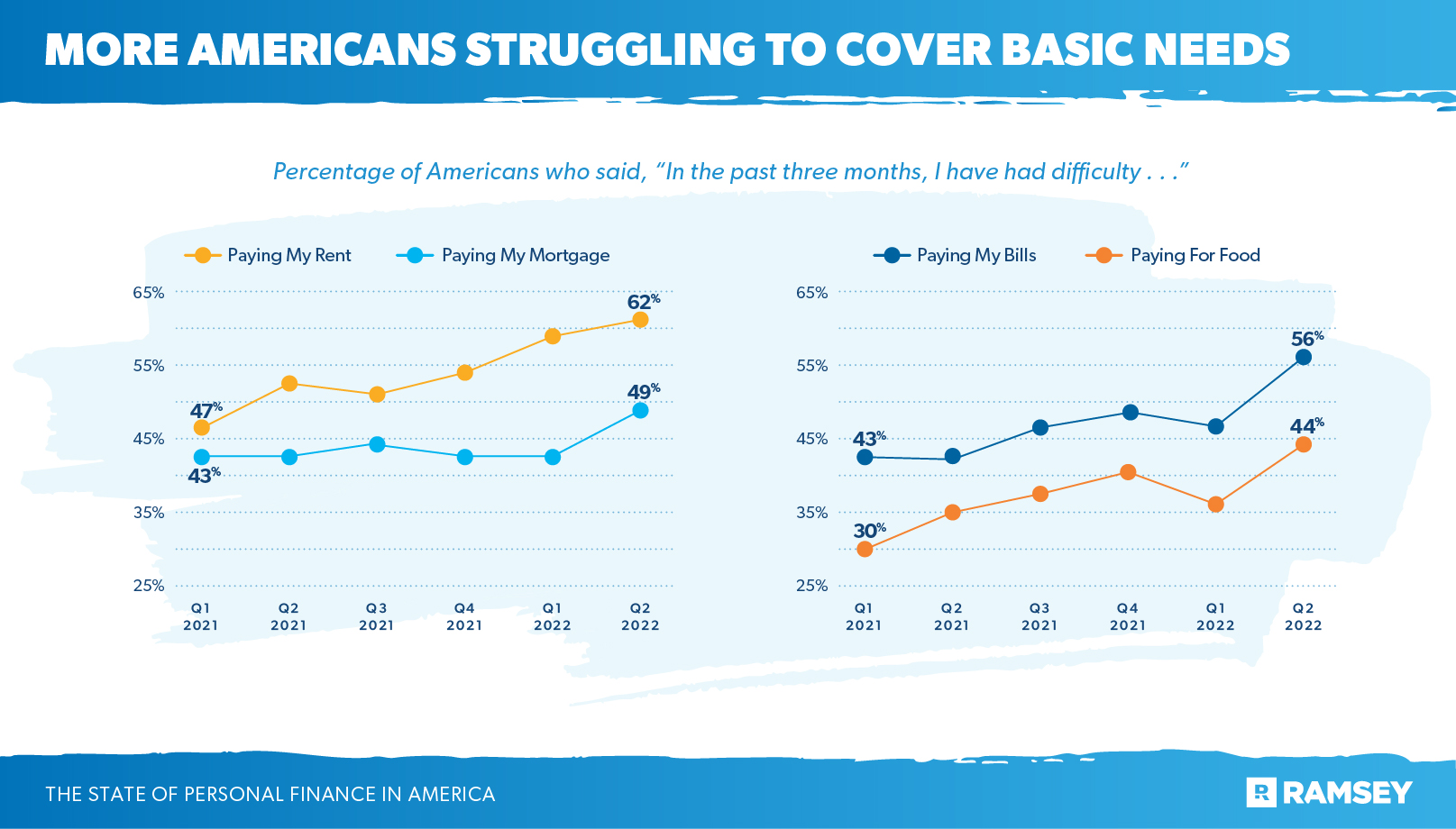
Over half (56{1b90e59fe8a6c14b55fbbae1d9373c165823754d058ebf80beecafc6dee5063a}) of Americans said they had at least some difficulty paying their basic bills overall, while the number of people saying they struggled to pay for necessities like food and housing is on the rise. About 44{1b90e59fe8a6c14b55fbbae1d9373c165823754d058ebf80beecafc6dee5063a} had trouble paying for food, up about 13 points from 18 months ago. Six in 10 renters said their housing costs were a strain (up 15 points) while nearly half (49{1b90e59fe8a6c14b55fbbae1d9373c165823754d058ebf80beecafc6dee5063a}) of homeowners with mortgages found it hard to make their monthly payments, up six points from Q1 2021.

Younger Americans had the most trouble covering the basics when compared to their Baby Boomer parents and grandparents. Over 60{1b90e59fe8a6c14b55fbbae1d9373c165823754d058ebf80beecafc6dee5063a} of Gen X, Millennials, and Gen Z (64{1b90e59fe8a6c14b55fbbae1d9373c165823754d058ebf80beecafc6dee5063a}, 64{1b90e59fe8a6c14b55fbbae1d9373c165823754d058ebf80beecafc6dee5063a}, and 67{1b90e59fe8a6c14b55fbbae1d9373c165823754d058ebf80beecafc6dee5063a} respectively) faced difficulty paying their bills, compared to only 39{1b90e59fe8a6c14b55fbbae1d9373c165823754d058ebf80beecafc6dee5063a} of Baby Boomers. About half of the younger generations (55{1b90e59fe8a6c14b55fbbae1d9373c165823754d058ebf80beecafc6dee5063a} of Gen Z, 49{1b90e59fe8a6c14b55fbbae1d9373c165823754d058ebf80beecafc6dee5063a} of Millennials, and 56{1b90e59fe8a6c14b55fbbae1d9373c165823754d058ebf80beecafc6dee5063a} of Gen X) said they had trouble paying for food compared to only about a quarter of Baby Boomers (24{1b90e59fe8a6c14b55fbbae1d9373c165823754d058ebf80beecafc6dee5063a}). Gen Z struggled the most with their mortgage payments (77{1b90e59fe8a6c14b55fbbae1d9373c165823754d058ebf80beecafc6dee5063a}), and Gen X had the most difficulty paying rent (72{1b90e59fe8a6c14b55fbbae1d9373c165823754d058ebf80beecafc6dee5063a}).

As with most things, debt made these issues even worse. People with debt had more trouble keeping their bills paid (66{1b90e59fe8a6c14b55fbbae1d9373c165823754d058ebf80beecafc6dee5063a}) than those without debt (43{1b90e59fe8a6c14b55fbbae1d9373c165823754d058ebf80beecafc6dee5063a}). The same was also true for paying a mortgage (53{1b90e59fe8a6c14b55fbbae1d9373c165823754d058ebf80beecafc6dee5063a} vs 36{1b90e59fe8a6c14b55fbbae1d9373c165823754d058ebf80beecafc6dee5063a}), rent (64{1b90e59fe8a6c14b55fbbae1d9373c165823754d058ebf80beecafc6dee5063a} vs 57{1b90e59fe8a6c14b55fbbae1d9373c165823754d058ebf80beecafc6dee5063a}), and for food (52{1b90e59fe8a6c14b55fbbae1d9373c165823754d058ebf80beecafc6dee5063a} vs 32{1b90e59fe8a6c14b55fbbae1d9373c165823754d058ebf80beecafc6dee5063a}).

americans trying to make ends meet

more americans struggling to cover basic needs

Inflation and Cost-of-Living are the Biggest Financial Problems

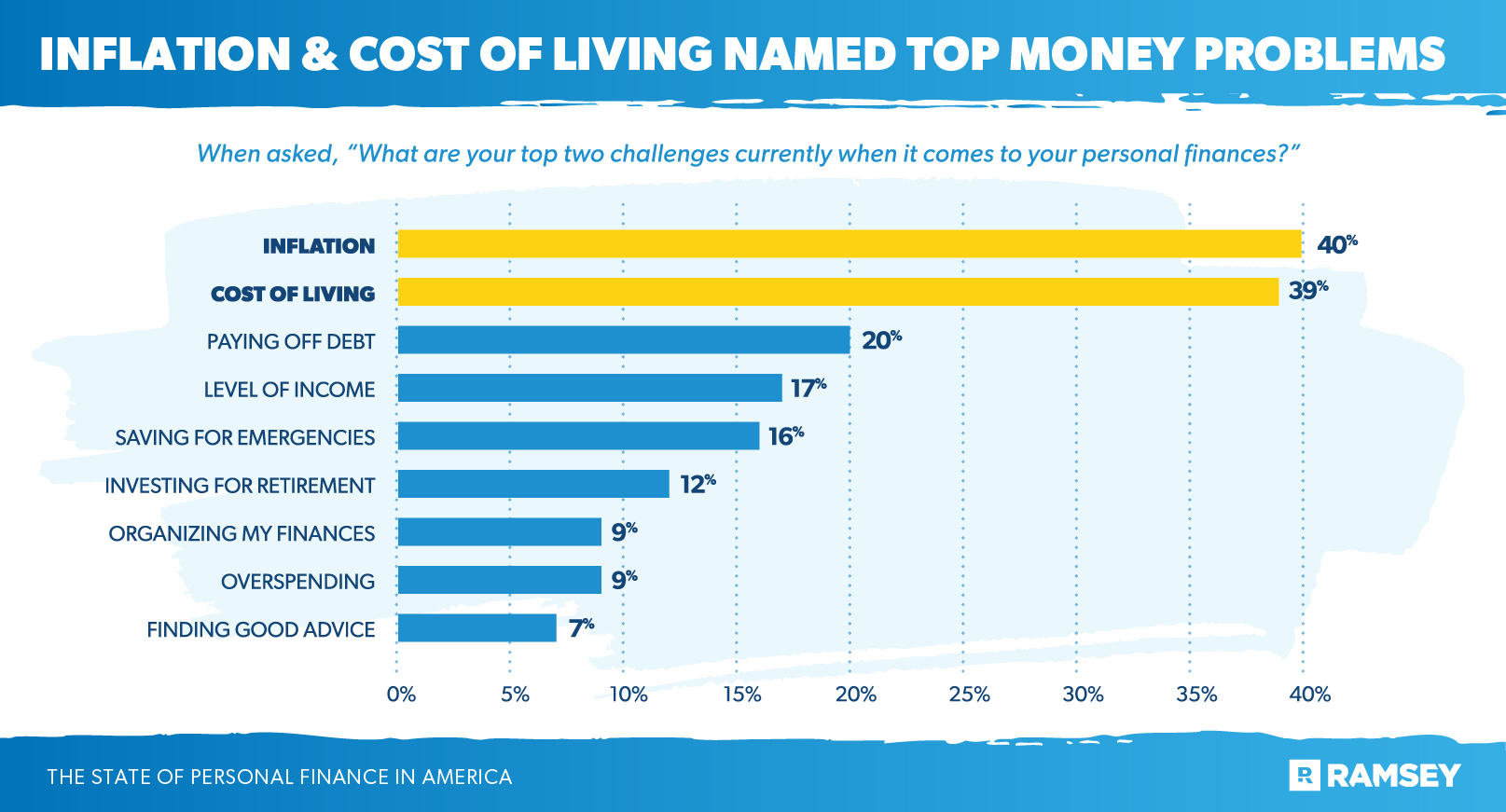
Americans’ two biggest challenges in paying for these basics were inflation (40{1b90e59fe8a6c14b55fbbae1d9373c165823754d058ebf80beecafc6dee5063a}) and the cost of living (39{1b90e59fe8a6c14b55fbbae1d9373c165823754d058ebf80beecafc6dee5063a}).

Consumers felt the effects of inflation the most with 85{1b90e59fe8a6c14b55fbbae1d9373c165823754d058ebf80beecafc6dee5063a} saying it had at least some effect on their finances—up three points from last quarter. Inflation’s impact on Americans’ budgets has been trending up for the last three quarters.

inflation and cost of living named top money problems

Americans are Cutting Back

As inflation continues to sap Americans’ spending power, most cut back on expenses to make ends meet, starting with travel. Seven in 10 said they cut back on their travel plans in the second quarter, continuing the trend from the first quarter. Other adjustments include not purchasing an item they had originally planned to purchase (41{1b90e59fe8a6c14b55fbbae1d9373c165823754d058ebf80beecafc6dee5063a}) and reducing their monthly savings amount (33{1b90e59fe8a6c14b55fbbae1d9373c165823754d058ebf80beecafc6dee5063a}) or debt payment (25{1b90e59fe8a6c14b55fbbae1d9373c165823754d058ebf80beecafc6dee5063a}). Almost a quarter (22{1b90e59fe8a6c14b55fbbae1d9373c165823754d058ebf80beecafc6dee5063a}) said they cut back on how much they’re putting away for retirement.

The money challenges of the last quarter encouraged many to keep better track of their money. Nearly three-quarters (73{1b90e59fe8a6c14b55fbbae1d9373c165823754d058ebf80beecafc6dee5063a}) reported changes in their spending, saving, budgeting, or other money-related behaviors. Almost one-third (32{1b90e59fe8a6c14b55fbbae1d9373c165823754d058ebf80beecafc6dee5063a}) said they started budgeting in some way.

Americans also found other ways to make their budgets work—some more helpful than others. 20{1b90e59fe8a6c14b55fbbae1d9373c165823754d058ebf80beecafc6dee5063a} said they took on a second job or a side hustle to boost their income. 27{1b90e59fe8a6c14b55fbbae1d9373c165823754d058ebf80beecafc6dee5063a} began selling items they had around the house. 25{1b90e59fe8a6c14b55fbbae1d9373c165823754d058ebf80beecafc6dee5063a} said they used a credit card for a purchase they would normally pay for with cash. And 15{1b90e59fe8a6c14b55fbbae1d9373c165823754d058ebf80beecafc6dee5063a} took on new debt to pay bills.

Worries Over Money Rise

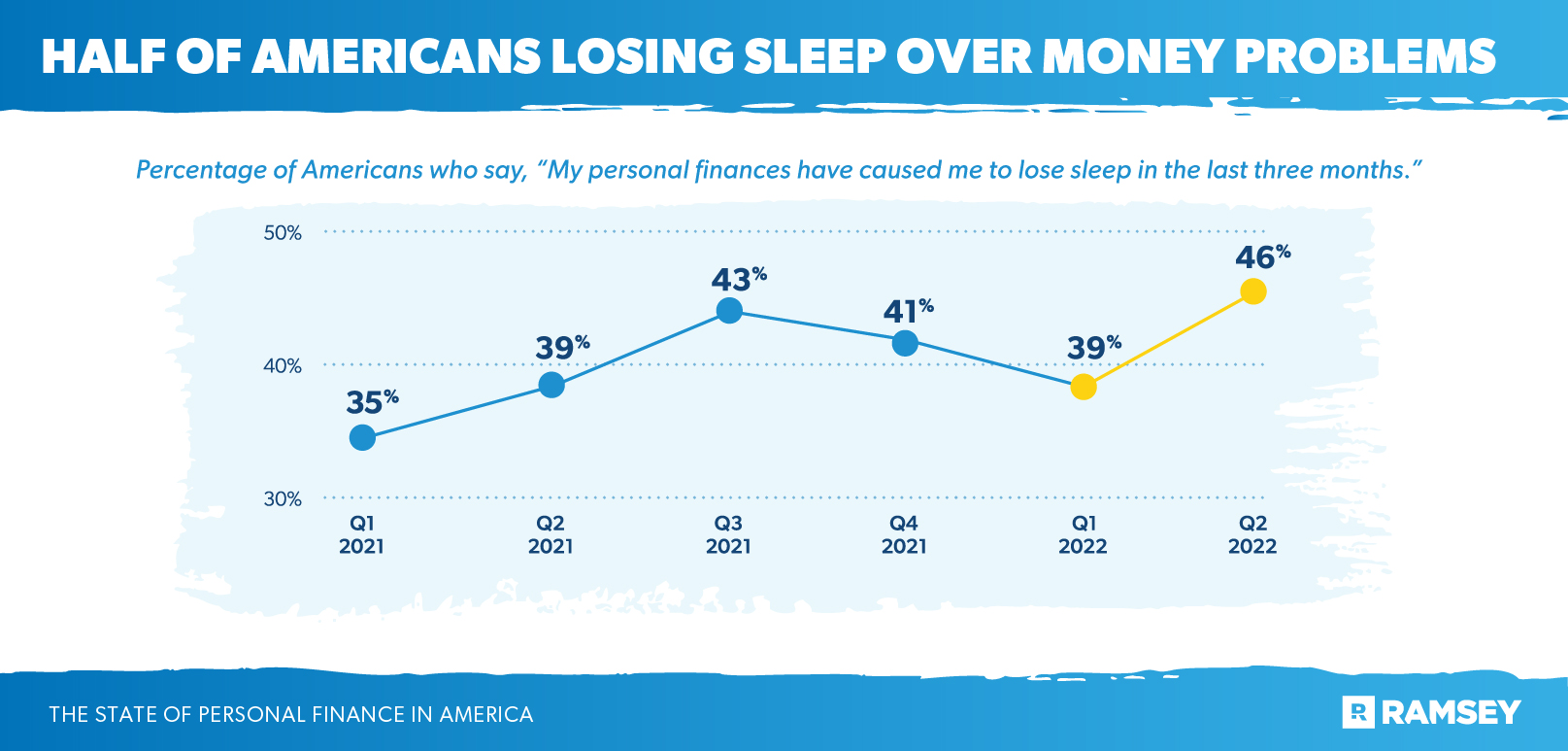
As the number of people struggling to pay for their basic needs grows, worry and anxiety about money are also on the rise. Nearly six in 10 Americans (59{1b90e59fe8a6c14b55fbbae1d9373c165823754d058ebf80beecafc6dee5063a}) said they worry about their general finances daily—a 15-point increase from 18 months ago. Almost half (46{1b90e59fe8a6c14b55fbbae1d9373c165823754d058ebf80beecafc6dee5063a}) have lost sleep in the last three months worrying about money, which is an 11-point increase from 18 months ago. And 59{1b90e59fe8a6c14b55fbbae1d9373c165823754d058ebf80beecafc6dee5063a} believe they can’t get ahead with their finances—living paycheck to paycheck and not saving very much as a result.

half of americans losing sleep over money problems

Americans Fear Recession and Feel Unprepared for One

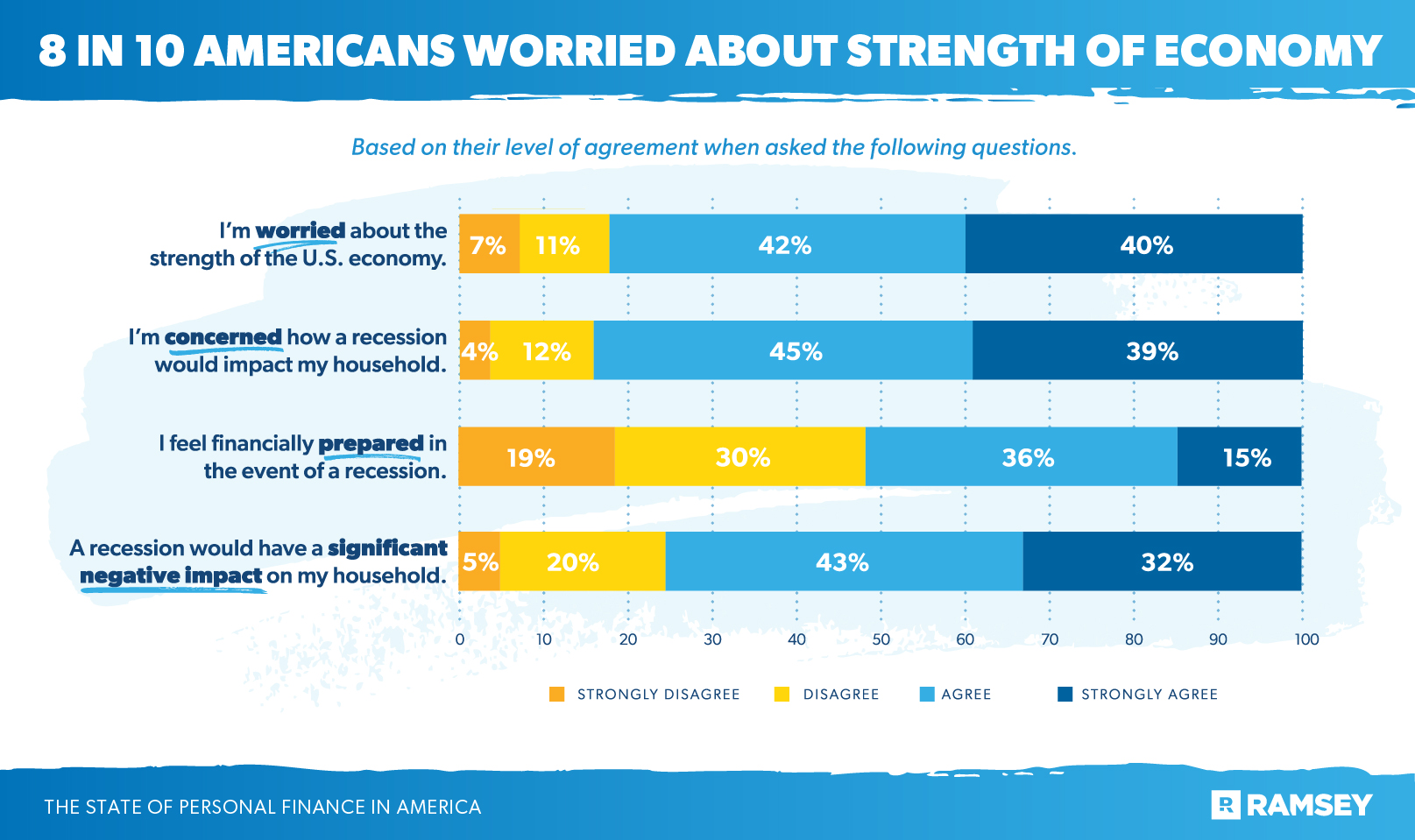
The reality of many Americans’ financial situation and the resulting stress and anxiety are reflected in their feelings about the economy overall—especially when it comes to a possible recession. More than eight in 10 Americans (82{1b90e59fe8a6c14b55fbbae1d9373c165823754d058ebf80beecafc6dee5063a}) are worried about the strength of the economy.

Not surprisingly, another eight in 10 Americans (84{1b90e59fe8a6c14b55fbbae1d9373c165823754d058ebf80beecafc6dee5063a}) are also concerned about how a recession will impact their household, with 75{1b90e59fe8a6c14b55fbbae1d9373c165823754d058ebf80beecafc6dee5063a} saying a recession would have a significant negative impact. A little over half (51{1b90e59fe8a6c14b55fbbae1d9373c165823754d058ebf80beecafc6dee5063a}) said they’re financially prepared for a recession.

Here again, the burden of debt plays a big role in American’s outlook. People who were debt-free were less likely to say a recession would have a negative impact on them (66{1b90e59fe8a6c14b55fbbae1d9373c165823754d058ebf80beecafc6dee5063a}) compared to those who had debt (82{1b90e59fe8a6c14b55fbbae1d9373c165823754d058ebf80beecafc6dee5063a}).

8 in 10 americans worried about strength of economy

The American Dream Seems Further Away

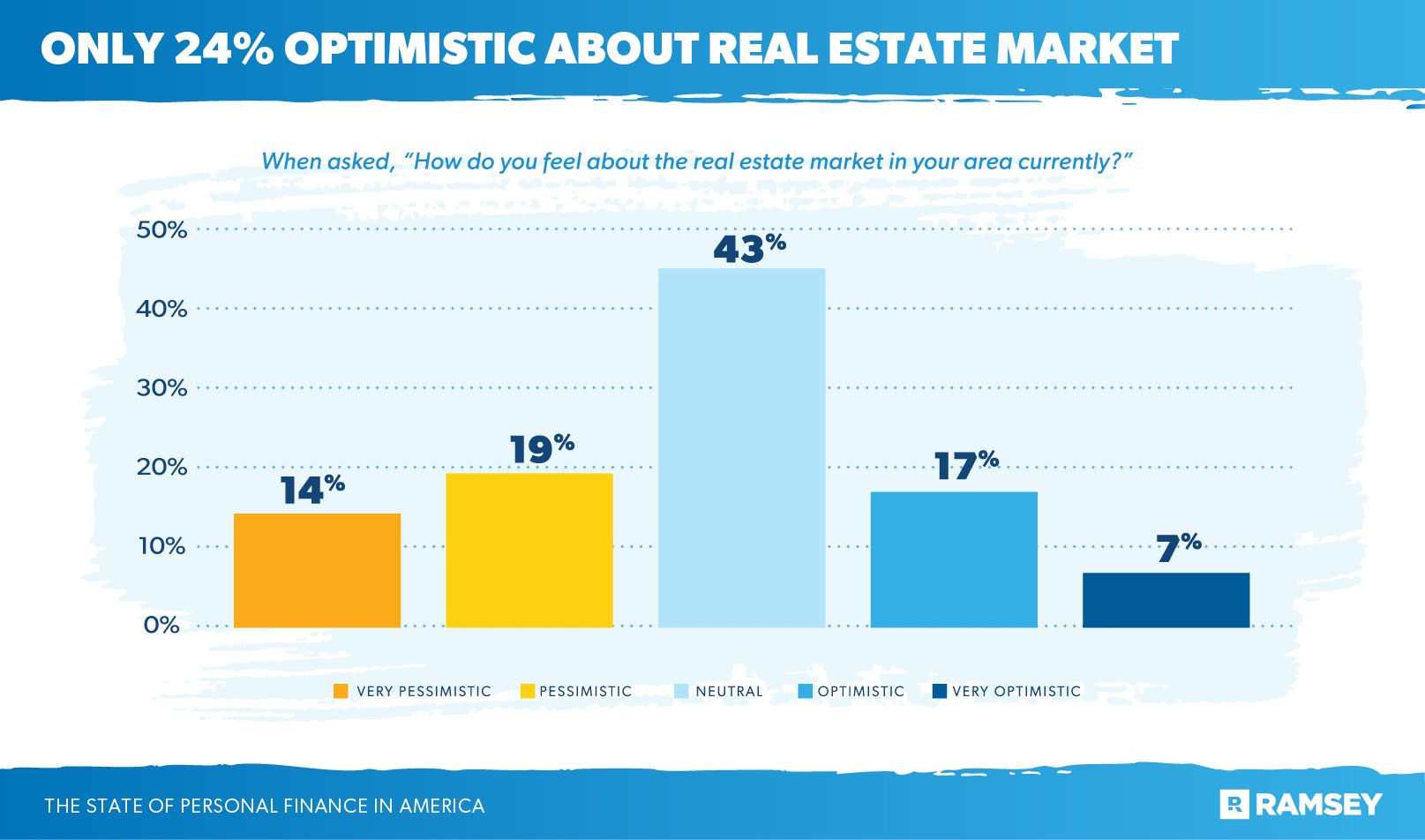
Americans’ uncertainty and stress around the country’s current economic situation carried over to their outlook on the real estate market. Most Americans were pessimistic about real estate—with only 24{1b90e59fe8a6c14b55fbbae1d9373c165823754d058ebf80beecafc6dee5063a} saying they were optimistic about the market in their area. Half (51{1b90e59fe8a6c14b55fbbae1d9373c165823754d058ebf80beecafc6dee5063a}) said the American dream of owning a home isn’t possible for most adults right now.

Digging deeper, 65{1b90e59fe8a6c14b55fbbae1d9373c165823754d058ebf80beecafc6dee5063a} of Americans said it’s more difficult to own a home today compared to past decades. The significant and steady price increases in the housing market over the last two years are a main factor in people’s pessimistic perceptions, with 61{1b90e59fe8a6c14b55fbbae1d9373c165823754d058ebf80beecafc6dee5063a} saying now was not a good time to buy a house and almost three-quarters (73{1b90e59fe8a6c14b55fbbae1d9373c165823754d058ebf80beecafc6dee5063a}) believing housing prices will increase even more over the next year.

In a reversal of the overall generational patterns in this study, Baby Boomers were the most pessimistic generation about the real estate market. 77{1b90e59fe8a6c14b55fbbae1d9373c165823754d058ebf80beecafc6dee5063a} said home ownership is difficult, which was significantly higher than the younger generations (59{1b90e59fe8a6c14b55fbbae1d9373c165823754d058ebf80beecafc6dee5063a} of Gen Z, 54{1b90e59fe8a6c14b55fbbae1d9373c165823754d058ebf80beecafc6dee5063a} of Millennials, and 66{1b90e59fe8a6c14b55fbbae1d9373c165823754d058ebf80beecafc6dee5063a} of Gen X). 71{1b90e59fe8a6c14b55fbbae1d9373c165823754d058ebf80beecafc6dee5063a} of Boomers didn’t think it was a good time to buy a house—compared to 55{1b90e59fe8a6c14b55fbbae1d9373c165823754d058ebf80beecafc6dee5063a} of Gen Z, 50{1b90e59fe8a6c14b55fbbae1d9373c165823754d058ebf80beecafc6dee5063a} of Millennials, and 65{1b90e59fe8a6c14b55fbbae1d9373c165823754d058ebf80beecafc6dee5063a} of Gen X.

only 24{1b90e59fe8a6c14b55fbbae1d9373c165823754d058ebf80beecafc6dee5063a} optimistic about real estate market

Job Dissatisfaction Leading to Shifting Jobs and Shifting Income

Despite (or perhaps, because of) concerns about the country’s economic situation, the Great Resignation is still a major force in the American job market. Well over half (57{1b90e59fe8a6c14b55fbbae1d9373c165823754d058ebf80beecafc6dee5063a}) of Americans were considering leaving their current job, and just over a quarter (27{1b90e59fe8a6c14b55fbbae1d9373c165823754d058ebf80beecafc6dee5063a}) took the plunge and changed their jobs in the past 12 months.

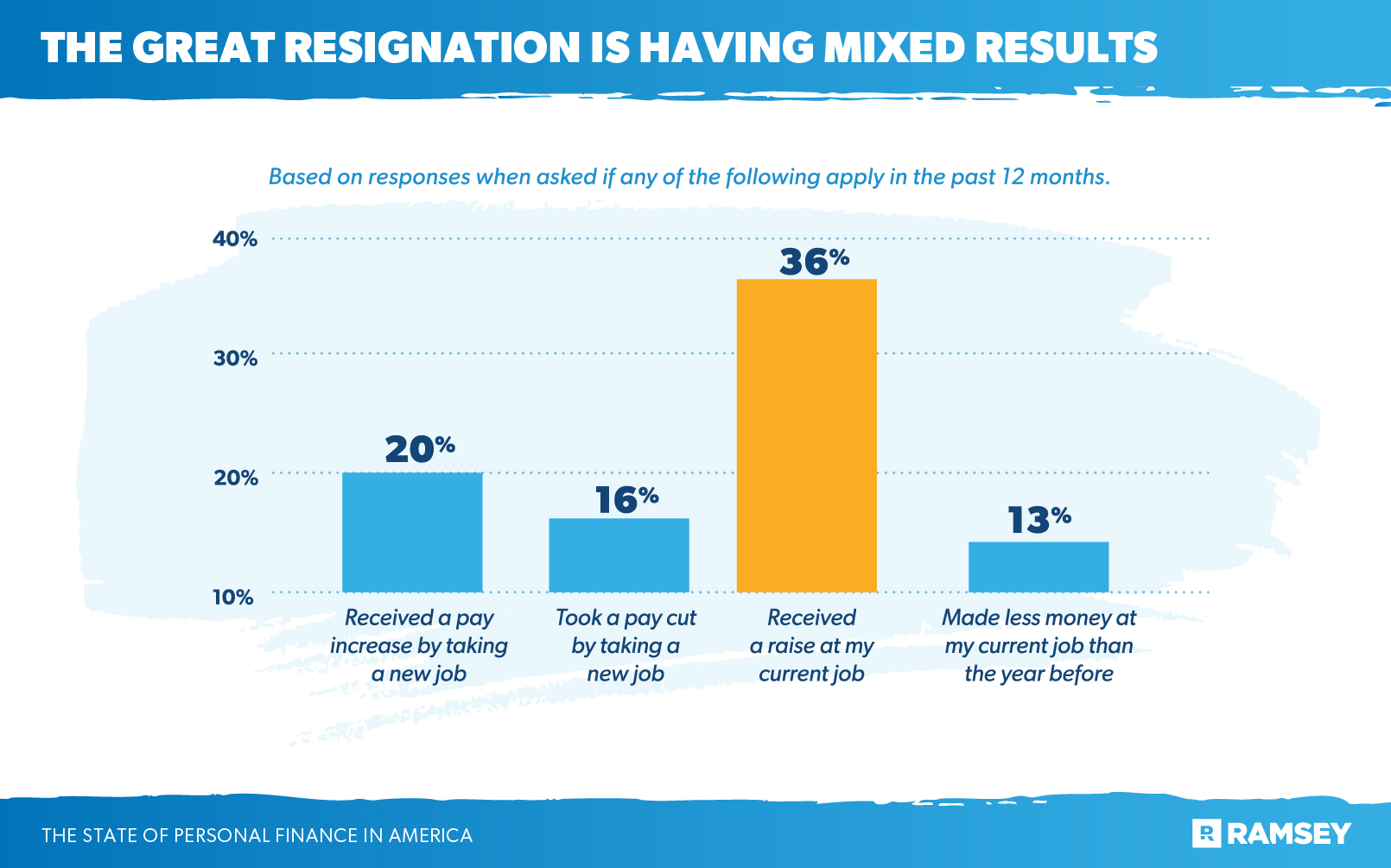
However, there’s another side to the career coin: The new jobs Americans are landing don’t always improve their personal financial situation. Of the people who changed jobs in the past 12 months, 20{1b90e59fe8a6c14b55fbbae1d9373c165823754d058ebf80beecafc6dee5063a} said they received a pay increase while 16{1b90e59fe8a6c14b55fbbae1d9373c165823754d058ebf80beecafc6dee5063a} took a pay cut to land a new job.

the great resignation is having mixed results

SECTION TWO: Q1 2022 FINDINGS

Downloads

Inflation Problems are Front-and-Center

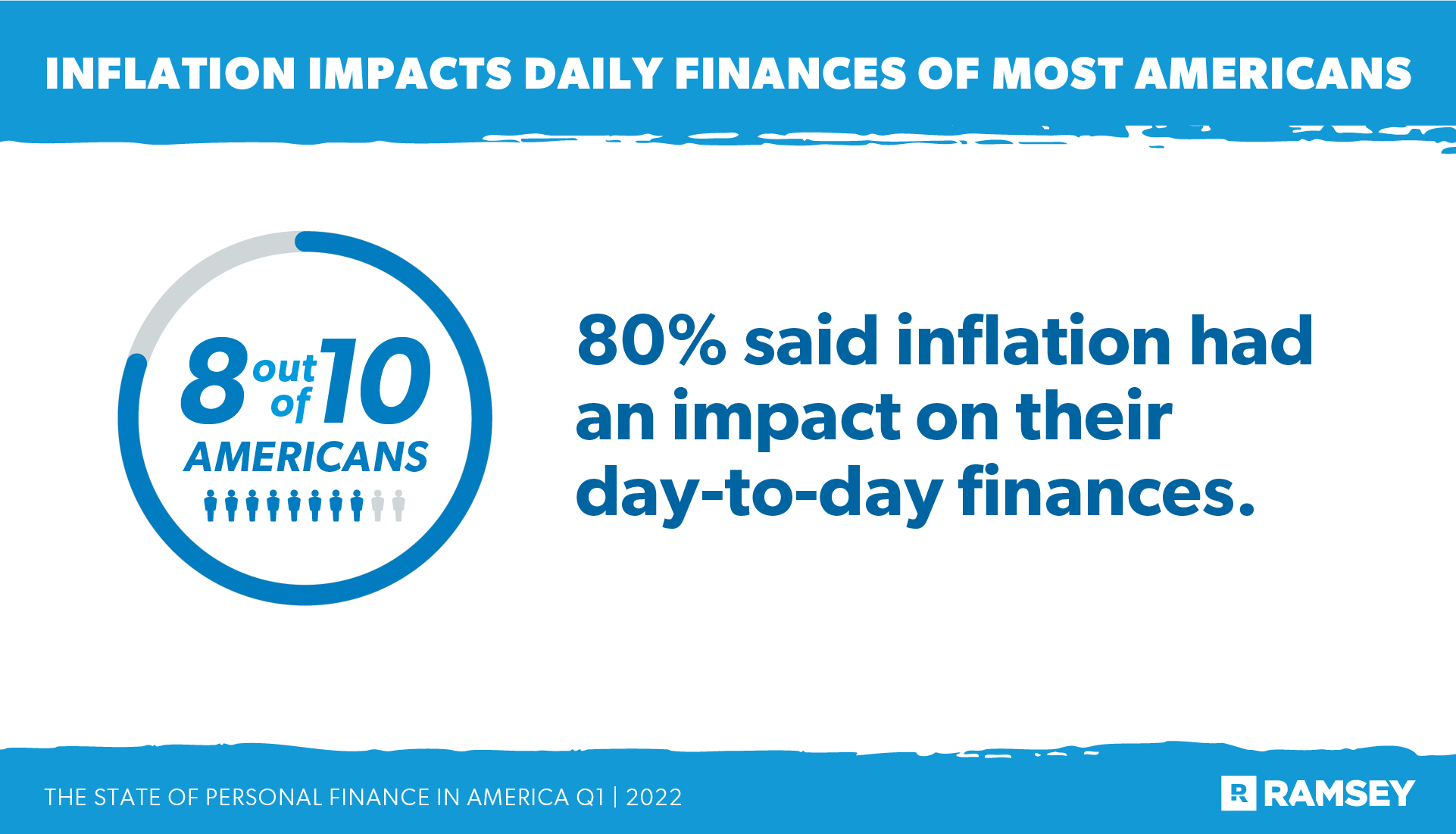
The shadow of rising inflation continued to play a major role in the financial decisions of most American consumers. The sharp increase in prices led to a nearly 10{1b90e59fe8a6c14b55fbbae1d9373c165823754d058ebf80beecafc6dee5063a} increase in the number of people who noticed the effects of inflation this quarter over last quarter, with people feeling the most pain at the gas pump and the grocery store. Eight in 10 said inflation had an impact on their day-to-day finances. And one-third reported that inflation made a significant impact on their financial decisions.

Inflation is Front-and-Center, Covering Everything

People were also finding ways to supplement their take-home pay to cover the increased costs. 13 percent said they got a side hustle or second job on top of their regular full-time job in response to inflation. And one in 10 took on new debt to cover rising costs.

As with most things, debt made the effects of inflation even worse. Those with consumer debt were nearly twice as likely (40{1b90e59fe8a6c14b55fbbae1d9373c165823754d058ebf80beecafc6dee5063a}) to say inflation had a significant impact on their day-to-day-finances compared to those who are debt-free (23{1b90e59fe8a6c14b55fbbae1d9373c165823754d058ebf80beecafc6dee5063a}). Because of the rising prices caused by inflation, one in four people with debt cut back on the amount they put toward paying off their debt, and one in five relied on credit cards to buy something they would normally pay for with cash. However, one in four have also started budgeting to track their spending.

The stress caused by increased spending due to inflation also led to increased anxiety among consumers. A majority (60{1b90e59fe8a6c14b55fbbae1d9373c165823754d058ebf80beecafc6dee5063a}) said they were anxious about how they were going to pay for the things because of inflation.

Inflation’s Impacts on Consumer Spending are Far-Reaching

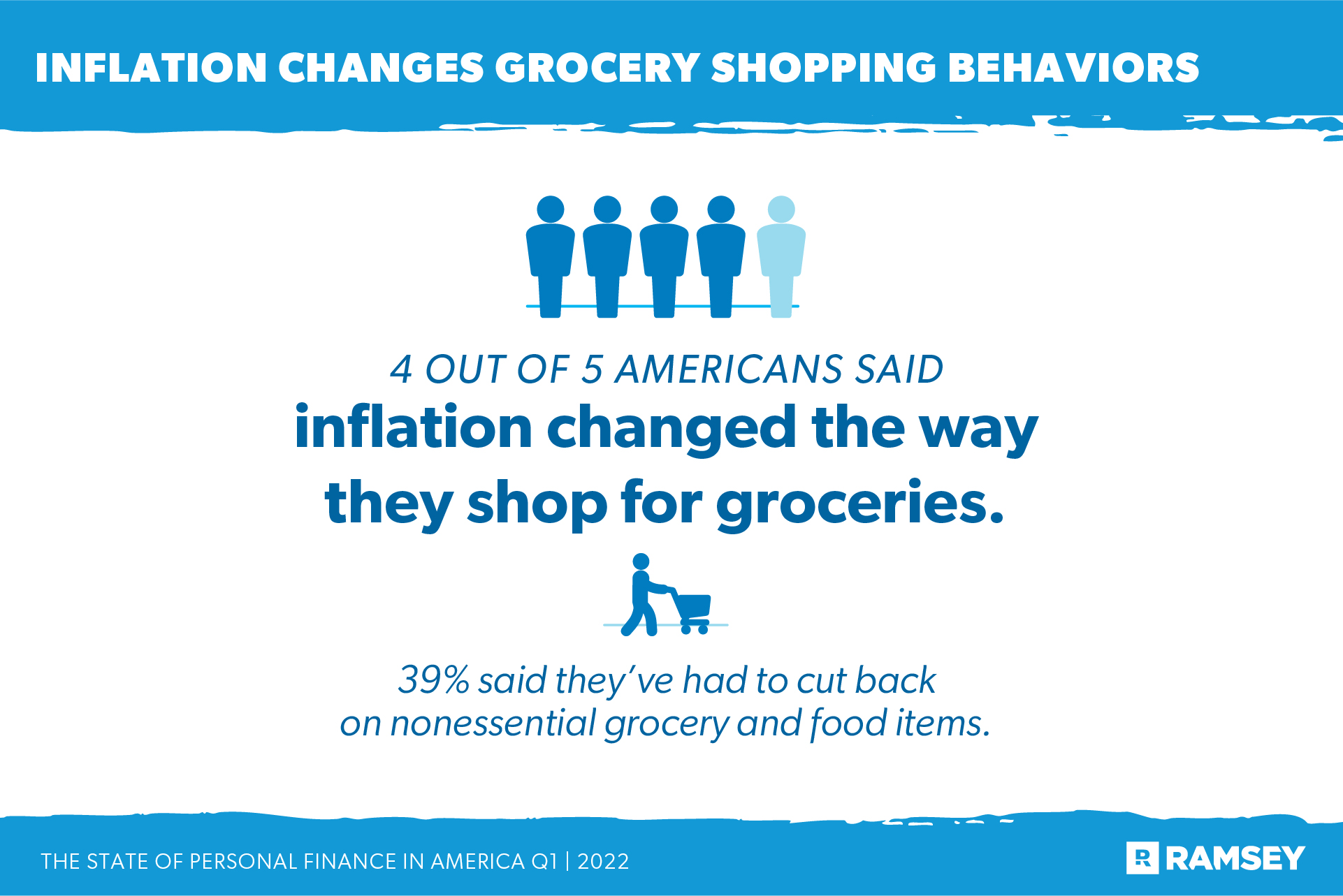
With prices rising on everyday goods and services, consumers looked for ways to lessen the impact on their family’s budgets by really thinking about the ways they spend money. Four out of five Americans said inflation significantly changed the way they shop for groceries, with 39{1b90e59fe8a6c14b55fbbae1d9373c165823754d058ebf80beecafc6dee5063a} saying they cut back on non-essential grocery and food items. Nearly one-third said they either delayed or cancelled a future purchase.

Inflation changes grocery shopping behaviors

Compared to last year around the same time, people spent more on groceries, utilities, and transportation in Q1 of 2022. On the other end of the spectrum, people spent less on non-essential items like eating out, entertainment, and travel—though the number of people spending less on those items was decidedly fewer. For example, in the top spots on both ends, 57{1b90e59fe8a6c14b55fbbae1d9373c165823754d058ebf80beecafc6dee5063a} said they spent more on groceries, but only 33{1b90e59fe8a6c14b55fbbae1d9373c165823754d058ebf80beecafc6dee5063a} said they spent less on eating out.

Inflation also impacted summer vacation spending plans. While six in 10 were planning to travel this summer, half are increasing their travel budget or completely changing their travel plans to offset higher prices. Despite the increase in gas prices, 12{1b90e59fe8a6c14b55fbbae1d9373c165823754d058ebf80beecafc6dee5063a} more people plan to drive to their destinations rather than fly.

Impulse Buying Continues Despite Inflation Concerns

Even though people have changed their spending habits to combat inflation, impulse buying remained common. More than a third of consumers in America admitted to making at least one impulse purchase in the last three months—the majority of which were food items found while shopping in a store. Nearly one quarter of consumers made impulse purchases on social media, with 30{1b90e59fe8a6c14b55fbbae1d9373c165823754d058ebf80beecafc6dee5063a} of Millennials in particular admitting to these types of purchases.

Impulse buying habits also have a psychological component. Most people who made impulse purchases (60{1b90e59fe8a6c14b55fbbae1d9373c165823754d058ebf80beecafc6dee5063a}) said they felt guilty about it—and 53{1b90e59fe8a6c14b55fbbae1d9373c165823754d058ebf80beecafc6dee5063a} regretted making the purchase. Sixty-four percent (64{1b90e59fe8a6c14b55fbbae1d9373c165823754d058ebf80beecafc6dee5063a}) said they were likely to make impulse purchases when stressed. However, among people who budget their money, 85{1b90e59fe8a6c14b55fbbae1d9373c165823754d058ebf80beecafc6dee5063a} said budgeting helped control their impulse spending.

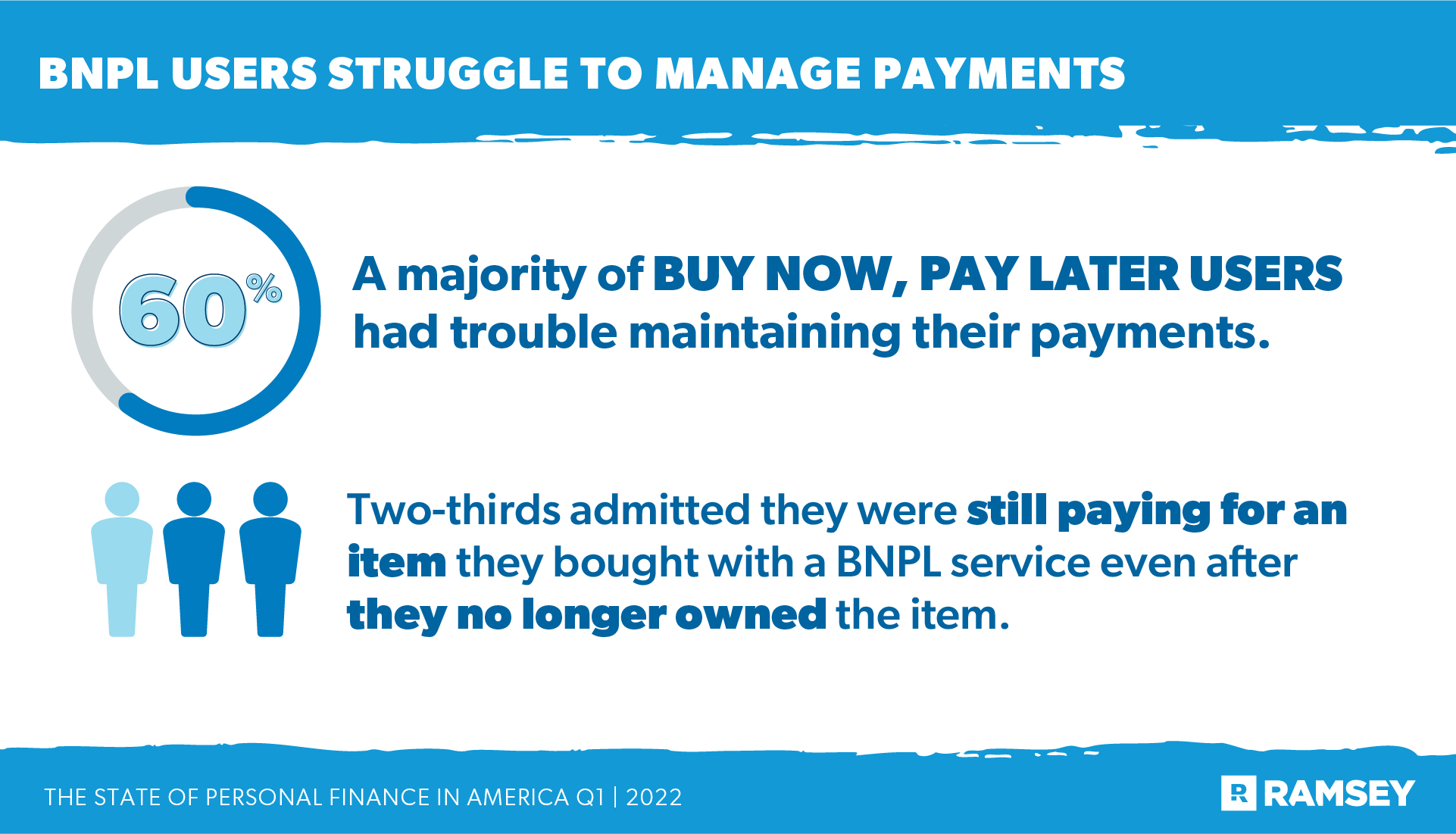
The popularity of buy now, pay later (BNPL) services remained steady despite increased inflation, with the number of people who used them hovering at around 21{1b90e59fe8a6c14b55fbbae1d9373c165823754d058ebf80beecafc6dee5063a}. A majority of BNPL users (79{1b90e59fe8a6c14b55fbbae1d9373c165823754d058ebf80beecafc6dee5063a}) preferred the service over using a credit card. But a majority (60{1b90e59fe8a6c14b55fbbae1d9373c165823754d058ebf80beecafc6dee5063a}) also had trouble managing their payments. Two-thirds admitted they were still paying for an item they bought with a BNPL service even after they no longer owned the item.

BNPL users struggle to manage payments

Tax Refunds Come in . . . and Go Out to Savings and Bills

The beginning of the year also brought launch of the 2021 tax season. Of the people who had filed their 2021 taxes at the time of the survey, seven in 10 expected to receive a refund.

In a possible reaction to the uncertain financial times, 47{1b90e59fe8a6c14b55fbbae1d9373c165823754d058ebf80beecafc6dee5063a} said they plan to save their refund. And half said they would use their refund to cover bills—either paying everyday expenses or paying down debt.

Consumers are Looking for Reliable Financial Information

In this time of financial uncertainty and worries about inflation, people are looking for sources they truly trust for advice on what to do with their money. The most popular sources of financial advice in the first quarter of 2022 were family (33{1b90e59fe8a6c14b55fbbae1d9373c165823754d058ebf80beecafc6dee5063a}) and friends (25{1b90e59fe8a6c14b55fbbae1d9373c165823754d058ebf80beecafc6dee5063a}). Four in 10 said they don’t have anyone to turn to for financial advice. Younger generations (Gen Z and Millennials) especially lacked trustworthy financial sources, with about half of them saying they had no one to turn to.

Consumers, especially the younger generations, increasingly looked to content on social media for financial advice. One third said they implemented financial advice they found from someone they follow on social media. YouTube had the most influence in all generations and was as popular as an actual financial advisor as a trusted source of financial advice. Gen Z was the most likely to get money advice from YouTube (43{1b90e59fe8a6c14b55fbbae1d9373c165823754d058ebf80beecafc6dee5063a}), followed by Millennials (37{1b90e59fe8a6c14b55fbbae1d9373c165823754d058ebf80beecafc6dee5063a}), Gen X (20{1b90e59fe8a6c14b55fbbae1d9373c165823754d058ebf80beecafc6dee5063a}), and Baby Boomers (6{1b90e59fe8a6c14b55fbbae1d9373c165823754d058ebf80beecafc6dee5063a}).

Investment in Cryptocurrency on the Rise

Americans’ interest in cryptocurrency continued to rise steadily. One in four investors said they had purchased crypto—up two percentage points from the previous quarter, and up 15 percentage points from the same time last year. Millennials lead the pack in crypto interest (40{1b90e59fe8a6c14b55fbbae1d9373c165823754d058ebf80beecafc6dee5063a}), followed by Gen Z (37{1b90e59fe8a6c14b55fbbae1d9373c165823754d058ebf80beecafc6dee5063a}), Gen X (23{1b90e59fe8a6c14b55fbbae1d9373c165823754d058ebf80beecafc6dee5063a}), and Baby Boomers (2{1b90e59fe8a6c14b55fbbae1d9373c165823754d058ebf80beecafc6dee5063a}).

Student Loan Deferments Create an Uncertain Certainty

Outstanding student loan debt was also a source of financial stress for Americans in Q1. Three-fourths of those who took out student loan debt are still paying on their loans. But, since the start of the COVID-19 pandemic in March of 2020, federal student loan payments have been paused by the federal government. With the pandemic getting further and further in the rear-view mirror, those payments were scheduled to restart in May 2022. Then the government extended the moratorium through August 2022.

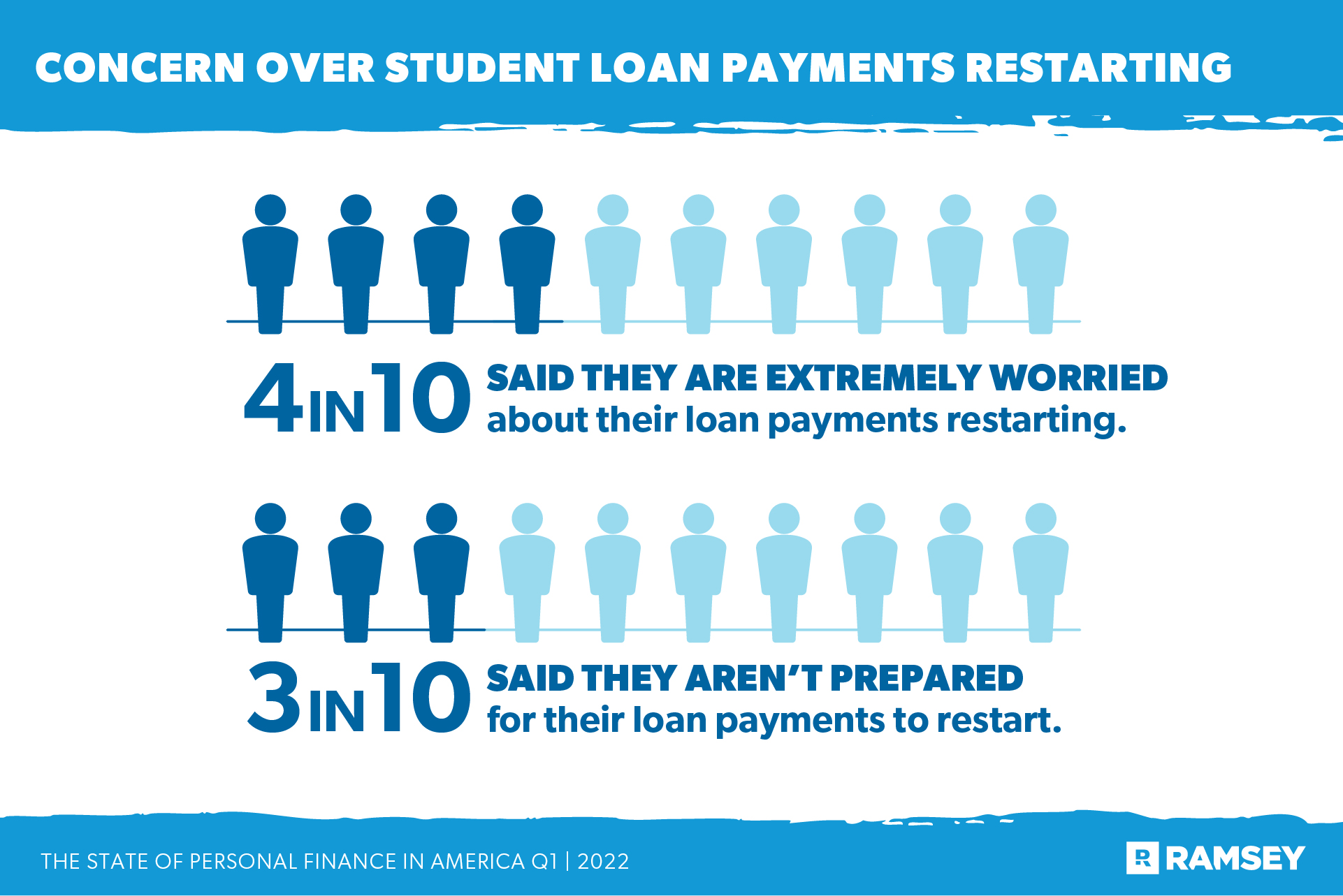
The Q1 State of Personal Finance survey was conducted before the government announced the most recent extension of the moratorium. At that time, four in 10 people with student loan debt said they were extremely worried about their loan payments restarting. And three in 10 said they weren’t prepared to start making payments again. Most borrowers (77{1b90e59fe8a6c14b55fbbae1d9373c165823754d058ebf80beecafc6dee5063a}) are holding out hope that at least some of their student loan debt will eventually be forgiven.

Concern over student loan payments restarting

Career Trends Point to Continued Job Dissatisfaction and Remote Work Favorability

The 2021 Great Resignation brought on in the wake of the COVID-19 pandemic didn’t seem to lose any steam going into 2022. Less than half of Americans (40{1b90e59fe8a6c14b55fbbae1d9373c165823754d058ebf80beecafc6dee5063a}) were extremely satisfied with their jobs, and half were considering changing their jobs—a result consistent with the last two times Ramsey Solutions surveyed this question in The State of Work and The State of Financial Wellness studies. There was also very little difference in current levels of satisfaction between those who changed jobs and those who didn’t. Among the generations, Gen Z (65{1b90e59fe8a6c14b55fbbae1d9373c165823754d058ebf80beecafc6dee5063a}) and Millennials (60{1b90e59fe8a6c14b55fbbae1d9373c165823754d058ebf80beecafc6dee5063a}) were the most likely to consider changing jobs.

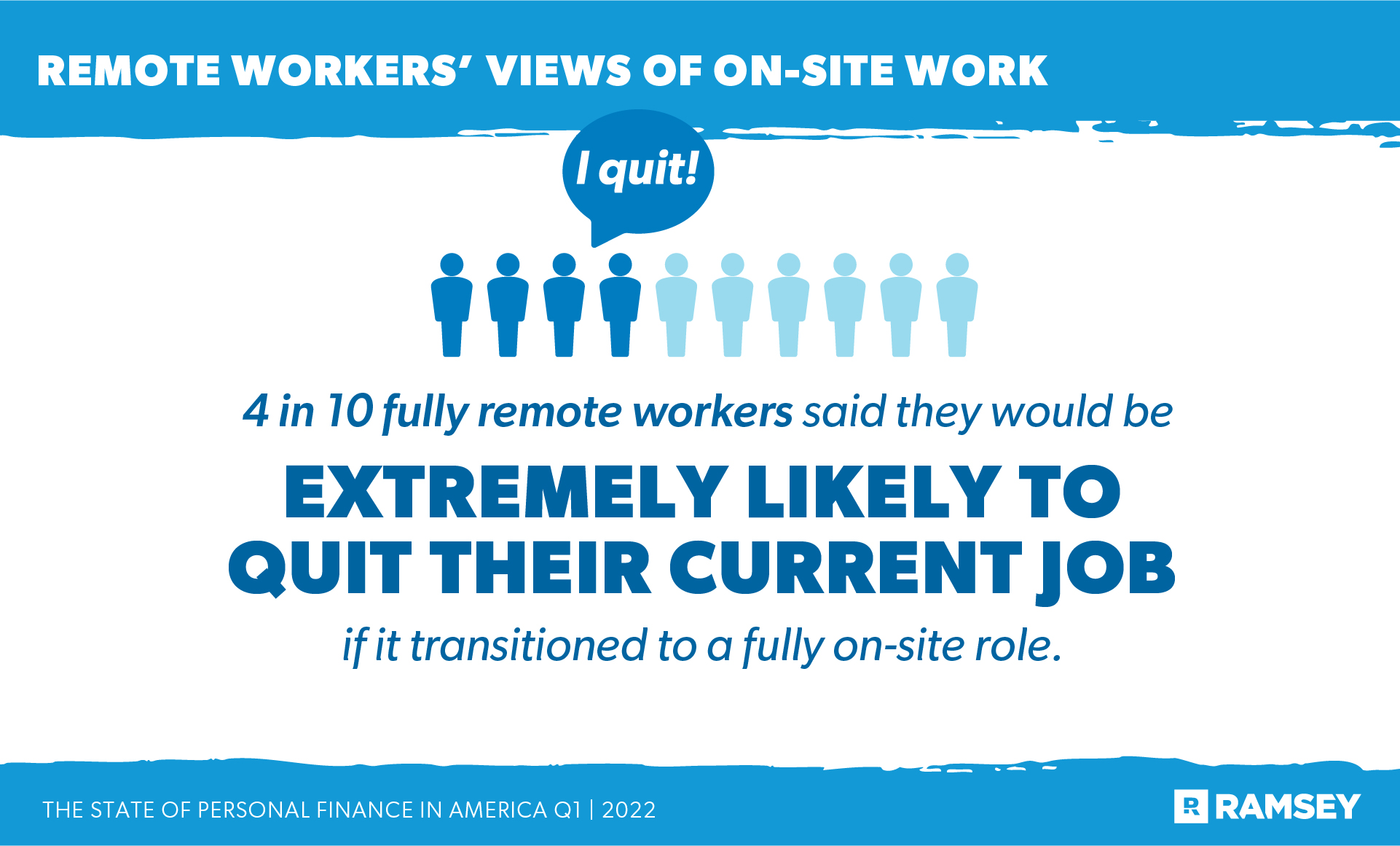
Many employees are facing a change in their work situation as companies plan to transition workers back on-site work. Forty-five percent (45{1b90e59fe8a6c14b55fbbae1d9373c165823754d058ebf80beecafc6dee5063a}) of fully remote workers said their employer plans to return employees to an on-site location soon. While a slim majority still listed their primary working environment as fully on-site (52{1b90e59fe8a6c14b55fbbae1d9373c165823754d058ebf80beecafc6dee5063a}), those who have been working from home had grown accustomed to the freedom it brought them, and most would like to see that way of working continue. In fact, four in 10 fully remote workers said they would be extremely likely to quit their current job if it transitioned to a fully onsite role.

Remote workers’ views of on-site work

Real Estate Market Impacted by Remote Work

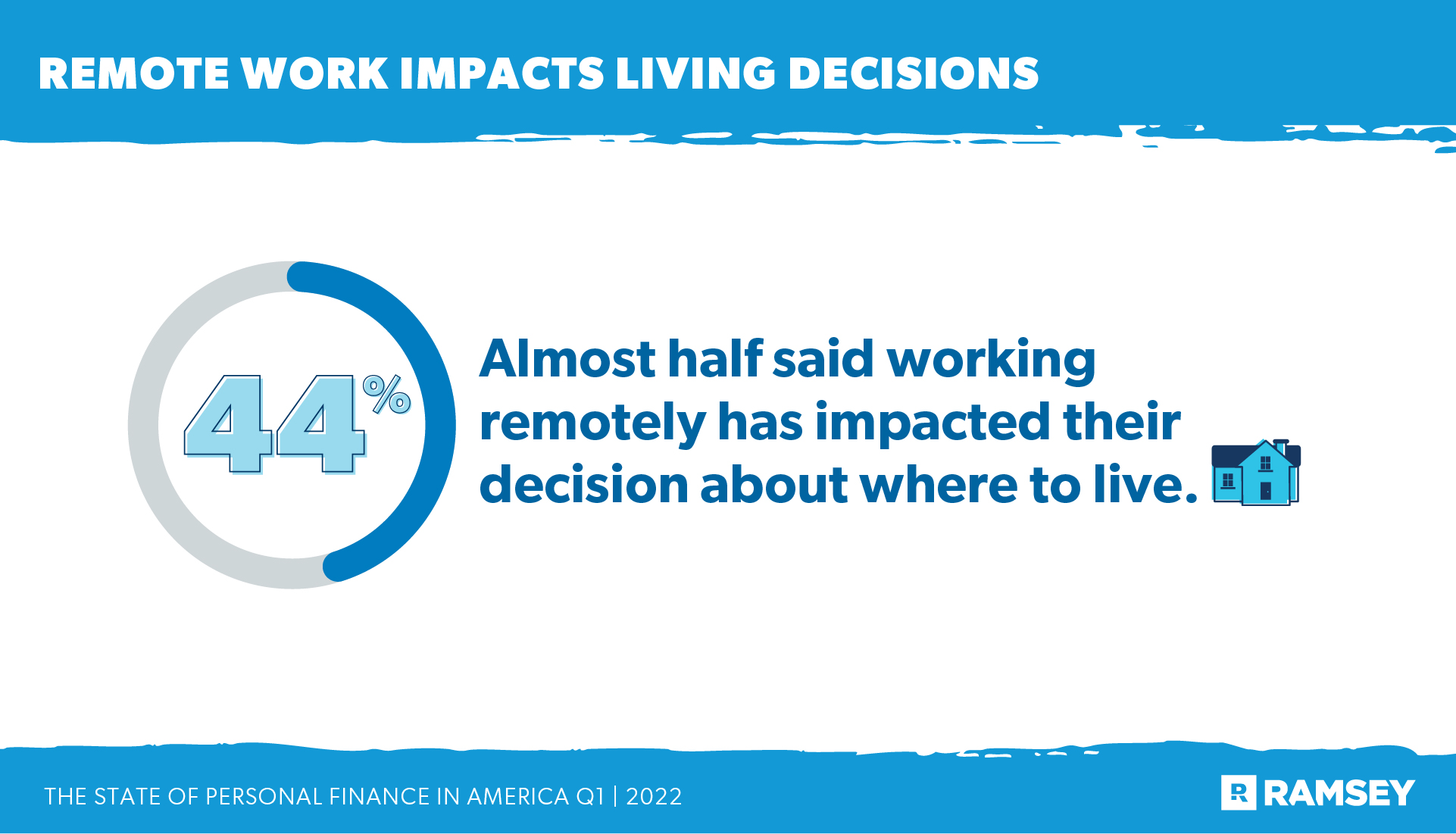
The remote working trend has also influenced the real estate market, as job location is now less of a factor when people are deciding where to live. Almost half (44{1b90e59fe8a6c14b55fbbae1d9373c165823754d058ebf80beecafc6dee5063a}) said the ability to work remotely has impacted their decision about where to live, and over one-third (37{1b90e59fe8a6c14b55fbbae1d9373c165823754d058ebf80beecafc6dee5063a}) said they moved away from where their job was based because of their ability to work from home.

Remote work impacts living decisions

However, with the real estate market’s surging prices and mortgage interest rates rising, there is also a lot of uncertainty. A majority of both buyers (46{1b90e59fe8a6c14b55fbbae1d9373c165823754d058ebf80beecafc6dee5063a}) and sellers (43{1b90e59fe8a6c14b55fbbae1d9373c165823754d058ebf80beecafc6dee5063a}) reported being pessimistic about the real estate market.

Conclusion

The current state of personal finance in America is full of worry—part of an upward trend over at least the past 18 months. Inflation concerns have cast a big shadow over everything—making consumers nervous on many financial fronts like grocery shopping and vacation planning. Many are finding it stressful to pay their bills and are cutting back, with some losing sleep in the process. The worries have especially hit Gen Xers, who are struggling the most in the current economic climate compared to their Baby Boomer parents are grandparents.

From the job market to real estate and student loans, a big cloud of mystery hangs over the air, with most consumers hunkering down and adjusting their spending accordingly. The country’s bearish economic situation has contributed to Americans’ pessimistic perception of the housing market. Half of Americans believe the American dream of owning a home might be beyond their reach, and more are convinced now is not a good time to buy a house. But despite a continued rise in inflation, there is still only slightly less spending on non-essentials.

About the Study

The State of Personal Finance study is a quarterly research study conducted by Ramsey Solutions with 1,001 U.S. adults to gain an understanding of the personal finance behaviors and attitudes of Americans. The nationally representative sample was fielded from March 28 to April 5, 2022 (Q1), and from June 30 to July 8, 2022 (Q2), using a third-party research panel.

Tesla countersues Calif. agency behind race bias suit

Tesla countersues Calif. agency behind race bias suit

(Reuters) — Tesla Inc. on Thursday countersued the California agency that has accused the electric powered carmaker of tolerating widespread race discrimination at its flagship assembly plant.

Tesla in a grievance filed in state court in Alameda County mentioned the California Civil Rights Section, which sued the company in February, adopted “underground regulations” letting it to file the lawsuit without 1st notifying Tesla of the claims or providing the enterprise a chance to settle.

Tesla’s counter-lawsuit alleges that the CRD violated state regulation by not trying to find general public comment prior to adopting strategies for investigating and suing employers.

And those people methods flout necessities that the CRD disclose facts of its investigations to companies and make tries to settle statements outside the house of court right before suing, Tesla claims.

Tesla is seeking an order barring the CRD from adhering to its allegedly illegal techniques in the investigation of any employer and requiring the agency to adopt new rules by means of a formal rulemaking course of action.

A spokesperson for the CRD did not instantly react to a request for comment.

Tesla had built similar statements in a bid to dismiss the California agency’s lawsuit, which was denied by a condition decide very last month.

But the grievance submitted on Thursday may perhaps let the firm’s lawyers to uncover new particulars about the CRD’s practices and its investigation of Tesla through the discovery method, which could bolster its efforts to have the scenario dismissed.

The CRD claims Tesla’s flagship Fremont, California, plant is a racially segregated office where Black staff members confronted racist slurs and graffiti and have been discriminated towards in conditions of job assignments, self-discipline and pay back.

Tesla has denied wrongdoing and claimed the lawsuit was politically inspired.

The company in June experienced questioned a separate California agency, the Place of work of Administrative Regulation, to investigate the CRD’s alleged adoption of unlawful procedures. The OAL previous month declined to review Tesla’s petition without having conveying its decision.

Austin, Texas-based Tesla is also facing a sequence of race and sexual intercourse discrimination situations by employees, most involving the Fremont plant.

A condition choose in April slash a jury verdict for a Black worker who alleged racial harassment from $137 million to $15 million. The plaintiff rejected the minimized award and opted for a new trial, which is scheduled for March 2023.


Stuyvesant’s new personal finance elective is a good start. Now, let’s make it mandatory.

Stuyvesant’s new personal finance elective is a good start. Now, let’s make it mandatory.

Initially Particular person is exactly where Chalkbeat characteristics own essays by educators, students, parents, and others pondering and producing about community education.

When I bought my initial paycheck for doing work on a political campaign and virtually a 3rd was taken out for taxes, I was startled simply because I was only producing minimal wage. I shrugged it off assuming this was why developed-ups always are always complaining about taxes. 

As I recounted this as a coming-of-age story to spouse and children close friends, an individual spelled out to me that I could probable get some of that money again if I filed a tax return the next April. While the finance conditions flew over my head, I perked up right away at discuss of a tax refund. I hadn’t acknowledged this was achievable, and I’m not by yourself. 

Headshot of a teenager girl wearing hoop earrings and a white blouse.

Several substantial college college students are about to face one particular of the largest money decisions of their life: how to spend for school. Nevertheless a ton of us are unprepared to make this decision and quite a few some others that will stick to — from shelling out rent to using credit score playing cards to saving for the proverbial wet day. What we don’t know about cash management can observe us for a long time to come. 

I go to Stuyvesant Substantial Faculty, the place pupils can consider about 30 AP classes and pick from more than 50 electives. But until eventually not long ago, there was no personal finance class. Pupils were graduating well well prepared for higher education, but generally clueless about taking care of their dollars.

In 2021, I wrote in my high university paper, The Stuyvesant Spectator, about the will need for economical literacy instruction my piece pushed Stuyvesant to build a personal finance elective the adhering to college calendar year. I was delighted by the faculty administration’s responsiveness to the report but soon understood that just presenting the class was not plenty of. In a grade of more than 800 college students, only 8{1b90e59fe8a6c14b55fbbae1d9373c165823754d058ebf80beecafc6dee5063a} of seniors could get the course. 

Not able to enroll thanks to superior desire, I sat in on the class a pair of moments. I watched as seniors reviewed their college or university acceptances and fiscal support deals, and have been demonstrated how to create a price range with the authentic figures at hand. In the course of a different lesson, they acquired about advertising ways that organizations use to entice prospects students developed their personal imaginary providers employing all those strategies to fully grasp how to stay away from falling for deceptive advertising and marketing promises. 

Financial literacy is not a matter only some learners need to get to have an understanding of. It’s like a wellbeing course: a field of crucial knowledge each higher schooler desires (certainly, even if that means but a further graduation requirement). Recognizing this, The Stuyvesant Spectator’s editorial board published a distinctive problem titled “The Stocktator” to market the class and its growth. We talked to lecturers, college students, and alumni to determine out what learners required and desired from a monetary literacy course.

A monthly bill that would call for educational institutions to offer and pupils to complete a fiscal literacy program is in committee in the New York Condition Senate.

We uncovered that 89{1b90e59fe8a6c14b55fbbae1d9373c165823754d058ebf80beecafc6dee5063a} of students surveyed didn’t know how to choose out a higher education bank loan, and 92{1b90e59fe8a6c14b55fbbae1d9373c165823754d058ebf80beecafc6dee5063a} of pupils wished far more financial training. Alumni shared tales of misusing credit rating, filling out federal monetary assist paperwork without the need of parental enable, going into enormous financial debt, and still not being familiar with how to do their taxes. 

In response to the college student demand and advocacy as a result of journalism, our administration expanded the personalized finance class from 1 to two sections, but without the need of state mandates, it is tricky to supply it to absolutely everyone. A lot more than a dozen states mandate private finance education and learning for high schoolers, but New York — the nation’s monetary capital —  is not 1 of them.

New York State currently necessitates economics classes (necessary for graduation) to touch on personal finance, but in fact, at the very least a semester is desired to introduce subjects such as budgeting, banking basic principles, purchasing vs. leasing, insurance coverage, identity theft, and credit rating scores. 

There are several higher colleges that won’t have the sources to start out a personal finance course without the need of a state mandate. A bill that would have to have colleges to present and learners to entire a economic literacy course is in committee in the New York Condition Senate. 

I hope to be lucky ample to nab a location in Stuyvesant’s individual finance class following semester for the reason that I even now never know how to get out a faculty loan or how to safeguard towards identity theft. I’m continue to fuzzy on the difference in between a examining and discounts account, and I never know what my credit history score is. Though I received my tax refund, the approach was so complex that I enable my father determine it out. But I’m nearly an grownup, and I never want to start off my unbiased life minimal by my absence of economical literacy. 

High schoolers focus a great deal on scores when it will come to the SAT, ACT, and their GPA. But handful of of us know sufficient about the rating that will stick to us via adulthood: our credit history score. Following significant university, some of us will under no circumstances once again remedy a calculus difficulty. Our test scores and GPAs will fade into inconsequential steps of previous achievement. But every single one one of us will have to manage our funds. That is what we require to understand. 

Anisha Singhal is a senior at Stuyvesant Significant College and the thoughts editor of the school newspaper, The Stuyvesant Spectator. She is an advocate for fiscal literacy and a soccer participant. You can usually find her Citi Biking around New York Metropolis.

What do the top travel insurance companies in Canada cover?

What do the top travel insurance companies in Canada cover?

The association added that these almost billion dollars in reimbursements covered largely trip cancellations, which included flights and hotel room bookings. Sadly, for the large number of Canadians who opted not to take out travel coverage, they lost thousands of their hard-earned money.

So, it is not surprising that in a recent poll by travel insurance specialist Generali Global Assistance (GGA), the majority of Canadian respondents (60{1b90e59fe8a6c14b55fbbae1d9373c165823754d058ebf80beecafc6dee5063a}) said that they were likely to purchase coverage for their upcoming trips.

The insurer’s 2022 holiday barometer survey – conducted between April and May and participated in by a national representative sample of 1,000 Canadians – also revealed that summer travel is close to returning to pre-pandemic levels, with 61{1b90e59fe8a6c14b55fbbae1d9373c165823754d058ebf80beecafc6dee5063a} of respondents indicating plans to go on a trip, either domestically or overseas.

Read more: Travel insurance industry tested by disruption from coronavirus

How did the pandemic change how Canadians plan their travels?

Earlier this year, the government began easing border restrictions, triggering a surge not only in travel-thirsty Canadians heading abroad but also in the sales of travel insurance, which is designed to keep them protected during their trips.

A recent analysis of comparison website RATESDOTCA of insurance quotes from the first quarter of 2021 to the same period this year has shown a significant year-on-year rise in interest across all types of travel insurance plans.

Annual travel insurance plans posted the biggest increase at a whopping 1,229{1b90e59fe8a6c14b55fbbae1d9373c165823754d058ebf80beecafc6dee5063a}, followed by trip cancellation policies at 1,175{1b90e59fe8a6c14b55fbbae1d9373c165823754d058ebf80beecafc6dee5063a}. All-inclusive coverage, the most comprehensive plan type, also registered a massive spike in interest, with inquiries climbing 1,032{1b90e59fe8a6c14b55fbbae1d9373c165823754d058ebf80beecafc6dee5063a} year-on-year.

“While travel intent may be up, the COVID-19 virus remains active – and many Canadians have the foresight to consider travel insurance to mitigate risks,” the site noted. “As Canadians plot their next getaway or travel to see family overseas, they’ll want to ensure they protect themselves financially if there are cancellations or travel guidelines change.”

Read more: Airport delays prompt Canadians to consider travel insurance – survey

How does travel insurance work in Canada?

Most travel insurance policies in Canada are designed to cover costs incurred from health-related emergencies and disruptions to the travel itinerary. Here are the common types of plans Canadian travellers can access, along with their corresponding features and benefits, according to RATESDOTCA.

1. Single-trip emergency medical travel insurance or single-trip travel insurance

  • Covers emergency medical expenses that may arise during the trip
  • Coverage for a single trip can last up to 365 days
  • Provides up to $10 million in emergency medical benefits
  • Travellers may need to complete a health questionnaire to qualify for the policy depending on their age

2. Annual emergency medical travel insurance or multi-trip travel insurance

  • Covers all trips taken over the course of a year
  • Best travel insurance for people who take multiple trips in a year, and those who travel frequently for business

3. Trip cancellation and interruption insurance

  • Covers the full cost of the trip if cancelled, delayed, or interrupted for reasons beyond the traveller’s control
  • Trip cancellation and trip interruption coverage are similar insurance types, but the difference is that cancellation applies before the trip, while the latter comes into play once travellers already left
  • Best for travellers who have medical coverage through their employer’s health benefits or credit card

4. Top-up travel insurance

  • Optional insurance coverage for travellers who already have coverage through an employer or a credit card but who are not covered for the entire length of the trip, or do not have enough coverage
  • Ensures travellers get extended coverage for the full length of the trip

5. All-inclusive travel insurance

  • Bundles common travel coverages, including unexpected medical emergency, loss of baggage, and trip delay, cancellation, and interruption insurance into a single policy
  • Most expensive option, but also offers the best protection

Read more: Nine simple ways Canadian travellers can save on insurance costs

What types of COVID-19-related coverage are available for Canadian travellers?

The good news is unlike at the onset of the pandemic when COVID-19 cover was uncommon, travel insurance providers have since stepped up their game and have started offering protection against disruptions related to the coronavirus.

Tourists, however, also need to consider a few points before purchasing travel insurance policies. These are:

  • Coverage may be “explicitly excluded” if the destination countries are under an “avoid non-essential travel” (Level 3) or “avoid all travel” (Level 4) advisory at the time of purchase.
  • COVID-19 vaccination status may also affect coverage – those unvaccinated by choice may have their claims declared ineligible by their insurers.

RATESDOTCA also listed the common COVID-19 protections the top travel insurance companies offer as part of, or as an add-on for, emergency medical travel insurance. Their plans typically include:

  • Emergency medical costs – including intensive care, medical tests, and medications – for up to $1 million per insured
  • Non-COVID-19 emergency medical coverage for physical injury and illness for up to $5 million per insured
  • Quarantine-related costs – including meals and accommodation – for up to $2,000 per insured
  • Ambulance transportation costs
  • Air evacuation from destination to Canada, including a one-way economy ticket for the insured, and may also cover passage for dependents and travelling companions
  • Repatriation costs up to $5,000 per insured in the event of death

Read more: What COVID-19-related cover do Canada’s top travel insurers provide?

What do the best travel insurers in Canada cover?

There is no single travel insurance policy that can cater to the varying needs of every traveller. Different insurers offer varying levels of protection and often the best travel coverage is the one that fits the unique requirements of each trip.

A basic plan covering flight cancellation, for example, would suffice if a person already has supplemental individual medical coverage and is going on a trip within Canada. On the other hand, adventure travel enthusiasts planning a hiking trip to Alaska would benefit from a comprehensive plan with emergency medical care and evacuation back home in the event of an accident.

Here are some of the key coverages the best travel insurance providers in Canada offer.

1. 21st Century

Policy name: Medicare International Travel Insurance – All-Inclusive Plan


Type of coverage

Limit

Emergency medical care

​$10 million

Trip cancellation or interruption

$3,500 per trip

Baggage loss or delay

$1,000 (loss), $500 (delay)

Flight and travel accidents

$100,000 (flight), $50,000 (travel)


2. Allianz Global Assistance

Policy name: Medical + Cancellation Plan


Type of coverage

Limit

Emergency medical care

​$10 million

Trip cancellation or interruption

Amount purchased

Baggage loss or delay

$1,000 (loss), $400 (delay)

Flight and travel accidents

$100,000 (flight), $50,000 (accidental death & dismemberment)


3. BMO

Policy name: Single Trip Premium Travel Plan


Type of coverage

Limit

Emergency medical care

​$5 million

Trip cancellation or interruption

Up to sum insured to maximum of $20,000 per certificate (cancellation), $2,000 per insured person (interruption)

Baggage loss or delay

$750 per insured person to a maximum of $2,000 per trip


4. CIBC

Policy name: Comprehensive Travel Insurance


Type of coverage

Limit

Emergency medical care

​$10 million

Trip cancellation or interruption

Amount purchased; available up to $50,000 per person for trip cancellation

Baggage and personal effects

$2,000

Accidental death and dismemberment

$10,000


5. Desjardins

Policy name: Travel Insurance


Type of coverage

Limit

Emergency medical care

​$5 million

Trip cancellation or interruption

Non-refundable fees paid to a travel service provider

Baggage loss or delay

  • Actual value of baggage and personal effects, up to $500 for jewellery, watches, or articles made of gold, silver, or platinum
  • $500 for other belongings
  • $500 for baggage delay

Flight accident

  • 100{1b90e59fe8a6c14b55fbbae1d9373c165823754d058ebf80beecafc6dee5063a} of insurance amount for death or loss of use of two or more body parts
  • 50{1b90e59fe8a6c14b55fbbae1d9373c165823754d058ebf80beecafc6dee5063a} of insurance amount for loss of use of one body part

Accident while travelling

  • 200{1b90e59fe8a6c14b55fbbae1d9373c165823754d058ebf80beecafc6dee5063a} of insurance amount for death due to an accident while travelling as passenger of a common carrier vehicle
  • 100{1b90e59fe8a6c14b55fbbae1d9373c165823754d058ebf80beecafc6dee5063a} of insurance amount for death due to other accidents and loss of use of two more body parts
  • 50{1b90e59fe8a6c14b55fbbae1d9373c165823754d058ebf80beecafc6dee5063a} of insurance amount for loss of use of one body part


6. Goose Insurance

Policy name: Single Trip Worldwide


Type of coverage

Limit

Emergency medical care

$10 million

Trip cancellation or interruption

Up to sum insured

Baggage insurance (optional)

$1,500 per insured to a maximum of $3,000 for the family

Unstable pre-existing medical condition (optional)

$250,000


7. Johnson Insurance

Policy name: MEDOC Travel Insurance


Type of coverage

Limit

Emergency medical care

​$10 million

Trip cancellation or interruption

$15,000 per insured person per trip

Baggage and personal effects

$1,500 per insured person to a maximum of $3,000 per family

Flight accident

  • $150,000 to policyholder’s estate in case of death
  • $150,000 for an injury causing a loss of both hands or feet, or sight in both eyes
  • $75,000 for an injury causing the loss of one hand or foot, or sight in one eye

Accidental death and dismemberment

  • $50,000 policyholder’s estate in case of death
  • $50,000 for an injury causing a loss of both hands or feet, or sight in both eyes
  • $25,000 for an injury causing the loss of one hand or foot, or sight in one eye


8. Manulife

Policy name: CoverMe Single-Trip All-Inclusive Plan


Type of coverage

Limit

Emergency medical care

​$10 million

Trip cancellation or interruption

$3,500 per trip

Baggage loss or delay

$1,000 (loss), $500 (delay)

Flight and travel accidents

$100,000 (flight), $50,000 (travel)


9. Medipac

Policy name: MedipacMAX


Type of coverage

Limit

Emergency medical care

​$5 million (including COVID-19)

Accidental death

$10,000

Relocation benefit

$5,000

Pet benefit

$1,500

Excess luggage benefit

$1,000

Return to Canada benefit

$4,000

Canadian hospitalization benefit

$2,000

Inpatient rehabilitation benefit

$5,000


10. RBC

Policy name: Classic Medical Single-Trip Plan


Type of coverage

Limit

Emergency medical care

​Unlimited

Return to trip destination

One-way economy fare

Out-of-pocket expenses

$1,750

Repatriation of remains

Unlimited transportation costs

Emergency transportation

One-way economy fare, or stretcher, or qualified medical attendant or air ambulance

Return of excess baggage

$500


11. Scotiabank

Policy name: Scotiabank Travel Insurance – Out of Province (Single-Trip All-Inclusive Plan)


Type of coverage

Limit

Emergency medical care

​$5 million

Trip cancellation or interruption

$3,500 per trip

Baggage loss or delay

$1,000 (loss), $500 (delay)

Flight and travel accidents

$100,000 (flight), $50,000 (travel)

BounceBack benefit

$2,000


12. TD Insurance

Policy name: Travel Medical Insurance Single-Trip Plan


Type of coverage

Limit

Emergency medical care

​$5 million

Private duty nursing

$5,000 per trip

Accidental dental

$2,000

Bedside companion benefit

Round-trip economy airfare and up to $1,500 for meals and accommodations

Vehicle return

$2,000

Return of deceased

$10,000


13. World Nomads

Policy name: Travel Insurance Standard Plan


Type of coverage

Limit

Emergency medical care

​$5 million

Trip cancellation or interruption

$2,500 per trip; $700 per day (trip delay)

Emergency evacuation and repatriation

$500,000

Bedside companion travel and subsistence

Maximum 10 days; return economy airfare

Baggage loss or delay

$1,000 (loss), $100 (delay)

Flight and travel accidents

$50,000 (flight), $10,000 (travel)

Return of remains

$5,000

Is Finance a Good Career Path for You?

Is Finance a Good Career Path for You?

For a job with being electric power, think about a finance job. Though engineering is assisting individuals manage their money in new…

For a work with being electric power, consider a finance vocation. While technologies is supporting individuals regulate their revenue in new approaches — this sort of as by means of on the internet banking institutions and digital wallets — no app can switch the experience of a wealth advisor, accountant or monetary analyst.

“Banking may look very diverse in the long run, but finance isn’t likely away whenever before long,” suggests Arjun Kapur, taking care of director of Forecast Labs, a venture team inside of Comcast NBCUniversal.

That makes finance an desirable sector for all those who want an in-desire profession that has good cash flow possible. And fail to remember the stereotype of it remaining a man’s globe. Several gals locate achievement in the area as properly.

“It’s not all analytics,” says Judi Leahy, senior wealth advisor with Citi International Wealth. Finance pros want to be equipped to listen and share info in an available way. “I imagine females have a much higher benefit (when it arrives to) interaction with shoppers.”

If you are thinking of a job in finance, here’s what you will need to know about the execs and cons, normal salaries for finance employment and whether or not you require an MBA or put up-grad degree to keep aggressive.

Execs and Downsides of Finance Occupations

Excellent compensation is one particular motive finance occupations can be so appealing. The median yearly wage for all company and money occupations was $76,570 in May well 2021, according to the Bureau of Labor Studies. Which is considerably increased than the median once-a-year wage of $45,760 for all occupations. And a lot of finance jobs can gain a lot more.

“You have the skill to make a first rate revenue somewhat early on,” says Logan Allec, a CPA and owner of tax aid enterprise Alternative Tax Reduction. For those who operate in general public accounting firms, he says it’s not unreasonable to be earning a six-figure wage within just 4 or five a long time.

Nevertheless, that profits will come at a price tag: public accounting careers can be demanding. Private accounting roles — this sort of as serving as an in-property accountant for a business enterprise — can be a lot less stress filled but may not arrive with the similar upward mobility and income.

For Leahy, 1 of the pros of operating in finance is the chance to function in a dynamic field, in which no two days are the exact. She adds that her work has also supplied the prospect to make connections with others, saying she has designed many excellent pals more than the years thanks to her task.

The draw back may well be that this is not a job route that allows you shut down your computer system and leave your operate driving at the business office — at the very least not if you’re used as a economic advisor, according to Leahy. “This is not 9-to-5. It is 24/7,” she claims.

[See: Low-Stress Jobs]

Expertise Desired to Perform in Finance

Finance is not for absolutely everyone, and you’ll want the correct blend of challenging and gentle expertise to be thriving.

“You’ve acquired to be a quantities human being for anything at all in accounting and finance,” Kapur states.

Dependent on their position, finance and accounting gurus may use math and figures on a day-to-day basis. Their careers may well include generating spreadsheets, producing budgets, forecasting revenue and reconciling accounts.

Numerous jobs also include things like doing the job directly with clients, and getting ready to converse effectively is crucial for these roles.

“My greatest asset with shoppers is listening,” Leahy suggests. “You have to listen.”

Interest to element, difficulty resolving and vital wondering are also critical to accomplishment in numerous of the best work in finance.

[Read: 25 Highest Paying Jobs Without a Bachelor’s Degree.]

Is Finance a Challenging Vocation?

Whether or not finance is a difficult occupation is dependent on your certain expertise and tastes. Though there is place for innovation in some economic work opportunities, other individuals do not depart much place for creativity. After all, as Kapur claims, accounting is accounting.

Some individuals get pleasure from the complicated and dynamic do the job of many finance occupations even though some others may perhaps uncover it to be nerve-racking.

“You have to be able to multitask. You have to have a willingness to master,” Leahy claims. Stagnation isn’t genuinely an choice, notably for money advisors. The stakes are as well high, in accordance to Leahy: “As a prosperity advisor, you are taking care of not only their funds. You are handling their lives.”

Before committing to a job in finance, it can be wise to go over work duties with experts in the subject. They can offer a far more entire photograph of what an occupation entails and how you may invest your days when doing work in that placement.

How to Get a Finance Work

Most finance work opportunities demand at the very least a bachelor’s degree, ordinarily in a business or finance-related field. Nevertheless, not each and every effective professional took that route.

“I came in by the backdoor,” Leahy states. “My diploma was in geology.” In 1984, when positions in that area dried up, she found perform as a income assistant with a monetary organization and turned entirely certified in 1985.

Right now, there may be far more competitors for careers. “It’s gotten extra hard if you are not the product of the crop,” Leahy claims. On the other hand, she provides that it remains possible for people with a diploma in a distinctive industry to break into finance. “From an advisor standpoint, it allows to perform with an advisor to practice,” she implies.

Entry-stage work may not automatically be in which you visualize your career in the extensive run, but they can be stepping stones to superior alternatives in the long run. “I started my career in the commence-up entire world as an analyst,” Kapur says. “You have to be snug beginning from the bottom and working your way up.”

Obtaining an highly developed degree these types of as a Learn of Business enterprise Administration might be necessary for certain positions, significantly these at the managerial or government amount. Even so, it may be much better to get some perform practical experience to decide how nicely you like the field just before committing the time and power essential to receive an MBA.

For accountants, Allec says possessing a Accredited Public Accountant license can open up doors to new employment, but getting to be a CPA isn’t required to work in the discipline.

[Read: What Can You Do With a Finance Degree?]

What Is the Optimum Spending Finance Occupation?

Enterprise and finance employment, as a whole, shell out more than other occupations, and here’s a seem at median salaries from some of the finance occupations that built the 100 Very best Work rankings from U.S. Information:

Economical supervisor (No. 7): $134,180

Actuary (No. 20): $111,030

Accountant (No. 42): $73,560

Monetary analyst (No. 66): $83,660

“Within finance and accounting, the desire for competent pros is so significant,” Allec suggests.

That may well assist travel up salaries for some experts. Personal monetary advisors, money examiners and financial analysts are amongst the careers expected to have quicker than ordinary growth between 2021 to 2031, according to the BLS.

Is a Profession in Finance Worthy of It?

If you are hunting for a career with large-money possible and loads of task chances, finance can be a satisfying area. Lots of individuals who excel in this sector discover that it fits completely with their interests and abilities.

“I always loved quantities,” Allec suggests. “I beloved placing matters in spreadsheets as a kid so it seemed like a natural route to go.”

Finance possibly is not truly worth it if numbers put you to rest, but if you love building budgets, calculating investment decision returns or planning for your retirement money, a profession in finance may be a great way to gain some funds undertaking what you love.

More from U.S. Information

How to Select a Money Advisor

15 In-Demand from customers Work for Seniors

Bachelor’s Degree Positions That Can Spend A lot more Than $100K

Is Finance a Very good Profession Route for You? originally appeared on usnews.com