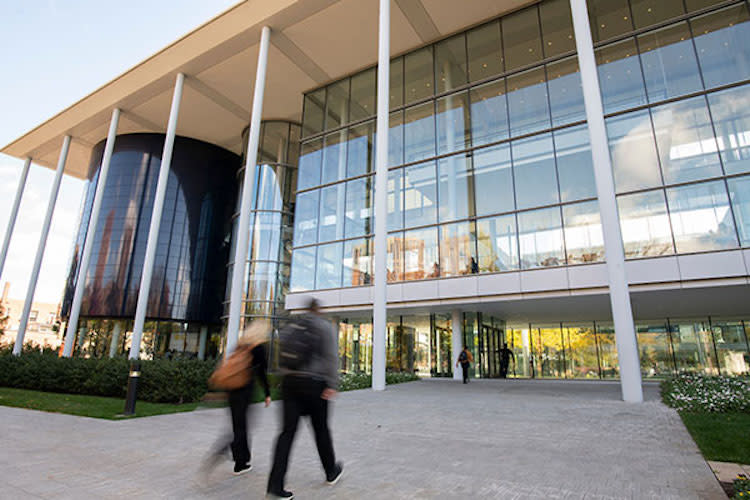

Digital Currency Group’s new Stamford HQ will bring hundreds of jobs to CT

Digital Currency Group’s new Stamford HQ will bring hundreds of jobs to CT

STAMFORD — Digital Currency Group, a leading company in the cryptocurrency and blockchain-technology sectors that recently opened offices in Stamford, announced Monday plans to create more than 300 jobs in Connecticut in the next five years — the latest of several prominent firms to commit this year to hiring on a large scale, with state financial assistance.

To support the new positions, DCG is building an approximately 90,000-square-foot headquarters across the fourth and fifth floors of 290 Harbor Drive, in the Shippan Landing complex. By the end of the summer of 2022, the company is aiming to open the new offices, which have panoramic views of Stamford and Long Island Sound.

Before deciding on Connecticut, DCG considered keeping its headquarters in Manhattan, while it also looked at locations in the other New York City boroughs, Westchester County and New Jersey.

“It was Connecticut where we were welcomed with open arms by Gov. (Ned) Lamont,” DCG founder and CEO Barry Silbert said Monday in a press conference on the fifth floor of 290 Harbor Drive. “It is here where we found a great home for financial-technology companies with the infrastructure, universities, access to capital and diverse pool of talent needed to build a global business.”

If DCG creates and retains more than 300 full-time jobs, it can earn a grant “in arrears” of up to approximately $5 million from the state Department of Economic and Community Development.


“This is a state that was one of the most entrepreneurial states in the country, going back a long time,” Lamont said at the press conference. “Then we lost a little bit of our entrepreneurial mojo, and we are getting it back thanks to entrepreneurs like you.”

Ahead of the completion of the permanent headquarters, DCG opened in the spring a temporary headquarters in the adjacent building at 262 Harbor Drive, where about 130 employees are based. As part of its expansion, DCG plans to hire more than 100 people in Stamford in 2022.

Today, the company employs more than 1,000 people across four continents.

Jobs report, Yellen Powell CARES Act hearing, Dollar General earnings top week ahead

Jobs report, Yellen Powell CARES Act hearing, Dollar General earnings top week ahead

After an abbreviated session on Friday, the markets will reopen for a full week of business, featuring a slew of earnings and key economic data, including the Beige Book, ADP employment and the jobs report.

Federal Reserve Chairman Jerome Powell and Treasury Secretary Janet Yellen will also testify before lawmakers at a hearing on CARES Act oversight, and Congress will race to pass a funding bill ahead of Friday’s looming deadline for a government shutdown.

FOX Business takes a look at the upcoming events that are likely to move financial markets in the coming days.

The week kicks off relatively quietly on the earnings and economic data front with pending home sales. New York Fed president John Williams will also speak during a virtual event to launch the New York Innovation Center (NYIC), a strategic partnership with the Bank for International Settlements (BIS) Innovation Hub.

Meanwhile, those who missed out on Black Friday deals over the holiday weekend will be able to take advantage of Cyber Monday sales from retailers including Walmart, Amazon, Best Buy, Target, Macy’s, Kohl’s, JCPenney, Home Depot, Old Navy, Adidas, REI, Nike, Barnes & Noble, GameStop, Bath & Body Works, Sephora, Ulta, Wayfair and Zappos.

Monday also marks the expiration of the Fearless Girl statue’s permit after three years of staring down Wall Street, the new date for the Ports of Los Angeles and Long Beach’s $100 surcharge for dwelling shipping containers, the deadline for Securities and Exchange Commission chairman Gary Gensler to response to Sen. Elizabeth Warren’s questions about Trump Media and Technology Group’s SPAC merger with Digital World Acquisition Corp. and the deadline to apply for FEMA assistance for Hurricane Ida.

In international news, Japan’s prime minister Fumio Kishida is expected to meet with European Council President Charles Michel to discuss closer ties in the Indo-Pacific region amid China’s growing assertiveness. Talks will also resume in Vienna on reviving the 2015 Iran nuclear deal.

Earnings will ramp up on Tuesday with Barnes & Noble Education and Chico’s FAS before the market open and Box, GlobalFoundries, Hewlett-Packard Enterprise, NetApp, Salesforce.com after the bell.

As for economic data, investors will take in the FHFA’s monthly home price index — the Case-Shiller home price index — for the latest reading on consumer confidence. New York Fed president John Williams will also deliver opening remarks before an event, “Combating Food Insecurity: What’s Working – and What’s Scalable?”

In addition, Treasury Secretary Janet Yellen and Federal Reserve chairman Jerome Powell will testify before the Senate’s Committee on Banking, Housing and Urban Affairs in a hearing entitled “CARES Act Oversight of Treasury and the Federal Reserve: Building a Resilient Economy.”

Merck will be a stock to watch on Tuesday as the Food and Drug Administration’s Antimicrobial Drugs Advisory Committee (AMDAC) will meet to discuss the available data supporting the use of molnupiravir, an investigational antiviral drug, to treat mild to moderate COVID-19 cases in adults and high-risk patients.

In technology news, Verizon Stores will begin selling Nreal Light augmented reality glasses, and chipmaker Qualcomm will kick off its Tech Summit, where it is expected to unveil its newest Snapdragon chipset. The event will run through Dec. 2.

Tuesday also marks Giving Tuesday, a worldwide celebration of generosity, and the deadline for live venues in California to apply for pandemic relief funds.

Earnings taking the spotlight on Wednesday include Build-A-Bear Workshop and G-III Apparel before the market open and Five Below, Okta, PVH, Snowflake, Splunk and Synopsys after the bell.

Meanwhile, Wednesday’s economic data will include the Beige Book, ADP national employment report, vehicle sales, construction spending, the ISM manufacturing PMI, weekly mortgage applications and the Energy Information Administration’s weekly crude stocks.

Federal Reserve chairman Jerome Powell previously said that the agency would also start tapering its monthly asset purchases beginning in December. He noted during his FOMC press conference on Nov. 3 that the purchases would initially be reduced by $10 billion for Treasury securities and $5 billion for agency securities.

Meta will also be a stock to watch as the company officially changes its stock ticker from FB to MVRS. The tech giant, formerly known as Facebook, rebranded itself last month as it shifts is focus to building the metaverse, a virtual reality space where users can interact with each other in a computer-generated environment.

The name change comes as Facebook is facing growing backlash following testimony and disclosures from former product manager turned whistleblower Frances Haugen. Haugen has accused the company of prioritizing profits over user safety and has released documents that highlight the inner workings of the social media giant, covering everything from how it handles misinformation and hate speech on its platforms to Instagram’s impact on the mental health of teens and young children.

On Capitol Hill, the House Energy and Commerce’s subcommittee on communications and technology will hold a hearing on holding Big Tech accountable. The hearing will focus on several bills, including the “Protecting Americans from Dangerous Algorithms Act,” the “Civil Rights Modernization Act of 2021,” the “Safeguarding Against Fraud, Exploitation, Threats, Extremism, and Consumer Harms Act” and the “Justice Against Malicious Algorithms Act of 2021.”

Thursday’s earnings docket will include Dollar General, Duluth Holdings, Express, Kroger, Lands’ End and Signet Jewelers before the market open and Asana, Cooper Companies, DocuSign, Smith & Wesson and Ulta Beauty after the bell.

Economic data in focus on Thursday will be challenger layoffs and the latest in initial and continuing jobless claims.

Meanwhile, Atlanta Fed president Raphael Bostic will moderate a virtual conversation dubbed “Why is Housing So Expensive?” before the Biennial Real Estate Conference and participate in a virtual live interview, “Policy for Progress,” before the Reuters Next conference. San Francisco and Richmond Fed presidents Mary Daly and Thomas Barkin will also participate in a virtual fireside chat called “State of the Labor Market,” which is hosted by the Peterson Institute for International Economics.

OPEC+ will also hold its December policy meeting, which comes about a week after the Biden Administration announced it would tap 50 million barrels of oil from strategic reserves in an attempt to mitigate rising gas prices, and the Treasury Department’s Federal Advisory Committee on Insurance will meet to discuss climate-related financial risk and the insurance sector, receive updates on activities from its subcommittees and the Federal Insurance Office and consider any new business.

On Capitol Hill, the House of Representatives will hold a series of hearings on topics including cybersecurity and the nation’s infrastructure, supporting U.S. workers and business in the face of unfair Chinese trade practices and strengthening the safety net for injured workers.

Earnings from Big Lots and Hibbett, the jobs report, factory orders and ISM non-manufacturing PMI will finish out the week.

Friday also marks the deadline for Congress to pass a funding bill to avoid a government shutdown. In addition, the World Trade Organization’s meeting of trade ministers will also wrap up.

U.S. Jobs Report Expected to Show Another Strong Increase: Eco Week Ahead

U.S. Jobs Report Expected to Show Another Strong Increase: Eco Week Ahead

(Bloomberg) — Sign up for the New Economy Daily newsletter, follow us @economics and subscribe to our podcast.

Most Read from Bloomberg

U.S. employers probably added more than half a million workers for a second straight month in November, pushing the labor market closer to a full recovery despite swirling inflation worries and persistent Covid-19 infections.

Payrolls are expected to rise by 550,000 and the unemployment rate to edge down to 4.5{1b90e59fe8a6c14b55fbbae1d9373c165823754d058ebf80beecafc6dee5063a}, according to the median estimates of economists ahead of Labor Department data due Friday in Washington.

A strong jobs report, coupled with another monthly jump in consumer prices in Labor Department data out Dec. 10, could seal a decision at the Federal Reserve’s mid-December meeting to accelerate the tapering of bond purchases. But a new pandemic wave might still scupper that, a fear that caused market jitters on Friday.

Fed Chair Jerome Powell, fresh from being picked for a second term by President Joe Biden, is likely to face questions Tuesday about tapering, interest rates and inflation when he appears before the Senate Banking Committee for a regular hearing on the Cares Act, the March 2020 pandemic aid package. Treasury Secretary Janet Yellen will testify alongside Powell, and the House Financial Services Committee has a similar panel scheduled for Wednesday.

The Fed’s Beige Book survey, out Wednesday, will also shed light on the economic situation across the country. Other key U.S. data during the week include pending home sales, consumer confidence, and Institute for Supply Management indexes of manufacturing and services.

What Bloomberg Economics Says:

“A strong jobs report as we expect, together an with elevated CPI reading for November — a highly likely outcome given what we know about energy, housing prices and base effects — will cement policy makers’ decision.”

–Anna Wong, Andrew Husby and Eliza Winger. For full analysis, click here

Elsewhere, the fastest inflation since the euro was created and easing price pressures in Brazil may feature among economic reports due.

Click here for what happened last week, and below is our wrap of what’s coming up in the global economy.

Asia

China’s official PMI reports on Tuesday will give the latest pulse check on the world’s second-largest economy, with economists’ forecasts anticipating an improvement for manufacturers as power shortages abated.

Japan gets a raft of data on production, unemployment and retail sales that will show how the economy was faring at the beginning of this quarter, days after Prime Minister Fumio Kishida launched a record fiscal stimulus package. Capital spending figures will indicate how business sentiment has been holding up.

South Korean export numbers should take the latest pulse of world trade, while inflation figures the following day will show if prices are continuing to heat up.

India posts gross domestic product data for the July-to-September quarter, with the rebound’s pace set to moderate from the prior three months, while GDP data for the third quarter will show how badly Australia’s economy suffered during its lengthy lockdowns.

Europe, Middle East, Africa

Any acceleration in euro-area consumer-price data on Tuesday will mean the region’s enduring the fastest inflation since the creation of the single currency. That will heap further scrutiny on the European Central Bank, whose officials insist the surge is largely transitory as they approach a crucial decision on the future of stimulus.

In Germany, the region’s biggest economy, the cost-of-living squeeze is even more intense. The median prediction of economists is for an inflation rate of 5.5{1b90e59fe8a6c14b55fbbae1d9373c165823754d058ebf80beecafc6dee5063a} in November, though the Bundesbank reckons the outcome may be closer to 6{1b90e59fe8a6c14b55fbbae1d9373c165823754d058ebf80beecafc6dee5063a}.

Inflation numbers from elsewhere in Europe will also show significant jumps. Spain’s rate due on Monday is seen at 5.6{1b90e59fe8a6c14b55fbbae1d9373c165823754d058ebf80beecafc6dee5063a}, according to the median estimate. Poland’s may be even higher at 7.3{1b90e59fe8a6c14b55fbbae1d9373c165823754d058ebf80beecafc6dee5063a}.

Other highlights in western Europe include a speech by Bank of England policy maker Catherine Mann on Tuesday, multiple appearances by Swedish Riksbank officials, and the latest global economic outlook from the OECD in Paris on Wednesday.

In Turkey, foreign trade data on Monday and inflation figures on Friday could move the lira, which just plummeted to its longest losing streak in two decades. President Recep Tayyip Erdogan has defended monetary policy that economists say will cause inflation to spike higher than 20{1b90e59fe8a6c14b55fbbae1d9373c165823754d058ebf80beecafc6dee5063a}. The turmoil has even led some banks to stop external forecasts.

In Africa on Monday, Kenya’s central bank is expected to leave its key interest rate unchanged for an 11th straight meeting to spur the economy’s recovery, as demand remains muted even after the government eased Covid-19 lockdown restrictions.

Data on Tuesday will likely show that South Africa’s unemployment rate is still the highest on a global list of 82 countries monitored by Bloomberg. It’s projected to remain above 33{1b90e59fe8a6c14b55fbbae1d9373c165823754d058ebf80beecafc6dee5063a} in the third quarter, following deadly riots in July and a security breach at the state-owned port operator that hobbled trade.

Also Tuesday, Angola’s central bank will probably hold interest rates steady to give some time for a 450 basis-point-hike in July and new measures by the government aimed at curbing price growth to take effect.

Latin America

Look for November’s reading of Brazil’s broadest inflation measure, out Monday, to slow for a sixth straight month as electricity and food prices ease.

Mexico’s October unemployment data may reflect a pick-up in activity as Covid case counts and lockdowns ease. In Chile, currently Latin America’s hottest economy, the unemployment rate likely extended a six-month decline. Brazil and Colombia will also report October unemployment.

Mexican remittances are running at record highs and have been above $4 billion per month since February. Transfers from the U.S. represent 95{1b90e59fe8a6c14b55fbbae1d9373c165823754d058ebf80beecafc6dee5063a} of all remittances received in Mexico and two states — California and Texas — account for half of the total.

Banxico’s quarterly inflation report due Wednesday promises a trove of fresh forecasts and analysis. Also, look for Chile’s economic activity index to post double-digit growth for a seventh month.

Given a litany of headwinds facing Brazil’s economy, analysts have been marking down their 2021 and 2022 GDP forecasts, but third-quarter output data due Thursday may show at least marginal growth after shrinking 0.1{1b90e59fe8a6c14b55fbbae1d9373c165823754d058ebf80beecafc6dee5063a} in the April-to-June period.

Look for Brazil’s October industrial production figures out Friday to disappoint as supply shortages and rapidly rising interest rates bite.

Most Read from Bloomberg Businessweek

©2021 Bloomberg L.P.

How MPs’ second jobs fail to gain them experience of the UK economy

How MPs’ second jobs fail to gain them experience of the UK economy

Almost three times more British MPs declared earnings from financial services companies than from manufacturing, FT analysis has revealed — one of many imbalances that may complicate Tory efforts to defend legislators’ right to pursue part-time careers.

MPs’ right to hold second jobs, which spurred a political row this month, has been defended by Jacob Rees-Mogg, leader of the House of Commons. He told Parliament that it was “a historic strength . . . that MPs should have a wider focus than the Westminster bubble”.

The government has now proposed changes to the rules to bar MPs from doing too many hours of outside work or acting as political consultants — but to preserve their right to have other income. A report on how the new rules might operate is set to be published by a cross-party committee next week.

In declarations made since the last election in 2019, some of which relate to the year before the vote, 37 MPs have registered income of various kinds from financial services companies — the largest such bloc of corporate income. The sector accounts for 8.1 per cent of UK GDP.

These include longstanding contractual relationships as well as one-off payments — such as the £160,000 paid to Theresa May, the former prime minister, by JPMorgan Chase in April 2020. The sum was an “advance payment” for two speeches that were postponed by the pandemic; she has yet to give one of them.

By contrast, just 13 MPs have received income from manufacturers, which contribute 9.9 per cent of GDP. Just 8 MPs have financial links to retailers, which contribute 4.9 per cent. Public relations or lobbying companies have employed 30 MPs.

Hannah White, deputy director of the Institute for Government who previously ran the independent Committee on Standards in Public Life, said: “If the point of second jobs is to ensure that MPs can bring real life experience to parliament, then it is deeply problematic that the experience MPs are actually getting is so unrepresentative of the UK economy”.

This has become a partisan issue because of an imbalance in who holds these posts: the positions listed above were held by 68 Tory MPs and just 18 legislators from all the other parties combined.

The issue was also brought to public attention by the actions of Owen Paterson, a Conservative former minister, who was found by a bipartisan committee to have “repeatedly used his position as a member to promote the companies by whom he was paid” in a manner not permitted by the rules. The government whipped its MPs to save him from proposed sanctions — only to be forced to retreat in the face of a public backlash.

Some forms of outside income are more bipartisan: 155 MPs received additional funds from filling in surveys for pollsters — receiving between £30 and £275 for each survey, which typically takes less than an hour.

Meanwhile 105 MPs declared earnings from the media, largely for writing articles (including for the FT Group) or TV appearances. Another 63 have held paid roles in local government. An additional 23 have declared income from book publishing.

Bar chart of number of MPs declaring income from each industry since 2019 v share of the economy showing MPs' corporate experiences do not represent economy

Westminster MPs are allowed to lobby ministers on behalf of companies that have given them money or gifts, and to advocate for them in debates so long as they do not “initiate” conversations or debates. Clients must also not “exclusively” benefit from anything they propose. They also must not use parliamentary facilities for business.

These rules are weaker than in the UK’s devolved parliaments, and markedly weaker than those in the US House of Representatives — where there is a cap on some kinds of earned income and outright bans on others.

Members of the House of Representatives are banned from practising law to prevent them from having conflicting public and private duties.

In the UK, lawyer-MPs are allowed to practise and are not required to disclose their ultimate clients. The 30 MPs declaring income from law — mostly as barristers — include some of Parliament’s biggest earners, such as Sir Geoffrey Cox, the former attorney-general. Cox, whose large volume of outside work helped fuel the outrage over MPs’ second jobs, told the FT that barristers were hired “to advise and represent . . . on a specific issue or in litigation”, not for general representation.

Lawyers are heavily represented in parliament, but together with accountancy, from which 7 MPs declared earnings, the legal sector contributes just 2.7 per cent of GDP.

In the US, members of the House are banned from accepting most gifts — with a particular prohibition on gifts from lobbyists or anyone who also engages a lobbyist. No such bar exists in the UK, where 26 MPs have registered gifts from betting companies and their lobbying body. A total of 111 MPs have taken gifts or hospitality from sports businesses.

The largest gift went to Tracey Crouch, who has just completed a review of the regulation of English football on behalf of the UK government. She declared a £4,560 hospitality package from the Football Association, the sport’s English body, to watch a football match.

“It turns out to be only a small set of businesses that are most interested in paying and entertaining MPs,” said Duncan Hames, a former MP and director of policy at Transparency International UK. “That these companies are often heavily regulated suggests more interest in their parliamentary role than prior experience they might bring.”

MPs are allowed to hold up to £70,000 of shares in a company without registering the holding, so long as the stake constitutes less than 15 per cent of the equity. They are not required to list participation in any funds. In the US, members of the House of Representatives must declare shareholdings over $1,000, as well as any other investments.

One person involved in administering the current UK system told the FT they were “very sceptical” about comparisons to the US — “not least because of [US politicians’] need to raise campaign finance”. This, they said, led to US politicians being “more in hock to big business”.

Campaigners are calling for much more sweeping reforms than are currently being considered. Hames said: “There are still too many blind spots for mischief to hide . . . It could save a lot of trouble if, like in many other workplaces, those wanting to take on second jobs or other contractual relationships first sought authorisation from an independent body, just as former ministers are expected to do.”

Weekly jobless claims total 199,000, reaching the lowest since1969

Weekly jobless claims total 199,000, reaching the lowest since1969

New jobless claims fell far more than expected to the lowest level since November 1969 last week, underscoring the present tight labor market conditions as initial unemployment claims near 2019 levels while job openings hold near record highs. 

The Labor Department released its jobless claims report on Wednesday, a day earlier than usual due to the Thanksgiving holiday. Here were the main metrics from the print, compared to consensus estimates compiled by Bloomberg:

  • Initial unemployment claims, week ended November 20: 199,000 vs. 260,000 expected and a revised 270,000 during prior week 

  • Continuing claims, week ended November 13: 2.049 million vs. 2.033 million expected and a revised 2.109 million during prior week

The total number of new weekly filings fell to a fresh virus-era low for a seventh straight week. During the comparable week last year, initial filings came at well over 700,000. Claims also fell below their 2019 weekly average of approximately 220,000. 

“It is fair to say that we didn’t see that coming,” Mark Hamrick, senior economic analyst at Bankrate, wrote in an email Wednesday morning. “Getting new claims below the 200,000 level for the first time since the pandemic began is truly significant, portraying further improvement.” 

“Americans head into the heart of the holiday season with a reasonable expectation that an already tight job market will continue to tighten in the months ahead,” he added. “Retail sales have recently surprised to the upside and that momentum should continue.”

Continuing claims for regular state unemployment benefits have also drawn closer to pre-virus levels. After coming in at the lowest level since March 2020 last week, continuing claims also neared their 2019 average rate of about 1.7 million per week. 

The latest jobless claims data also bodes well for November’s monthly jobs report from the Bureau of Labor Statistics. This week’s report coincides with the survey week for that data, which is due for release next week. Consensus economists expect that report to show non-farm payrolls rose by half a million in November, with the unemployment rate ticking down to 4.5{1b90e59fe8a6c14b55fbbae1d9373c165823754d058ebf80beecafc6dee5063a} from 4.6{1b90e59fe8a6c14b55fbbae1d9373c165823754d058ebf80beecafc6dee5063a} in October. 

The past couple months’ worth of jobless claims reports have offered just one look at a labor market that has grown increasingly tight as the economic recovery progressed. Though the labor force participation rate has yet to return to pre-pandemic levels, the number of those rendered newly unemployed has fallen precipitously, with many employers incentivized to keep their current workforces as job openings and labor shortages across industries remain elevated. Job openings were last reported at 10.4 million as of the end of September, with this sum dipping only slightly from July’s record high of more than 11 million.

Monetary policymakers have been dealt the delicate task of further stoking employment growth while keeping inflation from running too hot for too long. Federal Reserve Chair Jerome Powell, who just this week was renominated to lead the central bank for another four-year term, has suggested that supply-side constraints contributing present levels of elevated inflation will eventually begin to ease.  

“In our assessment — against a backdrop of moderating growth and slowing inflation in 2022 — policymakers will have to shift focus next year from price pressures to a complete labor market recovery, which will take some time, delaying an eventual rise in interest rates,” wrote Rubeela Farooqi, chief U.S. economist for High Frequency Economics, in a note. 

Emily McCormick is a reporter for Yahoo Finance. Follow her on Twitter: @emily_mcck

Read the latest financial and business news from Yahoo Finance

Follow Yahoo Finance on Twitter, Facebook, Instagram, Flipboard, LinkedIn, YouTube, and reddit

Plenty Of Jobs For Yale MBAs, But Median Pay Flattens

Plenty Of Jobs For Yale MBAs, But Median Pay Flattens

Yale School of Management released employment data for its MBA program this month

MBA job offers and acceptances were down across the board in 2020, and we don’t need to remind you why. However, while the jobs were harder to find, the ones that graduates did land paid well enough to allow B-schools to boast about the continued strong ROI of their programs.

That was the case at Yale School of Management. Last year, in the depths of the pandemic, the Yale Class of 2020 made news with a major increase in total compensation, fueled by a big boost in median base pay — even as both job offers an acceptances dipped at Yale, as they did elsewhere.

Now, with the release of the SOM’s 2021 numbers, we see a curious reversal: Salaries are up nominally and total compensation is flat overall, but placement rates have rebounded. After dropping from 92.4{1b90e59fe8a6c14b55fbbae1d9373c165823754d058ebf80beecafc6dee5063a} in 2019 to 90.2{1b90e59fe8a6c14b55fbbae1d9373c165823754d058ebf80beecafc6dee5063a} last year, offers at three months at Yale bounced way back to 95.7{1b90e59fe8a6c14b55fbbae1d9373c165823754d058ebf80beecafc6dee5063a}; after slipping to 85.9{1b90e59fe8a6c14b55fbbae1d9373c165823754d058ebf80beecafc6dee5063a} from 91.4{1b90e59fe8a6c14b55fbbae1d9373c165823754d058ebf80beecafc6dee5063a}, acceptances at 90 days roared back to 94.1{1b90e59fe8a6c14b55fbbae1d9373c165823754d058ebf80beecafc6dee5063a}. Both numbers represent school records.

MEDIAN PAY FOR 2021 YALE MBAs: $165,248

Yale SOM grads were paid well in 2020. Factoring in an overall median base salary of $140K, up from $130K in 2019, as well as a median signing bonus of $30K (unchanged) reported by 77.3{1b90e59fe8a6c14b55fbbae1d9373c165823754d058ebf80beecafc6dee5063a} of grads and a median “other” comp of more than $20K reported by just over 10{1b90e59fe8a6c14b55fbbae1d9373c165823754d058ebf80beecafc6dee5063a}, Yale MBAs’ median total comp was $165,333 last year, up from $155,170 the previous year — a 6.5{1b90e59fe8a6c14b55fbbae1d9373c165823754d058ebf80beecafc6dee5063a} jump in one year. For comparison, the overall compensation increase at Yale between 2018 and 2019 was 2.3{1b90e59fe8a6c14b55fbbae1d9373c165823754d058ebf80beecafc6dee5063a}.

Now, even as the Ivy B-school’s job offers and acceptances three months after graduation increased 5.5 and 8.2 percentage points, respectively, pay for Yalies has stagnated. For the 256 of 312 students seeking employment (82.1{1b90e59fe8a6c14b55fbbae1d9373c165823754d058ebf80beecafc6dee5063a}), SOM saw only a very modest increase in median starting salary, to $140,400, while median bonuses were flat at $30K for a fourth straight year. Those receiving “other” compensation also dropped to a four-year low, at 8.4{1b90e59fe8a6c14b55fbbae1d9373c165823754d058ebf80beecafc6dee5063a} — it was nearly 20{1b90e59fe8a6c14b55fbbae1d9373c165823754d058ebf80beecafc6dee5063a} in 2018 — though the amount ticked upward to $22,950 from $20,413.

The result is that total median compensation for Yale SOM MBAs in 2021 was $165,248, an $85 decline from 2020 — about 0.05{1b90e59fe8a6c14b55fbbae1d9373c165823754d058ebf80beecafc6dee5063a}. Statistically insignificant? Yes. But noteworthy in that it’s the first decline of any kind at Yale in several years, an acute contrast with the big jump in pay when the market was in turmoil in 2020.

COMPARISONS & CONTRASTS

Harvard Business School experienced a similar 2021 to Yale’s. HBS MBAs had plenty of jobs to choose from, with the school’s offers and acceptances bouncing back nicely from the 2020 trough. However, median compensation for Harvard MBAs slipped to $189,850 from $193,200, a decline of about 1.2{1b90e59fe8a6c14b55fbbae1d9373c165823754d058ebf80beecafc6dee5063a}, and still lag 2019’s level.

It’s not a clear-cut case of every school suffering the same reversal. At Chicago Booth School of Business, coming off a 2020 in which bonuses were flat and total compensation grew only 1.2{1b90e59fe8a6c14b55fbbae1d9373c165823754d058ebf80beecafc6dee5063a} from 2019, Boothies reported a big jump in median salary, to $155,000, and in median bonuses, to $35,000, powering an overall compensation total of $178,450, up 4.9{1b90e59fe8a6c14b55fbbae1d9373c165823754d058ebf80beecafc6dee5063a} from 2020. Likewise, at Northwestern Kellogg School of Management, 97.1{1b90e59fe8a6c14b55fbbae1d9373c165823754d058ebf80beecafc6dee5063a} of two-year MBA graduates in 2021 received offers by three months after graduation, up from 95{1b90e59fe8a6c14b55fbbae1d9373c165823754d058ebf80beecafc6dee5063a} last year, and 96.1{1b90e59fe8a6c14b55fbbae1d9373c165823754d058ebf80beecafc6dee5063a} accepted, up from 93{1b90e59fe8a6c14b55fbbae1d9373c165823754d058ebf80beecafc6dee5063a}. Pay also climbed, with median starting salaries up to $150,000 from $144,000, leading to a 2.1{1b90e59fe8a6c14b55fbbae1d9373c165823754d058ebf80beecafc6dee5063a} uptick in total compensation, to $175,800 from $172,200. Bonuses, which 86{1b90e59fe8a6c14b55fbbae1d9373c165823754d058ebf80beecafc6dee5063a} of grads reported receiving, were the same at a median of $30,000.

And at the Ross School of Business at the University of Michigan — a school that once held Yale’s spot in the top 10 of the rankings — pay was up along with placement rates. Graduates of the Ross School’s full-time MBA program received the highest total median salary package in school history, $171,450, a 6{1b90e59fe8a6c14b55fbbae1d9373c165823754d058ebf80beecafc6dee5063a} increase over the Class of 2020. The class’s median salary was $144,000, 6.7{1b90e59fe8a6c14b55fbbae1d9373c165823754d058ebf80beecafc6dee5063a} more than last year. Placement at Ross, meanwhile, rebounded big time, with 97.5{1b90e59fe8a6c14b55fbbae1d9373c165823754d058ebf80beecafc6dee5063a} of MBAs receiving offers within three months of graduation (up from 90{1b90e59fe8a6c14b55fbbae1d9373c165823754d058ebf80beecafc6dee5063a} last year), and 96.1{1b90e59fe8a6c14b55fbbae1d9373c165823754d058ebf80beecafc6dee5063a} accepting; the latter is a 10-year-high and a nearly 9{1b90e59fe8a6c14b55fbbae1d9373c165823754d058ebf80beecafc6dee5063a} year-over-year improvement.

CONSULTING REMAINS TOP INDUSTRY FOR YALIES; TECH TUMBLES

“Throughout their careers,” reads the Yale SOM MBA employment web page, “Yale MBAs take on a range of challenges across regions and sectors. Graduating students find positions in a variety of industries. The range of employers that hire Yale SOM students is remarkable, reflecting the initiative and creativity that our students bring to shaping their own careers. Alumni of the school excel in roles that span industries, sectors, and regions.”

Currently and historically, consulting is the sector that Yalies love the most. In 2021, more than 34{1b90e59fe8a6c14b55fbbae1d9373c165823754d058ebf80beecafc6dee5063a} of grads went into the industry, hired by such firms as McKinsey, Bain, Boston Consulting Group, Deloitte, EY, Strategy&, and Accenture; since 2015 the share of each class that became consultants has grown 4.9 percentage points, or 16.7{1b90e59fe8a6c14b55fbbae1d9373c165823754d058ebf80beecafc6dee5063a}. Consulting peaked at 37.2{1b90e59fe8a6c14b55fbbae1d9373c165823754d058ebf80beecafc6dee5063a} of Yale’s MBA class in 2019.

Finance, meanwhile, is steady-eddie, with 25.1{1b90e59fe8a6c14b55fbbae1d9373c165823754d058ebf80beecafc6dee5063a} of the Class of 2021, up from 23.3{1b90e59fe8a6c14b55fbbae1d9373c165823754d058ebf80beecafc6dee5063a} last year and up 2.4{1b90e59fe8a6c14b55fbbae1d9373c165823754d058ebf80beecafc6dee5063a} in six years. Finance has crawled back from a low of 19.6{1b90e59fe8a6c14b55fbbae1d9373c165823754d058ebf80beecafc6dee5063a} in 2016. Contrast that with tech, which dropped to 10{1b90e59fe8a6c14b55fbbae1d9373c165823754d058ebf80beecafc6dee5063a} from 12.7{1b90e59fe8a6c14b55fbbae1d9373c165823754d058ebf80beecafc6dee5063a} and which is on a three-year decline from a high of 14.9{1b90e59fe8a6c14b55fbbae1d9373c165823754d058ebf80beecafc6dee5063a} in 2018.

Regionally, Yale MBAs once again preferred to remain in the New York-Boston corridor, with 52.1{1b90e59fe8a6c14b55fbbae1d9373c165823754d058ebf80beecafc6dee5063a} of the class working there, up from 47{1b90e59fe8a6c14b55fbbae1d9373c165823754d058ebf80beecafc6dee5063a} last year. Those MBAs also make the most, at a median of $150K (unchanged from last year). Next closest was the West, where 26.6{1b90e59fe8a6c14b55fbbae1d9373c165823754d058ebf80beecafc6dee5063a} of the Class of 2021 went, down from 29.2{1b90e59fe8a6c14b55fbbae1d9373c165823754d058ebf80beecafc6dee5063a}; median salary for Silicon Valley-bound Yale MBAs was $135K, down from $140K. Once again, more Yale MBAs stayed stateside this year, another reflection of the reality of the pandemic, with 91.5{1b90e59fe8a6c14b55fbbae1d9373c165823754d058ebf80beecafc6dee5063a} of full-time jobs reported inside the U.S. compared to 87{1b90e59fe8a6c14b55fbbae1d9373c165823754d058ebf80beecafc6dee5063a} last year and just under 80{1b90e59fe8a6c14b55fbbae1d9373c165823754d058ebf80beecafc6dee5063a} in 2019. Yale MBAs working in the U.S. made a median base salary of $150K, up $15K in two years. Of the 8.5{1b90e59fe8a6c14b55fbbae1d9373c165823754d058ebf80beecafc6dee5063a} who did find work abroad, most went (or went back) to Asia (40{1b90e59fe8a6c14b55fbbae1d9373c165823754d058ebf80beecafc6dee5063a}), though at a considerable pay disadvantage: their median starting salary was $103,629, down from last year’s $106,610.

See the full Yale SOM MBA employment report here.

DON’T MISS OUR COVERAGE OF THE JOB PROSPECTS FOR THE MBA CLASS OF 2021:

THE UNIVERSITY OF CHICAGO BOOTH SCHOOL OF BUSINESS

THE WHARTON SCHOOL AT THE UNIVERSITY OF PENNSYLVANIA

HARVARD BUSINESS SCHOOL

NORTHWESTERN UNIVERSITY KELLOGG SCHOOL OF MANAGEMENT

MIT SLOAN SCHOOL OF MANAGEMENT

THE UNIVERSITY OF VIRGINIA DARDEN SCHOOL OF BUSINESS

THE UNIVERSITY OF MICHIGAN ROSS SCHOOL OF BUSINESS

NEW YORK UNIVERSITY STERN SCHOOL OF BUSINESS

MICHIGAN STATE UNIVERSITY BROAD COLLEGE OF BUSINESS

The post 2021 MBA Employment: Plenty Of Jobs For Yale MBAs, But Median Pay Flattens appeared first on Poets&Quants.