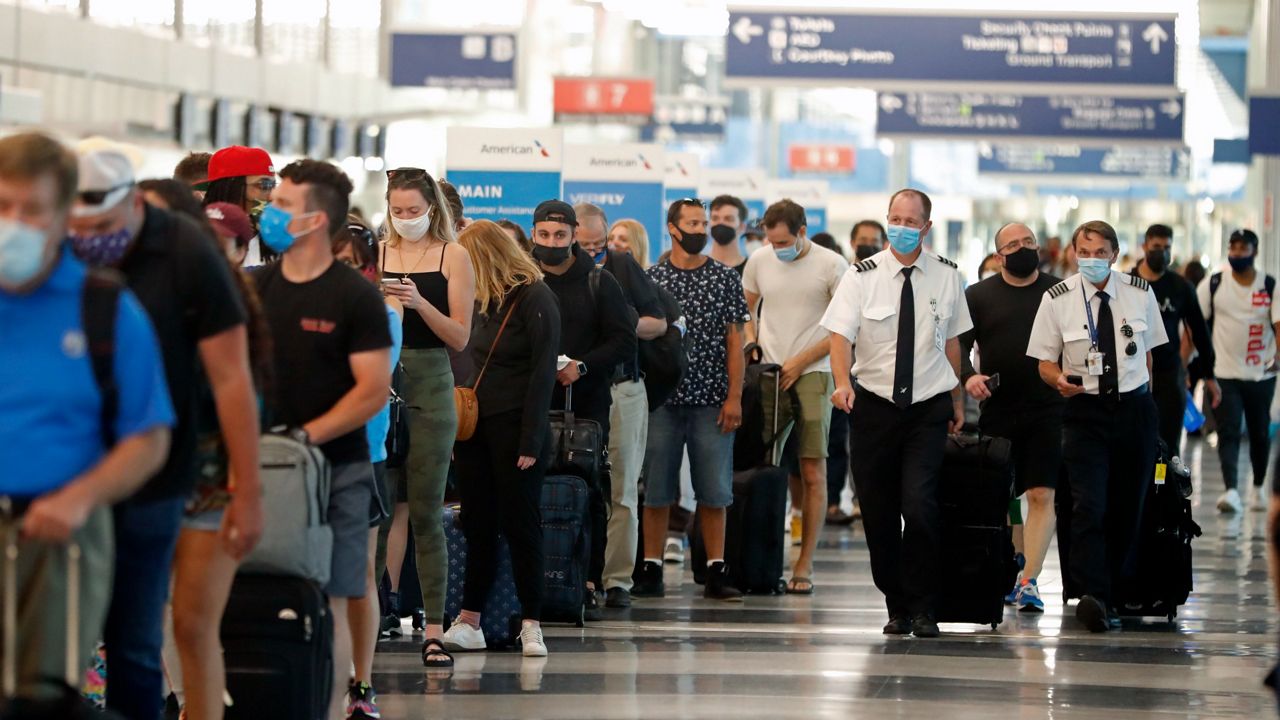
SAN FRANCISCO (KGO) — The new travel restrictions announced Thursday may be just the beginning of tightened rules — not only in the United States, but other countries too. If you’re traveling in the next few weeks, especially abroad, experts say be ready for more limits, even border closures that can disrupt your trip.
So will travel insurance cover you?
This may be a time to get some insurance. There are specific COVID-19 policies that cover everything from a potential quarantine, to medical expenses to canceled tours. And with the new rule requiring a negative test result within 24 hours to come back home, experts say plan now.
RELATED: How omicron COVID-19 variant is changing holiday travel plans
Globetrotters were just beginning to come out of isolation, when the new variant brought a fresh set of travel restrictions. And experts say be ready for even more rules during the holiday travel rush ahead.
Travel insurance CEO Omar Kaywan says some countries may enact new restrictions, or even close borders if the new variant spreads.
“We are walking into the next six weeks of complete uncertainty. There’s a lot of last-minute decisions that are being made, a lot of restrictions are being put in place by many countries,” he says.
VIDEO: Travelers react to ‘stress’ of new omicron variant, possibility of new restrictions
New rules already require passengers to show a negative COVID test within 24 hours of their flight back to the U.S.
“This is something that they need to plan, and they need to start as soon as possible, wherever their destination is to book their appointments ASAP, because this is a requirement. and you will not be essentially getting on a plane coming back home, if you don’t have your proof of negative COVID-19 test,” Kaywan says.
A positive result could mean being stranded overseas in quarantine. Border restrictions may mean losing money for tours, lodging and transportation.
However, many companies offer specific COVID-19 travel insurance.
If you’re going overseas, check for policies that cover:
Expenses in case you are quarantined
Medical coverage if you get sick from COVID
Cancelations for lodging, tours transportation and airfare
Finally, look for policies that let you cancel for any reason, such as not wanting to travel during a COVID surge.
“From what we’ve seen in the last couple days people are continuing with their travel plans and they’ll see how it goes and what it’s going to end up being,” Kaywan says.
One thing that’s still to be announced: what type of rapid test will be acceptable within that 24-hour window. 7 On Your Side will keep checking so you’re ready if you’re traveling over the holidays.
Take a look at more stories and videos by Michael Finney and 7 On Your Side.
Have a question for Michael and the 7 On Your Side team? Fill out the form HERE!7OYS’s consumer hotline is a free consumer mediation service for those in the San Francisco Bay Area. We assist individuals with consumer-related issues; we cannot assist on cases between businesses, or cases involving family law, criminal matters, landlord/tenant disputes, labor issues, or medical issues. Please review our FAQ here. As a part of our process in assisting you, it is necessary that we contact the company / agency you are writing about. If you do not wish us to contact them, please let us know right away, as it will affect our ability to work on your case. Due to the high volume of emails we receive, please allow 3-5 business days for a response.
LEXINGTON, Ky. — Holiday plans could be interrupted by COVID-19, but travel insurance would keep the financial burden from hinging on the generosity of airlines and hotels.
What You Need To Know
Fear of COVID is not cause for reimbursement
Policies basically the same as any other insurance
Airlines and resorts are adhering more to their rules
Some plans cover the need to quarantine
While travel insurance did not help travelers when the pandemic hit in 2020, policies now treat COVID-19 the same as any other medical condition. Carol Mueller, a vice president at Berkshire Hathaway Travel Protection, told The New York Times that fear of the virus is not a reimbursable claim, but illness is.
“If you become ill before your trip, you’ll need a doctor’s note confirming your illness and that you are unable to travel to be eligible for benefits,” she said. “The benefits are the same regardless of whether you contract omicron, another variant of COVID, or any illness for that matter.”
Most policies do not offer coverage if a foreign destination closes its borders to visitors, as Israel did recently. A few exceptions also go for a government-issued travel warning to a destination, which is generally not a covered reason to make a claim.
“When people deal with me to plan their travel, I always explain to them why travel insurance is important,” said Robin Cline, owner of Cline & Co. Travel Consulting in Lexington. “I would say 95{1b90e59fe8a6c14b55fbbae1d9373c165823754d058ebf80beecafc6dee5063a} of the people I deal with do buy it because they realize it’s important.”
Travelers not using a travel agent may add insurance at the end of buying airfare, through their supplier, whether a cruise, consolidator, AAA, etc., or go to various websites that sell direct to the public. A simple Google search for travel insurance will provide endless choices. Cline said people that do their own travel planning typically do not purchase a travel insurance policy because of assumptions their insurance or credit card will cover it.
“The other thing a lot of people will do if they’re like buying an airline ticket, or if they’re working directly with a supplier or something; they’ll just accept their plan or insurance coverage and take it as it is, not really exploring how covered they are,” she said. “Clicking the button at the end of purchasing is not always the best protection on an investment.”
Travel delay coverage can cover the cost of accommodations and meals during quarantine if a traveler contracts the virus. If travelers are forced to stay beyond their expected return date due to a positive test, this coverage can be extended for up to seven days.
Trip interruption coverage will reimburse travelers for missed portions of their trip if they are forced into quarantine due to a positive COVID test. Cline said it could cover 100{1b90e59fe8a6c14b55fbbae1d9373c165823754d058ebf80beecafc6dee5063a} to 200{1b90e59fe8a6c14b55fbbae1d9373c165823754d058ebf80beecafc6dee5063a} of your prepaid and nonrefundable trip costs, depending on the policy.
“The plans are tiered like any other insurance,” Cline said. “There are many different companies out there that you can deal with and they all kind of have their own little spin on specific packages. You can buy anything from what we call a zero-cost medical policy, all the way up to what we call a cancel for any reason policy, so your rates are going to vary.”
The “cancel for any reason” policy will return between half and three-quarters of expenses and is generally purchased when people buy tickets or make reservations.
Cline said costs also vary depending on age.
“They’re not going to insure somebody who’s 85 years old at the same rate they’re going to insure somebody who’s 25 years old,” she said.
Cline said she rarely travels without some form of travel insurance.
“I might do a domestic plane trip without it, but that’s it,” she said. “Let’s say you’re on your way to the hotel, and you’re not going to check in until 10 p.m. and your check-in time is at 4 p.m. If you have an accident on the way and you lose your hotel for the night or something like that, you have to weigh all the pros and cons of that. If it’s not an expensive hotel, maybe it’s not worth it because of the premium.”
Cline said another reason travel insurance has become more critical because of COVID-19 is that the pandemic has caused airlines and resorts to adhere more to cancelations.
“Cancelations have become more frequent, and they’re also running them out a little further as well,” she said. “Whereas it once was 48 hours now, it might be seven days because they need that chance to rebook. I don’t begrudge them that at all; they have to be able to pay their people. I think that there’s a lot of people out there that think the airline should just forgive everything and the hotels and everybody else because COVID is not their fault, but it’s not the hotel’s or the airline’s fault, either. If they’re going to stay in business for us for the future, they’ve got to protect themselves as well.”
U.S. stocks plunged on Friday, with global markets rattled by a new coronavirus variant discovered in South Africa, which fanned concerns that new growth-crushing lockdowns could be imposed if the variant spreads widely.
Trading volumes were low due to the Thanksgiving holiday in the U.S., which may have exacerbated the volatility.
However, major benchmarks fell sharply during the holiday-shortened session, with the Dow (^DJI) diving by more than 900 points — logging its worst day of the year and its third worst Thanksgiving selloff ever. Meanwhile, S&P 500 (^GSPC) sank by over 2{1b90e59fe8a6c14b55fbbae1d9373c165823754d058ebf80beecafc6dee5063a}, its biggest drop since February, and the Nasdaq (^IXIC) also fell sharply, but its losses were partly contained by a rally in stay-at-home stocks.
A new coronavirus variant has been discovered in South Africa, leading to an emergency session of the World Health Organization. Dubbed “Omicron,” scientists say the new B.1.1.529 strain is a concern, because it harbors a large number of mutations found in other variants — including the fast-spreading Delta variant that exploded over much of the summer — and it seems to be rapidly spreading.
While there’s no evidence yet, health officials are worried that the mutating variant could dilute or resist the efficacy of vaccines.
“It goes without saying that it’s still too early to say exactly how big a threat the new B.1.1.529 strain poses to the global economy,” Neil Shearing, Group Chief Economist at Capital Economics, said in a note.
Still, “the lesson from the past couple of years is that it’s the restrictions that are imposed in response to the virus – rather than the virus itself – that causes the bulk of the economic damage. So, the key question is how governments will respond in the event that the B.1.1.529 strain spreads,” Shearling wrote.
“That in turn will hinge on the extent to which it escapes the vaccines and, importantly, causes strains in national healthcare systems,” he added — underscoring that governments in the U.S. and U.K. had taken a “learn to live with the virus” approach, and thus are far less likely than other regions to impose new restrictions.
BioNTech (BNTX) said on Friday it expects more data on the new coronavirus variant in South Africa within two weeks to help its shots should be reworked, and that the company and Pfizer (PFE) — its vaccine partner — could redesign its vaccine within 6 weeks, with an aim to distribute it within 100 days.
Pfizer surged as much as 8{1b90e59fe8a6c14b55fbbae1d9373c165823754d058ebf80beecafc6dee5063a} to record, signaling that the new variant could create demand for the vaccine.
While fears of COVID-19 dominated investors’ attention for much of 2020 and 2021, Pfizer confirms it could make variant vaccine in 100 days with the ability to make four billion doses in the first 12 months, according to Citi analyst Andrew Baum.
Travel and leisure-related stocks were among those hit the hardest early Friday, with Carnival Corp (CCL) and Royal Caribbean (RCL) down by 10{1b90e59fe8a6c14b55fbbae1d9373c165823754d058ebf80beecafc6dee5063a} in premarket trading. United Airlines (UAL), Delta Air Lines (DAL) and American Airlines were down each 7{1b90e59fe8a6c14b55fbbae1d9373c165823754d058ebf80beecafc6dee5063a} each. Boeing slipped 6{1b90e59fe8a6c14b55fbbae1d9373c165823754d058ebf80beecafc6dee5063a}. Marriott International and Hilton Worldwide fell more than 5{1b90e59fe8a6c14b55fbbae1d9373c165823754d058ebf80beecafc6dee5063a}.
Travel platform Expedia (EXPE) was the fifth-worst performer in the S&P 500, dropping by 11{1b90e59fe8a6c14b55fbbae1d9373c165823754d058ebf80beecafc6dee5063a} during the shortened trading day, while home sharing site Airbnb (ABNB) was down more than 5{1b90e59fe8a6c14b55fbbae1d9373c165823754d058ebf80beecafc6dee5063a}.
On the flip side, stay-at-home stocks gained Zoom (ZM) up 9{1b90e59fe8a6c14b55fbbae1d9373c165823754d058ebf80beecafc6dee5063a}, while Netflix (NFLX) bounded higher by 2{1b90e59fe8a6c14b55fbbae1d9373c165823754d058ebf80beecafc6dee5063a}.
Oil prices also swooned to the lowest levels in more than two months Friday sparking fears about a slowdown in demand.
U.S. oil dropped 10{1b90e59fe8a6c14b55fbbae1d9373c165823754d058ebf80beecafc6dee5063a} its the worst day since April 2020, with U.S. crude futures down 6.2{1b90e59fe8a6c14b55fbbae1d9373c165823754d058ebf80beecafc6dee5063a} to $73.57 per barrel on perceived fears of falling demand amid the new variant.
Bond yields have also fallen as the market’s inflation fears temporarily gave way to the desire for safe-haven assets. The yield on the benchmark 10-year U.S. Treasury note was down to 1.53{1b90e59fe8a6c14b55fbbae1d9373c165823754d058ebf80beecafc6dee5063a} after closing at 1.63{1b90e59fe8a6c14b55fbbae1d9373c165823754d058ebf80beecafc6dee5063a} on Wednesday.
“We’re still in a place where yields are so low that the safe haven of bonds isn’t as safe as it looks,” ProShares’ Simeon Hyman told Yahoo Finance Live on Friday. “You’re making not that much today on that little bit of rally in treasuries, so it’s a tough spot.”
Banks, which benefit from the higher interest rates, were broadly weaker as bond yields declined. Bank of America sinks 5.8{1b90e59fe8a6c14b55fbbae1d9373c165823754d058ebf80beecafc6dee5063a}, Wells Fargo drops 6.3{1b90e59fe8a6c14b55fbbae1d9373c165823754d058ebf80beecafc6dee5063a}, Citigroup loses 4.8{1b90e59fe8a6c14b55fbbae1d9373c165823754d058ebf80beecafc6dee5063a}, JPMorgan declines 4.7{1b90e59fe8a6c14b55fbbae1d9373c165823754d058ebf80beecafc6dee5063a}, Goldman Sachs sheds 3.9{1b90e59fe8a6c14b55fbbae1d9373c165823754d058ebf80beecafc6dee5063a} and Morgan Stanley tumbled 4.9{1b90e59fe8a6c14b55fbbae1d9373c165823754d058ebf80beecafc6dee5063a}
__
1:00 p.m. ET: Stocks slump on Black Friday, as new variant spooks investors
Here were the main moves in markets as of 1:00 p.m. ET:
S&P 500 (^GSPC): -106.65 (-2.27{1b90e59fe8a6c14b55fbbae1d9373c165823754d058ebf80beecafc6dee5063a}) to 4,594.81
Dow (^DJI): -903.59 (-2.52{1b90e59fe8a6c14b55fbbae1d9373c165823754d058ebf80beecafc6dee5063a}) to 34,900.79
Nasdaq (^IXIC): -353.57 (-2.23{1b90e59fe8a6c14b55fbbae1d9373c165823754d058ebf80beecafc6dee5063a}) to 15,491.66
Crude (CL=F): +$9.73 (-12.41{1b90e59fe8a6c14b55fbbae1d9373c165823754d058ebf80beecafc6dee5063a}) to $68.66 a barrel
Gold (GC=F): -$1.10 (-0.06{1b90e59fe8a6c14b55fbbae1d9373c165823754d058ebf80beecafc6dee5063a}) to $1,785.40 per ounce
10-year Treasury (^TNX): -1.4 bps to yield 1.54{1b90e59fe8a6c14b55fbbae1d9373c165823754d058ebf80beecafc6dee5063a}
11:15 a.m. ET: Carnival, travel slumps on fears of South African Covid variant
Cruise lines stocks continues to retreat as covid fears swelled. Carnival Corp (CCL) shed more than 12{1b90e59fe8a6c14b55fbbae1d9373c165823754d058ebf80beecafc6dee5063a}, while Royal Caribbean (RCL) sunk more than 11{1b90e59fe8a6c14b55fbbae1d9373c165823754d058ebf80beecafc6dee5063a}.
11:10 a.m. ET: Stocks slump midday
Here’s where markets were trading midday:
S&P 500 (^GSPC): -93.46 (-1.99{1b90e59fe8a6c14b55fbbae1d9373c165823754d058ebf80beecafc6dee5063a}) to 4,608.00
Dow (^DJI): -913.69 (-2.55{1b90e59fe8a6c14b55fbbae1d9373c165823754d058ebf80beecafc6dee5063a}) to 34,890.69
Nasdaq (^IXIC): -318.08 (-2.02{1b90e59fe8a6c14b55fbbae1d9373c165823754d058ebf80beecafc6dee5063a}) to 15,523.46
Crude (CL=F): -$9.24 (-11.79{1b90e59fe8a6c14b55fbbae1d9373c165823754d058ebf80beecafc6dee5063a}) to $69.15 a barrel
Gold (GC=F): $13.30 (0.75{1b90e59fe8a6c14b55fbbae1d9373c165823754d058ebf80beecafc6dee5063a}) to $1,797.60 per ounce
10-year Treasury (^TNX): -1.49 bps to yield 1.5{1b90e59fe8a6c14b55fbbae1d9373c165823754d058ebf80beecafc6dee5063a}
10:30 a.m. ET: The end of the interest rate differential play?
Friday’s decidedly risk-off tone is calling into question the level of aggressiveness with which the Federal Reserve may pull back on its stimulus. Only a day ago, some thought the rapid surge in prices could prompt the Fed to speed up a taper — or even hike rates faster.
What a difference a day makes. Marc Chandler at Bannockburn Global FX, pointed out in a research note that the rise of a new variant is scrambling Fed expectations versus the European Central Bank and the Bank of Japan:
The dollar’s rally has been fueled by the prospect of a divergence of monetary policy that favored the Fed over the ECB and BOJ. Indeed, since the November 10 surprise jump in the October CPI to above 6{1b90e59fe8a6c14b55fbbae1d9373c165823754d058ebf80beecafc6dee5063a}, we had emphasized the likelihood that the Fed would have to taper quicker to give it the flexibility to lift rates earlier if needed. Since then, 4-5 Fed officials and several large banks have also underscored this possibility. However, this scenario is being called into question today, which is evident in the swaps markets and the Fed funds futures.
9:30 a.m. ET: Stocks open sink
Here’s where markets were trading just before the opening bell:
S&P 500 (^GSPC): -66.85 (-1.42{1b90e59fe8a6c14b55fbbae1d9373c165823754d058ebf80beecafc6dee5063a}) to 4,634.61
Dow (^DJI): -848.78 (-2.37{1b90e59fe8a6c14b55fbbae1d9373c165823754d058ebf80beecafc6dee5063a}) to 34,955.60
Nasdaq (^IXIC): -133.91 (-0.83{1b90e59fe8a6c14b55fbbae1d9373c165823754d058ebf80beecafc6dee5063a}) to 15,708.01
Crude (CL=F): -$5.34 (-6.81{1b90e59fe8a6c14b55fbbae1d9373c165823754d058ebf80beecafc6dee5063a}) to $73.05 a barrel
Gold (GC=F): $21.20 (1.19{1b90e59fe8a6c14b55fbbae1d9373c165823754d058ebf80beecafc6dee5063a}) to $1,805.50 per ounce
10-year Treasury (^TNX): -1.52 bps to yield 1.5{1b90e59fe8a6c14b55fbbae1d9373c165823754d058ebf80beecafc6dee5063a}
NEW YORK, NEW YORK – SEPTEMBER 30: Traders work on the floor of the New York Stock Exchange (NYSE) on September 30, 2021 in New York City. In afternoon trading the Dow was down over 250 points as investors continue to worry about inflation, wages and supply chain issues. (Photo by Spencer Platt/Getty Images)
In December 2019, Sharon Farrell flew from Florida to visit her brother Stephen at a New Jersey nursing home, where, she said, she found “disgusting” conditions. “I told the nurse, ‘I am calling the state,'” she said. “I’m paying $9,000 a month, and I wouldn’t let my dog live like this.”
Farrell said that four months later, as Covid-19 was spreading rapidly, she repeatedly called the facility to ask how her brother was doing. When she finally reached someone, she said, she was told he was fine. Within a few days, however, he was dead.
It has been 19 months since the discovery of 17 bodies in a tiny morgue at the Andover Subacute II nursing home in Sussex County, New Jersey, in April 2020. The federal government fined the owners $221,115 for not being in “substantial compliance,” and the attorney general’s office began an investigation.
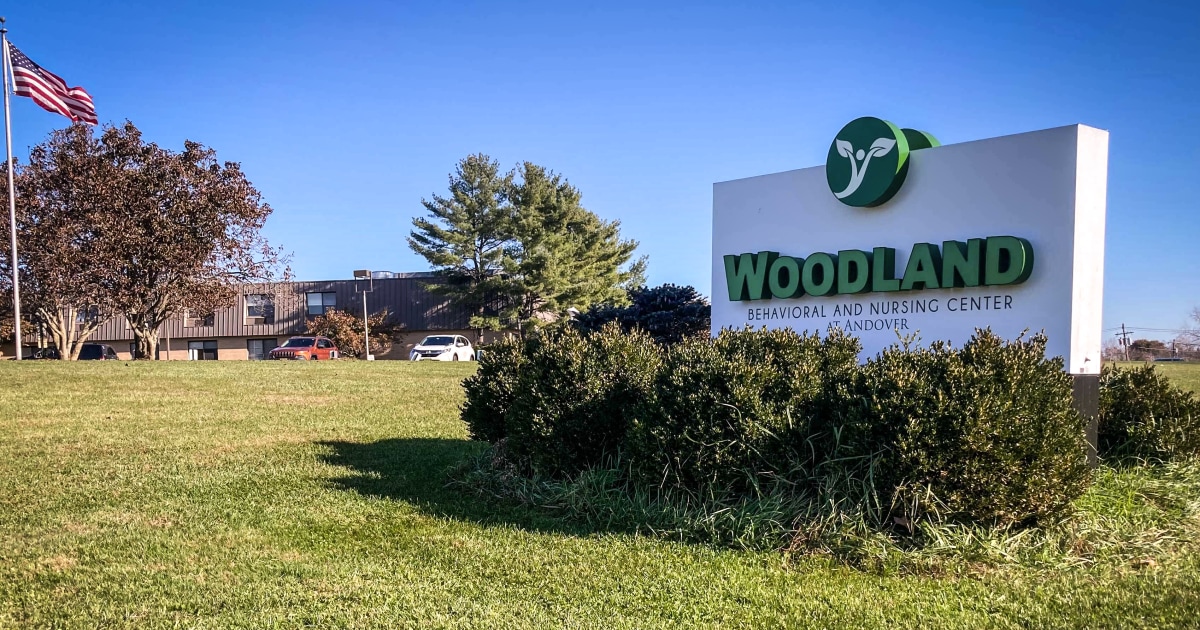
But the owners are still in business. They changed the names of Andover and its sister facility and installed new signs out front. As of Friday, there were 25 residents of Andover with Covid, according to state data.
And the owners are still being paid by Medicare and Medicaid, the taxpayer-funded programs that pay most costs for U.S. nursing home operators — even though one of the owners, Louis Schwartz, helped run a chain called Skyline Healthcare, which collapsed in 2019 amid accusations of neglect and financial mismanagement, which the chain denied.
Andover Subacute Facility I and II was renamed Woodland Behavioral and Nursing Center at Andover.NBC News
“The individuals that ran Skyline should not ever be in charge of a nursing home again, and yet here we are,” said David Grabowski, a professor of health care policy at Harvard Medical School. He said the pandemic exposed an industry already in crisis, with a lack of resources and regulation.
“Different names, same practices,” Grabowski said. “We need to ensure that there aren’t these kind of back doors, that nursing homes aren’t able to simply put a new name on the building and continue to operate as is.”
Some family members of those who died at Andover say they are frustrated, and some are suing over the facility’s alleged lack of preparation to deal with Covid and for mingling the infected and the healthy.
Farrell joined a lawsuit with other families but said: “I couldn’t care less about the class action. I want these guys out of business.”
Before Covid
At its peak, Skyline Healthcare had more than 100 facilities and oversaw the care of more than 7,000 elderly residents. But from 2017 to 2019, the chain began a slow-motion collapse, and more than a dozen Skyline-operated nursing homes shut their doors, throwing residents, vendors, employees and state regulators into chaos.
Many homes ran out of money. Others were shut down over neglect documented in government records. In one Arkansas nursing home regulators identified maggots in a resident’s catheter, according to an inspection. Fourteen homes were forced to close permanently, displacing more than 900 residents to new facilities, sometimes hours away.
Skyline’s main owner, Joseph Schwartz, and his son Louis did not return multiple messages and emails requesting comment in 2019. They have denied the allegations of neglect.
The Schwartz family has not left the nursing home business. While Skyline is defunct, Joseph Schwartz is still listed as the owner or a co-owner of four facilities, according to federal nursing home ownership data.
Louis Schwartz and Chaim Scheinbaum have ownership stakes in at least seven nursing homes between them, including the facility once known as Andover Subacute II.
In January 2020, New York health officials recommended against allowing Scheinbaum to take over a nursing home in upstate New York, citing an “ongoing investigation” and noting that they disapproved of his “character and competence,” according to a Health Department document. Scheinbaum did not respond when asked to comment about the recommendation.
A year before the Covid outbreak, a female Andover resident with dementia walked out of the facility through two broken doors and was found at 4:30 a.m. sitting in the snow with severe frostbite, according to a federal inspection. Terri Thompson, her daughter, sued the facility, alleging violations of the minimum standard of care. The lawsuit is pending, and the owners have denied the claims.
Dante Maglioli said that in early 2020, his father, Joseph, complained about the quality of care at Andover. The family was talking about moving him to another facility.
As Covid began to spread, Maglioli said, he heard his sister and his father talking on the phone. His father was saying he was not sure Andover could cope if he came down with the deadly new disease. And then, Maglioli said, “my sister never talked to my dad again.” Maglioli’s father died April 9, 2020.
Schwartz and Scheinbaum did not respond when asked to comment about the conditions at Andover before the pandemic.
When the pandemic arrived, nursing homes in New York and New Jersey, including Andover, took the early brunt. Eighty-three of the home’s 539 residents, or almost 1 out of every 6, died of Covid in the first four months of the pandemic. Farrell’s brother was among the casualties.
Health care officials prepare to load a patient into an ambulance at Andover Subacute and Rehab Center in Andover, N.J., on April 16, 2020.Stefan Jeremiah / Reuters file
Preston Nicolai, then a 20-year-old maintenance worker at the facility, said it was “horrific.”
“We were losing sometimes between 10 and 12 people a night,” he said.
Before the bodies began to pile up at Andover, Nicolai said, he was told to move residents from room to room, even though the facility did not know who had Covid and who did not. “I do believe it helped spread the cases of Covid throughout the building,” he said.
Nicolai said he was told to stack bodies on top of one another in a small room as the facility struggled to deal with the surge in deaths.
On Easter Sunday, April 12, Nicolai said, he went to work and found the body of a woman in an outdoor maintenance shed, next to shovels, rakes and a lawn mower. He said there was no more room for corpses inside the nursing home.
“I was so morally devastated,” he said. “It felt so wrong to put someone’s loved one out in the shed.”
He moved the body back inside the facility, but he cannot shake the images. “I have had really bad dreams, and I don’t have the money to pay a therapist,” he said.
‘They do not even know what they do not know’
Documents newly obtained through an open records request by NBC News show how the facility struggled to cope with the outbreak in April 2020.
Emails from Andover staff members to Sussex County officials document repeated requests for personal protective equipment, or PPE, like masks and gloves, some of which was delivered to the facility.
A summary of an inspection from the early morning hours of April 12 written by Kyle Wilson, a registered nurse, and addressed to the Andover Township chief of police describes in detail conditions inside the facility days before the first story broke about bodies stuffed into the tiny morgue. Wilson is employed part-time at the police department, according to a dispatch operator. He did not return a call seeking comment.
Wilson wrote that protective equipment delivered to the facility by the Sussex County Sheriff’s Office was unaccounted for. He said an Andover employee said the facility was “aware of a batch of PPE ‘donated by the Sheriff’s office’ but could not account for its whereabouts or the inventory of the facility’s existing PPE, if such an inventory exists.”
Wilson wrote, “Staff were observed to be touching their PPE (face shield, gown, mask) and their face with bare hands.” He wrote that he “confronted [the nurse on duty] about this observed behavior. She assured me that it was okay because she was ‘not in a room.'”
Wilson wrote that there was no Covid testing at the facility and that the staff had not segregated the patients suspected of having Covid. He wrote: “It is my opinion that the acquisition of PPE alone will not resolve the rate of spread at this facility. … [S]taff are undoubtedly contaminated throughout their shift. While the staff are tangibly scared, a culture of safety is not present in this facility. They have not been educated. They do not even know what they do not know.”
Two days later, a federal Department of Health and Human Services administrator working in Sussex County, Carol Novrit, emailed county officials to say Andover staff members had told her that residents were “not being fed,” that residents had “open wounds” and that the deaths of both residents and staff members were not being reported to public health officials. She wrote that the staff told her “there is no infection control now.”
Schwartz and Scheinbaum did not respond when asked to comment about the documents obtained by NBC News.
Federal inspection reports conducted in mid-April 2020 showed similar observations, noting that residents who had symptoms were intermingled with those who were asymptomatic.
‘Impossible to know’
Representatives for the owners said that at that time it was “often impossible to know who had Covid and who did not because of a lack of testing capability.”
In a statement, the owners of Andover, now known as Woodland Behavioral, said that “the safety and health of our residents has always been the top priority for Woodland Behavioral,” adding: “The COVID-19 pandemic brought unprecedented challenges, and our heroic staff faced those challenges as best as they could. We continue to thank them for everything they did (and continue to do) to protect our residents.”
Representatives for Scheinbaum and Schwartz said they asked for help from multiple government agencies, including two verbal requests to the National Guard on April 11 and April 15, but were told by military officials that they could not provide any assistance.
A spokesperson for the New Jersey National Guard disputed their assertion. “The National Guard does not have any information indicating that the Andover Subacute facility made a request for assistance, much less one that was turned down.” The spokesperson said that at the outset of Covid, the Guard “supported every single mission request we received.”
The National Guard did respond to a request for emergency aid that Sussex County officials sent to the governor on May 6. Two days later, 22 members of the Guard went to Andover and performed nonmedical tasks, like cleaning the facility.
The owners say problems identified in the federal inspections from spring 2020 have been resolved with state and federal regulators.
A spokesperson for an industry trade group, the American Health Care Association, said, “Even the best nursing homes with the most rigorous standards could not stop this highly contagious and invisible virus. Many lives were lost because long-term care was not made a priority by public health officials, especially in the initial months of the pandemic. Critical resources were directed toward hospitals, leaving long-term care facilities at a severe disadvantage.”
The investigation continues
Preston Nicolai said he was fired four months after the overstuffed morgue was discovered, accused of improperly disposing of medical waste.
He said he believes the owners were looking for an excuse to get rid of him after what he saw. He said he has not been contacted by the attorney general’s office. Sharon Farrell, however, was contacted this April.
Asked when the attorney general’s office would complete its investigation, a spokesperson said, “As is our standard practice, we will not provide updates on the investigation or release any additional information unless and until we bring an enforcement action or close the matter.”
The spokesperson said the Andover inquiry is part of a larger investigation of “facilities with high numbers of Covid-related deaths and below-average track records for health inspections, staffing, and quality of care.”
The class-action lawsuit filed by some relatives of the deceased, including Maglioli and Farrell, recently won a legal ruling allowing the lawsuit to stay in state instead of federal court, said the families’ attorney, Daniel Marchese. Marchese said that is good for the plaintiffs, who can plead their case before a local jury instead of being referred to a federal compensation program set up through the PREP Act, which shields businesses from some forms of liability after natural disasters like Covid.
Maglioli said: “I think that these gentlemen, their corporation, whatever it is, needs to pay the price. And I don’t mean in a financial way.”
When a pandemic is not likely to manifest on a frequent basis, but its prevalence is continue to feasible, and therefore we ought to have an crisis reserve of at the very least 3 months’ worthy of of fees.
The biggest danger a person can have in life is reduction of common earnings. The pandemic has showed us all the things, appropriate from people losing their work to full shutdown of businesses. We’re abruptly witnessing a new jolting period in which personnel are settling for substantial pay back cuts, even though small business properties from significant conglomerates to smaller enterprises are struggling with an unbelievable standstill.
Family personal savings, on the other hand, have witnessed a enormous uptick from the working day the state went into the quarantine mode. No matter whether you are a miser or a revenue burning equipment, the lockdown has prevented anyone from spending something further than the fundamentals. Everyone’s costs have appear down to rent, salaries, EMI and primary requirements. However this may possibly sound very good for folks who have managed to survive their business or keep on their careers but this would suggest blood bathtub for businesses which depend on consumer demand. If you assume the result of it will conclude there, then you have highly mistaken! It will at some point appear down to our work! As this will right have an affect on the means of these organization to pay salaries and create careers by growing, producing a adverse spiral.
With respect to investing, a ton of dollars eyes turned in direction of the inventory industry this yr as the market saw an astonishing V-shaped rocket restoration while the interest premiums made available by banking institutions stored going down. Homes with a surplus have saved their money in the lender to satisfy uncertainties, even though people with plenty of wealth to examine investment options made confident they took benefit of the market’s decrease.
When many individuals have a rigorous frame of mind to investing, the Covid-19-led disruptions may well serve as a wake-up contact for other folks to reinforce their finances.
4 techniques to preserve you all established for the following pandemic:
Improve Preserving share
I have an understanding of we all wish to dwell a flamboyant way of life, but a pandemic of this magnitude has forced us to preserve a bit additional than we use too. Although we at some point will restore all of the added expenditures we had prior to the epidemic these as holidays, browsing, get-togethers, and so on, it is essential to bear in mind that there’s no assurance that a disaster of this scale will not strike us once again. Consequently, devote but correctly.
Diversification
We observed it with our own eyes that in this pandemic, very little seemed protected, from a private lender seizing financial savings to fund properties closing down to the inventory industry collapsing, demonstrating that no economic merchandise is risk-free, it is just unique kinds of hazard. The epidemic served as a reminder that our dollars has no safe and sound harbor. The fact is that each financial commitment has some threat, and you have to decide which potential risks you are ready to acknowledge. The total of cash you place into just about every asset must be identified by the degree of risk you are willing to acknowledge, not by the present return it is making.
Unexpected emergency Fund
Though a pandemic is unlikely to arise on a standard basis, but its occurrence is continue to doable, and consequently we should have an unexpected emergency reserve of at minimum a few months’ well worth of fees. The key argument listed here is that what if we eliminate our work or our enterprise goes bankrupt? As a outcome, this emergency income will appear in helpful as you glimpse for a new employment.
By no means Stress in major corrections & make use of it
When investments turn into more unstable, investors may possibly be tempted to market as they may perhaps perceive matters could worsen. And, we have witnessed specifically that the marketplace at first fell like pinballs in the thirty day period of March 2020, Nifty50 fell from 12400 to 7700. But currently, in a span of much less than 18 months, it is touching an unbelievable substantial of 18000. Only investors with the needed risk-getting capability, both equally economically and emotionally, can deal with these volatility. In truth, just about every accountable and clever investor need to use these opportunity to spend if it can afford.
We may perhaps fail to remember about the Covid epidemic in a couple a long time. We may possibly refer to it with reduction relatively than concern. Even money lessons learnt may be forgotten, and we may go back again into prior behaviours. On the other hand, I’m positive a good deal of us could possibly alter our techniques when we bear in mind faces of the recognized individuals who confronted jobless and homeless nights since of the catastrophe. That is how crises function. It’s like accidents, it leaves a scar which hardly ever fades away! And the scar below is Dread!
Get stay Inventory Prices from BSE, NSE, US Sector and latest NAV, portfolio of Mutual Funds, Check out out newest IPO Information, Very best Doing IPOs, estimate your tax by Earnings Tax Calculator, know market’s Top rated Gainers, Top rated Losers & Most effective Equity Money. Like us on Facebook and stick to us on Twitter.
Nationwide Trends in Incapacity Employment (nTIDE) – issued semi-month to month by Kessler Basis and the College of New Hampshire
EAST HANOVER, N.J., Oct. 10, 2021 /PRNewswire-PRWeb/ — Position quantities improved for people today with disabilities, whose engagement with the labor sector surpassed their pre-COVID-19 pandemic degrees, according to present day National Developments in Incapacity Employment – Regular Update (nTIDE), issued by Kessler Basis and the University of New Hampshire’s Institute on Incapacity (UNH-IOD). Their gains distinction with these of folks devoid of disabilities, whose work figures have nevertheless to access pre-pandemic stages.
nTIDE COVID Update (thirty day period-to-month comparison) In the Bureau of Labor Statistics (BLS) Careers Report unveiled Friday, the labor drive participation rate for operating-age persons with disabilities elevated from 35.6 p.c in August 2021 to 36.4 percent in September 2021 (up 2.2 {1b90e59fe8a6c14b55fbbae1d9373c165823754d058ebf80beecafc6dee5063a} or .8 percentage points). For doing work-age individuals without the need of disabilities, the labor force participation amount decreased from 76.8 {1b90e59fe8a6c14b55fbbae1d9373c165823754d058ebf80beecafc6dee5063a} in August to 76.5 {1b90e59fe8a6c14b55fbbae1d9373c165823754d058ebf80beecafc6dee5063a} in September 2021 (down .4 p.c or .3 proportion details). The labor force participation level is the share of the population that is performing, not functioning and on momentary layoff, or not doing work and actively seeking for get the job done.
“People with disabilities show up to be recovering more quickly than people today without having disabilities. In truth, their labor market engagement is now surpassing their pre-Pandemic levels,” emphasized Andrew Houtenville, PhD, professor of economics and the exploration director of the University of New Hampshire’s Institute on Incapacity. “This is really very good news!”
The work-to-inhabitants ratio for performing-age men and women with disabilities elevated from 31.5 {1b90e59fe8a6c14b55fbbae1d9373c165823754d058ebf80beecafc6dee5063a} in August 2021 to 32.9 per cent in September 2021 (up 4.4 per cent or 1.4 proportion points). For operating-age persons without the need of disabilities, the work-to-populace ratio increased, albeit slightly, from 72.9 p.c in August 2021 to 73.1 per cent in September 2021 (up .3 per cent or .2 proportion factors). The employment-to-population ratio, a critical indicator, displays the proportion of persons who are performing relative to the complete population (the number of men and women working divided by the range of folks in the full population multiplied by 100).
“For the second consecutive month, we have witnessed enhancement in the work-to-inhabitants ratio for persons with disabilities,” stated John O’Neill, PhD, director of the Heart for Employment and Incapacity Study at Kessler Basis. “This vivid place exhibits ongoing resilience among the persons with disabilities in the labor marketplace,” he extra. “If the COVID Delta variant wanes and vaccination prices enhance, we may perhaps carry on to see improvement.”
Yr-to-Yr nTIDE Figures (comparison to the exact same time final year) The employment-to-population ratio for working-age folks with disabilities improved from 28.3 percent in September 2020 to 32.9 per cent in September 2021 (up 16.3 {1b90e59fe8a6c14b55fbbae1d9373c165823754d058ebf80beecafc6dee5063a} or 4.6 proportion details). For doing work-age individuals with no disabilities, the employment-to-inhabitants ratio also elevated from 70. {1b90e59fe8a6c14b55fbbae1d9373c165823754d058ebf80beecafc6dee5063a} in September 2020 to 73.1 percent in September 2021 (up 4.4 p.c or 3.1 proportion points).
The labor power participation level for doing the job-age persons with disabilities enhanced from 32.7 percent in September 2020 to 36.4 p.c in September 2021 (up 11.3 p.c or 3.7 percentage details). For operating-age people without having disabilities, the labor force participation price also elevated from 75.7 percent in September 2020 to 76.5 per cent in September 2021 (up 1.1 p.c or .8 proportion factors).
In September 2021, amid personnel ages 16-64, the 5,244,000 staff with disabilities represented 3.7 percent of the complete 143,536,000 employees in the U.S.
nTIDE COVID Update – Friday, Oct 22, 2021 at 12:00 pm Jap Keep tuned for our mid-thirty day period update about the employment of people today with disabilities as we abide by the impact of COVID-19 and seem at the numbers in more element.
Observe: The studies in the nTIDE are centered on Bureau of Labor Stats numbers but are not similar. They are personalized by UNH to combine the stats for guys and ladies of working age (16 to 64). nTIDE is funded, in element, by grants from the Nationwide Institute on Incapacity, Impartial Residing and Rehabilitation Investigation (NIDILRR) (90RT5037) and Kessler Foundation.
About Kessler Foundation Kessler Basis, a significant nonprofit firm in the subject of disability, is a world leader in rehabilitation investigate that seeks to improve cognition, mobility, and lengthy-phrase results — including work — for people with neurological disabilities triggered by diseases and injuries of the brain and spinal wire. Kessler Foundation qualified prospects the nation in funding impressive plans that broaden alternatives for employment for persons with disabilities. For additional details, take a look at KesslerFoundation.org.
About the Institute on Incapacity at the College of New Hampshire The Institute on Incapacity (IOD) at the College of New Hampshire (UNH) was founded in 1987 to present a coherent college-centered target for the enhancement of understanding, insurance policies, and practices associated to the life of individuals with disabilities and their family members. For information and facts on the NIDILRR-funded Work Policy and Measurement Rehabilitation Study and Coaching Middle, stop by ResearchOnDisability.org.
For additional info, or to job interview an professional, get hold of: Carolann Murphy, CMurphy@KesslerFoundation.org.





 Economical Express is now on Telegram.