

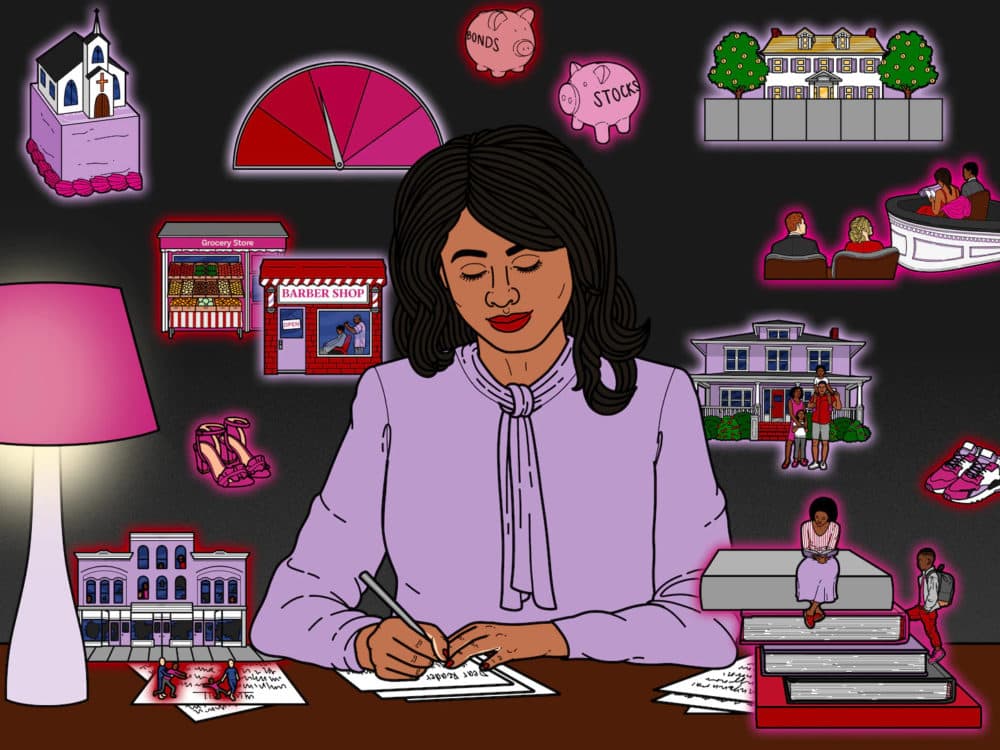
LISTEN: How personal finance columnist Michelle Singletary inspired one family’s debt journey.
Have a money question for Michelle Singletary? Call 1-855-ASK-POST (1-855-275-7678) with your personal finance questions.
Michelle Singletary loves to help people manage their money.
“This is what I was called to do,” she says. “I was born to give financial advice.”
And she’s been doing just that for 25 years, from the members of her Maryland church, to her nationally syndicated column in the Washington Post.
“I get e-mails from people almost every single day. White, Black, young, old, Democrat, Republican, it don’t matter. All in debt,” she says. “‘Michelle, how can I get out of debt? I’m so burdened with this debt.'”
Today, On Point: Michelle Singletary joins us with a quarter century’s worth of guidance and stories on how Americans manage their money.
Guest
Michelle Singletary, personal finance columnist for the Washington Post. Author of “The 21 Day Financial Fast.” Her column “The Color of Money” is syndicated in newspapers across the country. (@SingletaryM)
Teresa Ghilarducci, labor economist and expert in retirement security. Director of the Schwartz Center for Economic Policy Analysis at the New School for Social Research.
Also Featured
Trinita McCall, member of Michelle’s church who stopped being a ‘grocery-holic.’
Jennifer and Tyrone Harris, members of Michelle’s church who wound down over $200,000 in student loans in four years.
Linette Harris, member of Michelle’s church who went from 15 credit cards to one.
Transcript
MEGHNA CHAKRABARTI: This is On Point, I’m Meghna Chakrabarti. And Michelle Singletary is back with us. Hi, Michelle.
MICHELLE SINGLETARY: Hi. Hello.
CHAKRABARTI: 25 years, did I blink? And suddenly it was 25 years of you writing your column?
SINGLETARY: I know, I know. I like to joke. I started at the Post when I was 10 because I know people are doing the math like, Wait a minute.
CHAKRABARTI: 10. Five, you mean?
SINGLETARY: Yes, that’s even better.
CHAKRABARTI: OK, so for the few people out there who don’t know who you are, this is Michelle Singletary, one of our absolute favorite guests of all time. She’s come on the show quite often. She is the nationally syndicated columnist at the Washington Post. Her column, The Color of Money, is celebrating its 25th anniversary this year. … So we’re going to talk about all the lessons that you’ve learned over these 25 years. So first of all, let me ask you though, like, do you think your core beliefs about money and personal finance, have they shifted at all in a quarter century of listening and helping other people?
SINGLETARY: No, not at all. Not at all. You know, a lot of the basic information I know about money I gained from my grandmother, Big Mama, who raised me. And she just had basic stuff that kept her going and kept her solvent. And just the best money manager I’ve ever known. And it’s, you know, live below your means. Every dollar that you get, you save a little piece of it. You know, hate debt like it was a person and you wanted to just slap it, you know?
You know, give back to your community. … And you know, when you’re investing, investing should be boring. I know everybody is out there, you know, wanting to do speculation and and make money really quick. But just, you know, saving and over time, you’ll get there. And so the basics are the same no matter when you get into this money game.
CHAKRABARTI: And apparently, according to your column, she was nothing if not consistent, right? Tell us a story about what she told you every time you got on the phone with her.
SINGLETARY: Oh my gosh. So I graduated from college, University of Maryland College Park. And my grandmother said, You need to come live with me, save your money for a year or years. And I said, Sure, absolutely. Love my grandmother, lived for her for a year, but she has some things that kind of like bothered me a little bit. Like I didn’t have to be to work until 10 in the morning. She would get me up at 6:00 a.m. so that I wouldn’t be late, and my job was 10 minutes from where I live. So I thought, You know what? I need to be on my own.
So I went out and got an apartment without her knowing it. And when I told her she was livid. Because she said, You know, why are you giving your money to the white man? And you have to understand the generation that my grandmother came from, and her grandparents were enslaved individuals and she believed in homeownership. And so I rented for just one year, and I am not exaggerating, folks every single time I called my grandmother, every single time for a year, the first thing she would say to me was, You still giving your money to the white man?
And at the end of the year, she said, You have two choices. You can come back and live with me or you can buy some property. And folks, I bought a two bedroom, one bath condo, so I wouldn’t have to get up at 6:00 a.m. in the morning. Or take the shoes from underneath my bed because my grandmother says, if you keep shoes underneath your bed, if you get a man, he’s going to run out of your life. And I’m thinking, I don’t have a man. I’m just going to get a condo.
CHAKRABARTI: Well, listen, you actually said something that leads me to a question I wanted to ask you for quite some time. Because you know, the consistent things about finance that you just laid out that haven’t changed in those 25 years, like not wanting debt or looking at debt as the devil, in fact, is kind of core to that.
And I really want to know about how much that comes from the history that Black Americans have lived in this country. Because, you know, I do wonder in the Black community and especially the Black community that you grew up in, Michelle, this sense that to have anything in your life that would impede on your liberty, which debt does, it can do that, would be anathema. Tell me, am I sort of connecting legitimate dots?
SINGLETARY: You are connecting the dots. Exactly right, my grandmother, you know, she came through the Great Depression. And then the Red Summer, when many prosperous African American communities were burned to the ground because they were doing so well. And so she was so fearful of having anything that would obligate you to white establishment. And so absolutely, I mean, with no debt, you have more choices.
Even if she lost her job, which is, you know, when she was coming up, it was a real threat when you were Black. If you didn’t have loans, if you paid off your house early, you could make it until you got that next job. And so for her, she’s like, don’t have those chains of debt. And recognizing, you know, my grandmother borrowed to buy a car, she borrowed to buy her house, but she would make extra payments so that she could get out of that debt as soon as possible and free herself from that obligation.
So that is something that happened to her because of discrimination, because of Red Lining, because all the things that happen, she would be able to make it to the next paycheck or the next job. And that’s what she instilled in me. And I tell you, I’ve been at the Post 30 years total, 25 for the column. And I still think, Oh, they’re going to fire me. And of course, they’re not right, you know? But I just, you know, I had that fear still. And so I try to do a great job. I try to keep my debts down. I try to save, so that if anything ever happened, I could live till I got to that next job.
CHAKRABARTI: So I really appreciate you sharing that with us because you are so passionate about debt that you even preach about it in church, right?
SINGLETARY: I do. I do. I do. I belong to First Baptist Church of Glenarden in Prince George’s County in Maryland. And it’s a huge church. We have a financial ministry that I run. We have financial classes. And so we’re always talking about freeing yourself from debt, particularly high interest credit card debt. And so my pastor asked me to to teach a couple, you know, one Sunday, you know, we had four services at a time. So I taught, you know, four services about, you know, the dangers of debt.
And we did a little experiment one time in church and we asked, it was only like maybe about 1,500 or 1,600 people for Bible study, and we asked everybody to write down how much debt they had, not including their mortgage. And it was astounding in that group. It was millions and millions of consumers and consumer debt, and that was just really eye opening for me. And one of the reasons why I have this yearlong ministry at my church to help people free themselves, so that they can then use that money to save for retirement, or send their kids to college debt free or help relatives. Like right now, we’ve got the pandemic. Free money in your budget so that you can help other people in your life.
CHAKRABARTI: Well, so we have a little bit of you preaching your personal finance ministry at your church. So here is Michelle Singletary talking about mortgages and car loans.
SINGLETARY [Archival Tape]: I don’t want you to think that I say, don’t get a mortgage, that’s not what I’m saying, because most of us can’t afford to get our home without a mortgage. And I’m not even saying, don’t get a car loan, although you do know that you can pay cash for your car, do you not know that? They will take cash. They will. Because we shouldn’t be getting loans for cars. You can save up for your car. I see y’all not getting me on this. But you can.
Because here’s a trick my grandmother told me. When you get a car loan, you only get one. Then after you get that one, when you pay that one off, you take the payments that you weren’t paying on it, you pay it to yourself. So then when you need a car, add another 10 or 12 years or 15 years, which is how long my husband and I keep a car, then you’ll have the money for a car.
CHAKRABARTI: Michelle, did they get you after a while?
SINGLETARY: … Quite a few people did. And in fact, after one service, a woman came up to me. I’ll never forget this. My pastor does financial messages all the time. And he was pointing me out in the congregation as she ran up to me. She says, I just was at the dealership over the weekend and signed up to get a car for $40,000. Because she went in to get car repairs. And they said, Oh, don’t fix this car, get a new car.
But she could not afford that payment. And so I said, take that car back. She was in the window at which you could take it back. I said, Take it back. I gave her the name of my mechanic. And you know what, the amount of repairs was not nearly as not as much as the dealer had told her, and she took that $40,000 car back and fixed the car that she had. And it really helped her stay on point with her finances.
CHAKRABARTI: Well, you know, it’s funny. Cars, they’re really particular American thing when it comes to like what they mean to people too. But in my life, I was really lucky with my parents and their approach to personal finance. I mean, I think they like they inadvertently or they spiritually went to the Big Mama’s School of Savings and Personal Finance Practice. Because like, as I grew up, we only ever had used cars. And like some of them, were very, very, very used. Like my dad used to have this giant Chevrolet that you could hear coming from about a quarter mile away.
And I remember when he was like, it wasn’t until he was like in his mid to late fifties. There was one day we were sitting was having a picnic and he turned to me and he, like, almost whispered. He was like, Daughter, I have something shameful to admit to you. And I was like, Oh my god, are you okay? Like, what’s going on? And he goes, I have the urge to buy a new car. It was like a major moment in my family’s life. Because he was just so, he still couldn’t quite figure out why he wanted a new car when used cars were just fine.
CHAKRABARTI: That’s right. And you know, here’s the thing which I love about your story because you can, you know when you’re starting out and you’re trying to build your wealth, you know, you buy a used car. Because when you buy a new car, the moment you buy it, it depreciates. In the first year, you went from 20{1b90e59fe8a6c14b55fbbae1d9373c165823754d058ebf80beecafc6dee5063a} to 30{1b90e59fe8a6c14b55fbbae1d9373c165823754d058ebf80beecafc6dee5063a}, depending on the type of car. And so for most of my life, we had used cars. But then you get to a point where you are well established financially and you can buy that new car and it’s OK.
CHAKRABARTI: And he did what you recommended. He saved up and paid for it in cash, so.
SINGLETARY: That’s right.
CHAKRABARTI: Michelle Singletary is with us today. 25 years of her personal finance column, The Color of Money in The Washington Post its quarter century anniversary this year.
Related Reading
Washington Post: “What I’ve learned from writing a personal finance column for 25 years” — “I learned how to handle my money from my grandmother Big Mama.”