The excess and surplus lines insurance market has an opportunity to increase diversity in the industry, executives said during a panel discussion Thursday at the Wholesale Specialty Insurance Association’s Annual Marketplace in San Diego.
The industry needs to be diligent and understand that a diverse workforce is going to bring more diversity of thought, said Carlton Maner, CEO and global property practice leader, U.S. division, for Axis Capital Holdings Ltd. in Atlanta.
Diversity and inclusion efforts increase productivity, and “profits at companies with a diverse background and diverse staff are much better than companies that lack diversity,” he said.
Mr. Maner is chair of the WSIA Diversity Foundation’s board of directors. WSIA established the foundation in 2020 to promote and attract diversity in race, gender, sexual orientation and disability and to influence progress in the diversity of the wholesale, specialty and surplus lines insurance industry.
Working in a diverse environment is both challenging and rewarding, said Cristi Carrington, Seattle-based principal, director of underwriting, at Brown & Riding Insurance Services Inc.
“It’s a challenge because when you’re workshopping a problem or doing a think tank, not everyone works like you,” Ms. Carrington said.
Everyone has their own biases in how they approach a problem, she said. “But to sit there and listen and have empathy for someone else, their background, life or their approach, is rewarding,” she said.
To drive diversity, equity and inclusion within organizations executives need to slow down, said Erin Dolan, senior vice president, analytics and communications, at RSUI Group Inc. in Atlanta.
“We talk about the unintentional bias that comes into all the decisions that we make, and I think that is going to be most prevalent when we’re going fast,” Ms. Dolan said.
“You were hired to go fast, to make decisions fast, so it’s important to slow down and be very intentional about what we do,” she said. Reaching out to people you wouldn’t normally reach out to for recruiting or ideas around a topic, is also critical, she said.
There is an opportunity to educate oneself and others when it comes to understanding the benefits of having a diverse workforce, said Bryan Clark, Los Angeles-based president of Gorst & Compass Insurance.
“We are not changing, we are evolving as a society, and we need to look at the world differently. … A lot of people still don’t get it and we’re here as leaders to show them it’s a big world out there full of amazingly talented people,” Mr. Clark said.
Increasing diversity in the industry will bring more talent to the industry, he said.
There is an internal pool of talent to be tapped to increase diversity within insurance organizations, Mr. Maner said.
“When we started our training program at Axis years ago, I said one-third of our trainees (should) come from college, one-third were people with more experience but not in the insurance industry, and one-third were from promotions from within. That has worked well for us,” he said.
The WSIA Diversity Foundation has started a speakers bureau with a goal of 18 campus visits to historically Black colleges and universities this academic year at which WSIA members will speak about their careers in the industry.
It will also focus on non-HBCUs with diverse student populations to increase the talent pipeline.
“We want to bring awareness to schools about our industry,” Mr. Maner said.
The panel was moderated by Adam Care, Austin-based business segment leader, vice president of CAD IoT, at Hartford Steam Boiler Inspection and Insurance Co.
Good leaders should create and maintain a positive and diverse workplace. Please see the tips below for more help avoiding a toxic work environment and creating an inclusive one.
BRUSSELS (AP) — Tens of thousands of people demonstrated through central Brussels on Sunday to protest reinforced COVID-19 restrictions imposed by the Belgian government to counter the latest spike in coronavirus cases.
Many among the police estimate of 35,000 at the rally had already left for home when the demonstration descended into violence as several hundred people started pelting police, smashing cars and setting garbage bins ablaze. Police, responded with tear gas and water cannons and sought to restore order as dusk settled on the Belgian capital.
Three police officials and one demonstrator were injured in the clashes. In addition, 42 protesters were detained and two were arrested and charged in the violent spree that followed the march, said police spokesperson Ilse Vande Keere.
The marchers came to protest the government’s strong advice to get vaccinated and any possible moves to impose mandatory shots.
Political Cartoons on World Leaders
Political Cartoons
Shouting “Freedom! Freedom! Freedom!” and singing the anti-fascist song “Bella Ciao,” protesters lined up behind a huge banner saying “Together for Freedom” and marched to the European Union headquarters. Amid the crowd, the signs varied from far-right insignia to the rainbow flags of the LGBT community.
The World Health Organization said last week that Europe was the hot spot of the pandemic right now, the only region in which COVID-19 deaths were rising. The autumn surge of infections is overwhelming hospitals in many Central and Eastern European nations, including Ukraine, Russia, Romania, the Czech Republic and Slovakia.
Over the past several days, there have been many anti-vaccination marches in European nations as one government after another tightened measures. Dutch police arrested more than 30 people during unrest in The Hague and other towns in the Netherlands on Saturday, following much worse violence the previous night.
Austria is going into a 10-day national lockdown on Monday for everyone after first imposing a lockdown on the unvaccinated. Christmas markets in Vienna were packed Sunday with locals and tourists taking in the holiday sights before shops and food stalls are forced to close.
Follow AP coverage of the pandemic at https://apnews.com/hub/coronavirus-pandemic
Copyright 2021 The Associated Press. All rights reserved. This material may not be published, broadcast, rewritten or redistributed.
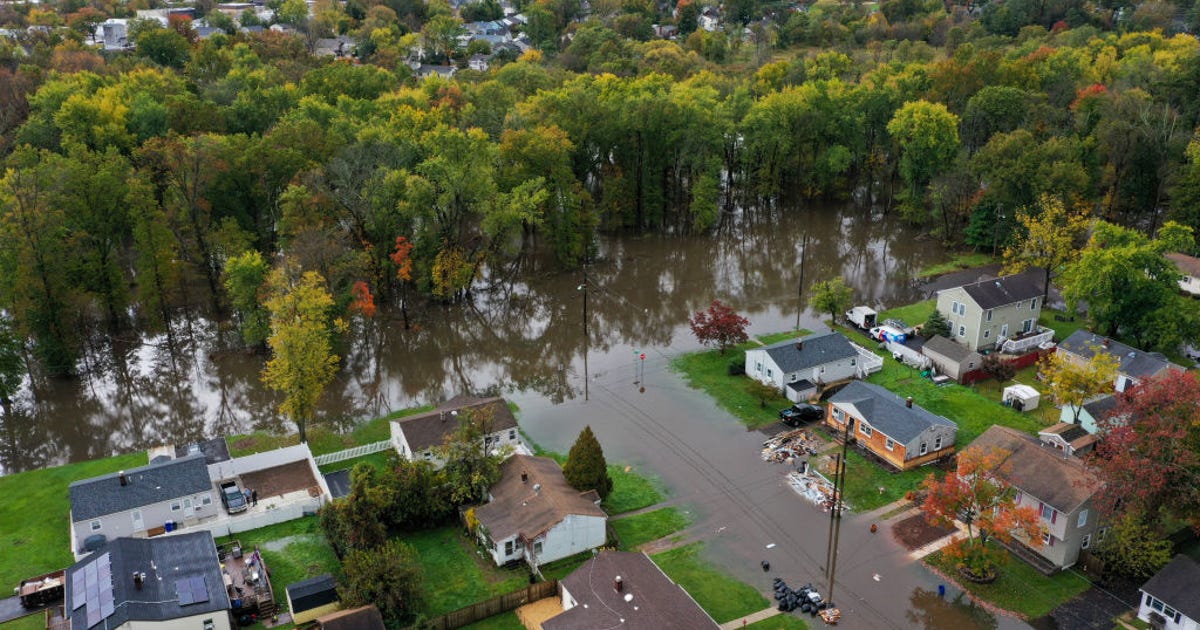
Neighborhood flooding can lead to mass evacuation, leaving your personal finances vulnerable.
Getty Images
This story is part of The Cost of Climate Change, CNET’s coverage of how the changing climate impacts a range of financial issues.
Evacuations are increasingly common as climate change leads to more severe weather events. Because storms, flooding and wildfires can devastate an area suddenly, it’s vital to have your finances, important documents and property prepped in case you need to get out quickly. Successful personal finance hygiene requires protecting what you’ve built for yourself from life’s uncertainties.
Of course, we hope you and your family never face an evacuation, and we know it can be grim to think about. But applying a little effort ahead of time can help in a potentially bad situation.
Make sure you have access to cash
Your top priority should be access to liquidity. Keep some cash stashed away somewhere safe in your home. A severe weather event has the potential to knock out the power and render ATMs and credit-card processors useless. Meanwhile, you might need to pay for gas, food, water, a hotel room or other incidental expenses during an evacuation. Keep enough cash on hand to at least get you out into safety. Once you are out of the affected area, you can use your debit card or emergency credit card to pay for basic necessities.
Keep all your receipts for living expenses while you’re unable to return to your home. Though you may have to front some costs, FEMA offers various forms of financial relief for climate disaster evacuees, like temporary housing, among other things. Other organizations may be able to help with costs not covered by FEMA.
What should you bring with you in an evacuation?
While you can back up important documents to a cloud-based service, it’s quite possible that you may be limited by cell service and internet outages. As such, it’s a good idea to keep physical copies of key documents and other important information you may need to access.
In the event of an evacuation order, there will be very little time to do any packing, so it’s crucial to have your paperwork collected before you’re impacted by a severe weather event. Some documents to gather include:
Driver’s licenses and applicable change-of-address addendums
Passports
Social security cards
Birth certificates
Credit and debit cards
Mortgage account information or lease
Utility/recurring bill account information
Medical information and proof of vaccinations
Tax information
Insurance policy information
Deed to car(s) and house
List of phone numbers (family, work, lenders, service providers)
Wills and other legal documents
Make sure you collect these documents for the whole family, including for your partner, parents, siblings and children. And don’t forget the paperwork for your pets. During an evacuation, it’s common to use boarding facilities for your pet, and they often require proof of vaccinations.
It may be possible to take small valuables with you in an evacuation if you’re prepared. Have a to-go bag with your paperwork and a list of valuables so you can collect them quickly. Consider including a solar-powered phone charger and anything you would need to live for a few days or weeks, such as medications. Being prepared will help ensure you don’t miss anything important.
To complement your insurance protection, maintain an inventory of the items in each room of your home. This will help keep track of items for insurance purposes in case they’re damaged or stolen. Check out our guide to documenting your possessions for emergency preparation for more details.
How to protect your home
Stay on top of your homeowners insurance policy. Regularly review your coverage and make sure there are no lapses. Typical homeowners policies will cover damage from hurricanes, tornadoes, hail, wind, lightning and volcanoes. Note that flood, earthquake and mudslide damage is typically not covered in a traditional policy. If your home is in a FEMA-designated Special Flood Hazard Area, or SFHA, then you’re required to maintain flood insurance. But you might consider it in any case.
“Roughly 40{1b90e59fe8a6c14b55fbbae1d9373c165823754d058ebf80beecafc6dee5063a} of properties suffering flood losses are not in SFHAs, and as homeowner policies don’t typically cover flood events, many incur significant financial loss year after year,” said Steve Murchison, vice president of MassiveCert, a flood certification company based in Florida.
He added that flood maps are based on local hydrology studies, which have not historically accounted for climate change: “It’s a multiyear process from the time a community embarks on a new hydrology study to new FIRMs [flood insurance rate maps] becoming effective. By the time a new map is published, it’s often already ‘out of date.’ Not to say that new maps aren’t better than old ones, but flood risk for many communities is changing faster than the mapping and approval process can keep up.”
Consider your local risk factors and keep an eye on drainage problems and any issues that start to crop up during heavy rains around your home and neighborhood. Stay alert to pivot to flood coverage if you suspect your home may be getting vulnerable to severe weather events as they become more prevalent.
How to protect your car
If you have a car, you may use it to evacuate. If you have advance notice of an upcoming severe weather event, it’s a good idea to fuel up or charge your car ahead of time.
Consider the routes you would take in an emergency evacuation. You want to stay safe, but you also want to prevent expensive and unnecessary damage to your vehicle. Discern areas that may be prone to flooding, mudslides or downed trees, and plan viable alternative routes in case some roads get blocked. You don’t want to drive through a puddle that’s deeper than it looks. It may also prove worthwhile to keep some hard copies of maps in your car.
You’ll typically need a comprehensive car insurance policy to get covered for flood, storm or wildfire damage — basic collision and liability won’t cut it.
Danielle Marchelle, a licensed insurance agent and spokeswoman for the insurance company The Zebra, pointed out the importance of timely preparation: “With both home and car insurance, be sure you’re covered well in advance of a storm. Disaster coverage typically doesn’t take effect for 30 days, and as inclement weather approaches, several insurance companies enact ‘binding restrictions’ making getting coverage impossible until after the storm.”
How to handle your job
Write down any phone numbers and email addresses for people you interact with on a regular basis in your job and keep it with your other important documents. If you use a work computer or have any other essential work item, take it with you when you evacuate, since you don’t know how long it could be until you return home.
If you evacuate, contact your boss and let them know what’s happening as soon as it’s safe to do so. Together you’ll figure out the best plan of action moving forward. Likewise, contact any clients or teammates who rely on you to maintain your business connections.
Post-disaster scams and relief
Another harsh reality of climate disasters is that they come with their fair share of scammers. If you familiarize yourself with the traits of some common relief scams, you can better recognize nefarious activity post-evacuation when your focus is likely compromised.
The Consumer Financial Protection Bureau advises that disaster survivors watch out for certain suspect behaviors when accepting help after a severe weather event. One red flag includes organizations with names that are similar to official government entities. Also look out for anyone trying to sell an after-the-fact insurance policy or anyone charging upfront fees for disaster relief or loans. The bureau also recommends not accepting help from contractors offering services door to door, especially if they demand immediate payment or offer discounts.
After you’ve evacuated, contact your mortgage lender or landlord, utility providers and other service providers. Oftentimes they’ll be able to offer some sort of assistance in the wake of a disaster. Along with FEMA, charitable organizations will likely be available to offer help. Take advantage of the resources at your disposal.
Just over a week after some 200 nations struck an agreement aimed at intensifying global efforts to fight climate change, the finance minister of France has warned that the cost of the energy transition will be “much higher than expected.”
By ISABEL DEBRE Associated Press
November 21, 2021, 6:08 PM
• 3 min read
ABU DHABI, United Arab Emirates — Just over a week after some 200 nations struck an agreement aimed at intensifying global efforts to fight climate change, the finance minister of France warned on Sunday that the cost of the energy transition will be “much higher than expected.”
“We should never underestimate the price of the climate transition,” Bruno Le Maire told reporters in Abu Dhabi, the oil-rich capital of the United Arab Emirates.
Reveling in France’s strong economic rebound from the devastation of the pandemic, Le Maire was in the Gulf Arab sheikhdom to discuss joint investments in a wide range of fields, from port infrastructure to hydrogen fuel and renewable energy.
The UAE has publicly pledged to have net zero carbon emissions by 2050, among a list of countries that made the long-range, still-vague commitment before the climate summit in Glasgow opened earlier this month. Even as the country with the region’s first nuclear power plant tries to position itself as a leader on environmental issues, the hydrocarbon-rich UAE’s economy feeds on petrodollars.
Le Maire noted the challenges facing industrialized economies if they shift away from the cheap fuel pumped out of the Persian Gulf toward renewable energy sources.
“We don’t want the people with the lowest income to pay for the climate transition,” he said, acknowledging lessons learned from the carbon tax aimed at encouraging alternative energy use that sparked France’s mass so-called Yellow Vest protest movement in 2018.
To help bridge the energy transition, Le Maire stressed the need to fund new energy technologies, adding that France’s “faster cooperation” with the UAE in the field “is of the highest value.”
The UAE and France have become increasingly aligned in recent years, sharing a mistrust of political Islam across the Middle East. Major French aviation and defense companies have powered growth in the emirates, home to over 30,000 French citizens. Le Maire on Sunday toured Abu Dhabi’s outpost of the Louvre, which draws visitors to artifacts on loan from the Paris museum.
Le Maire, a close partner of President Emmanuel Macron who’s now gearing up for a re-election campaign, touted France’s mass vaccinations that he said fueled the economy’s expected 6.25{1b90e59fe8a6c14b55fbbae1d9373c165823754d058ebf80beecafc6dee5063a} growth rate for the year.
“We are not in the position of other European countries,” he said, as Austria lurches into lockdown to stem its worst wave of coronavirus infections.
“(Lockdowns) have a very negative impact on the economy and that’s the exactly the kind of situation we want to avoid.”
CINCINNATI, Nov. 20, 2021 /PRNewswire-PRWeb/ — Coterie Insurance recently announced a new partnership with B2Z Insurance—a small business insurance company offering an experience-led and human-centric platform—to introduce their one-stop-shop aimed at simplifying the small business liability insurance experience. Now, small business owners can directly access Coterie Insurance products on the B2Z platform, further expanding simplified digital insurance offerings to small businesses.
“B2Z and Coterie share the vision of providing a seamless small business liability insurance experience for small businesses, with digital options available at the user’s convenience,” said Ashleigh Burden, Account Director at Coterie Insurance. “Unlike traditional insurance companies, both Coterie and B2Z are committed to turning the insurance process on its head with a focus on what’s best for the small businesses of today.”
Coterie Insurance integrates with B2Z to provide tailored small business liability insurance coverage for small businesses. Small businesses can access Coterie’s general liability and business owners policies on the B2Z platform as well as all optional coverages.
“B2Z is very excited to partner with Coterie. Their business insurance expertise is an important part of our growth strategy and ultimately helps us reach more small businesses in need of coverage,” said B2Z Insurance Chief Growth Officer and founder James Norris.
“With the increase in new business applications and office reopenings, matching business owners with the right insurance coverage has skyrocketed in importance. This partnership combines Coterie’s exceptional coverage with B2Z’s best-in-class customer experience—to the benefit of small business owners,” said Norris.
For more information on Coterie and the digital transformation of small business insurance, go to http://www.coterieinsurance.com.
About Coterie Insurance
Coterie Insurance is on a mission to make business insurance easy. Through tech-based business insurance solutions, Coterie Insurance delivers simpler coverage, more accurate pricing, and a streamlined experience. By enabling the instant quoting and issuing of policies as well as a 100{1b90e59fe8a6c14b55fbbae1d9373c165823754d058ebf80beecafc6dee5063a} digital underwriting process, agents and brokers can simplify and digitize their operations to better serve small businesses. Digital insurance platforms are able to leverage Coterie’s simple, easy to integrate APIs, to further streamline the quoting and binding experience. Coterie’s expansive appetite is the most inclusive for the small businesses of today.
About B2Z Insurance
B2Z is a small business insurance company that provides coverage for on-the-go business owners: simple explanations, digital purchasing, and mobile claims. A product that is easy-to-use and helps you assess the unique coverage needs of your business with confidence—freeing you up to grow your business. You know your business, but we know how to protect it. Whether you work in retail, real estate or some other market, B2Z has the coverage you need to protect your employees and your business. For more information on B2Z Insurance, or to get a quote for your small business, visit https://www.b2z-insurance.com.
Media Contact
Stephanie N. Blahut, CMO, B2Z Insurance, +1 800-330-1750, marketing@b2z-insurance.com
There is a story developing in the labor market, which has marked a significant shift in who is participating amid the ongoing pandemic.
Among the many stories are resignations, for various reasons, and the struggle to fill more labor-intensive jobs. It has resulted in an unprecedented demand for more highly-skilled, remote jobs, and those willing to work in lower-wage jobs are being paid significantly more than those who previously held the positions.
ZipRecruiter chief economist Julia Pollak told Yahoo Finance that low wage workers are in a stronger position than ever before to demand higher wages.
At the start of the pandemic, 80{1b90e59fe8a6c14b55fbbae1d9373c165823754d058ebf80beecafc6dee5063a} of the jobs that were lost were from the lowest quarter of income distribution. As a result, those who now work in those jobs are earning more.
“Wage growth is actually fastest for workers at the bottom. And some groups of workers that typically really struggle, like teenagers, especially Black male teenagers, actually have lower unemployment rates than they have historically, typically. So, very puzzling, unusual situation,” Pollak said.
But a disparity still exists. The unemployment rate now is 4.0{1b90e59fe8a6c14b55fbbae1d9373c165823754d058ebf80beecafc6dee5063a} for whites and 7.9{1b90e59fe8a6c14b55fbbae1d9373c165823754d058ebf80beecafc6dee5063a} for Blacks, according to Pollak.
So what does that mean for the future? Jain Family Institute Senior Fellow Claudia Sahm told Yahoo Finance said it remains to be seen, as more and more statistics and data are coming in.
“We really, really have to look under the hood, understand different peoples’ experiences,” Sahm said.
She noted that in the story of a shifting labor market, there is a clear disparity in where jobs are and where people are going — but there’s more to the story.
“I’ve been very critical of the ‘Great Resignation’ story, in the sense of the pandemic has had people step back and rethink their lives, and now they’re going to work less, or pursue some other passion. The reality is, the ‘rethinking our lives,’ is a privilege and something that professional workers, higher income workers, are able to do. And that is, frankly, not a choice that most American workers can have,” Sahm said.
For those who can seek remote work or better paying skilled jobs, the available jobs don’t match the supply, according to Pollak.
“It is a numbers game. There are certainly areas where there are huge labor shortages, and employers are struggling to find candidates. But there are many other roles … remote jobs, where there are 50, 60, 70,100 applications per posting,” she said.
In fact, 55{1b90e59fe8a6c14b55fbbae1d9373c165823754d058ebf80beecafc6dee5063a} of job seekers surveyed on ZipRecruiter in November said they would prefer to find a remote job, Pollak said. And a majority of those were women — but for jobs in male-dominated fields like tech.
Whether or not some who left the market return, especially for lower-wage jobs, remains to be seen.