
What Happens if I Buy Amazon Before the Stock Split? | Personal Finance

What Happens if I Buy Amazon Before the Stock Split? | Personal Finance

Amazon‘s (NASDAQ: AMZN) much-anticipated stock split may finally take place this year. On Wednesday, March 9, the tech giant filed a Form 8-K with the Securities and Exchange Commission (SEC) and the stock price soared. Amazon notified investors about plans for a 20-for-1 stock split — the first in over two decades. If you own shares of Amazon, you’ll be the recipient of 19 extra shares for every one share in your account after the stock split.

Here are a few things to consider before you dive in.

Image source: Getty Images.

What you should know about Amazon’s stock split

Amazon’s board of directors approved a 20-for-1 stock split that’s slated to take place on June 3. However, nothing is set in stone until shareholders give Amazon the green light at the company’s annual meeting on May 25.

If all goes as planned, shareholders on record as of May 27 will be granted 19 additional shares for every one share they own. That means if you have two shares of Amazon in your account now, you’ll have 40 shares after the split.

People are also reading…

Receiving additional shares in your account may sound like a sweet deal if you’ve been eyeing Amazon’s stock for a while. But a stock split in itself won’t make your wallet fatter. It just allows more people to gain access to a full share of Amazon stock at a cheaper price. You can think of it like exchanging a $20 bill for 20 singles. That transaction didn’t make you richer; you just walked away with the same amount of money cut up in bite-sized pieces.

Is now a good time to buy Amazon’s stock?

A stock split shouldn’t be the only reason you buy a stock. Although Apple and Tesla‘s stock performed well after their stock splits in 2020, you can’t always count on extreme growth with every stock. You need to focus on the underlying business to determine the company’s future potential.

Before you gobble up shares of Amazon, here are some questions that will help you determine if the company deserves a spot in your portfolio:

  • What is the company’s competitive advantage?
  • Do you notice trends in earnings growth?
  • How effective is the executive team?
  • How has this company performed during downturns?
  • Does this company have the potential to be around in the next 10 years?

You can use this information to develop your investment thesis. If you have a change of heart about Amazon’s stock after the split, you can return to your investment thesis to remind yourself why you believe this company could deliver profitable results over the long term.

You want to buy shares of Amazon. Now what?

If you decide to pull the trigger and add Amazon to your portfolio, you should think about which account you want to buy it in. You can take advantage of tax-advantaged retirement accounts or brokerage accounts.

Let’s say you decide to buy shares of Amazon in your Roth IRA (individual retirement account). If you buy two whole shares for $3,000, you’ll have 40 shares of Amazon in your account after the stock split. You can sell some of the shares without having to worry about taxes. You won’t be penalized unless you withdraw your gains in your Roth IRA before you turn 59 1/2, unless you qualify for an exception.

But if you buy Amazon in a taxable brokerage account, you could be on the hook for higher tax rates if you sell too soon. Anytime you sell investments that you’ve held for a year or less, you’ll pay the same tax rates that you pay on your earned income you receive at work. You can fix that problem by holding your investments over a year and taking advantage of long-term capital gains rates. Those rates can be 0{1b90e59fe8a6c14b55fbbae1d9373c165823754d058ebf80beecafc6dee5063a}, 15{1b90e59fe8a6c14b55fbbae1d9373c165823754d058ebf80beecafc6dee5063a}, or 20{1b90e59fe8a6c14b55fbbae1d9373c165823754d058ebf80beecafc6dee5063a} for the average investor. Below are the 2022 capital gains tax rates based on your taxable income.

Single Filer Taxable Income

Married Joint Filers Taxable Income

Head of Household Taxable Income

Long-Term Capital Gains Rate

$0 to $41,675

$0 to $83,350

$0 to $55,800

0{1b90e59fe8a6c14b55fbbae1d9373c165823754d058ebf80beecafc6dee5063a}

$41,676 to $459,750

$83,351 to $517,200

$55,801 to $488,500

15{1b90e59fe8a6c14b55fbbae1d9373c165823754d058ebf80beecafc6dee5063a}

Over $459,750

Over $517,200

Over $488,500

20{1b90e59fe8a6c14b55fbbae1d9373c165823754d058ebf80beecafc6dee5063a}

Get ready for the split

Before you invest your hard-earned money in any company, you should know what you are signing up for. Do your homework and make decisions based on your goals, risk tolerance, and age. If Amazon passes your buy test, you can scoop up shares before the stock split and watch your shares multiply after the stock split.

10 stocks we like better than Amazon

When our award-winning analyst team has a stock tip, it can pay to listen. After all, the newsletter they have run for over a decade, Motley Fool Stock Advisor, has tripled the market.*

They just revealed what they believe are the ten best stocks for investors to buy right now… and Amazon wasn’t one of them! That’s right — they think these 10 stocks are even better buys.

*Stock Advisor returns as of March 3, 2022

John Mackey, CEO of Whole Foods Market, an Amazon subsidiary, is a member of The Motley Fool’s board of directors. Charlene Rhinehart, CPA owns Amazon, Apple, and Tesla. The Motley Fool owns and recommends Amazon, Apple, and Tesla. The Motley Fool recommends the following options: long March 2023 $120 calls on Apple and short March 2023 $130 calls on Apple. The Motley Fool has a disclosure policy.

Visa, CEE Team on Student Financial Education

Visa, CEE Team on Student Financial Education

Visa has joined forces with the Council for Financial Training (CEE) on FinEd50, a nationwide coalition of nonprofits, neighborhood leaders and corporate companions concentrating on greater fiscal schooling for pupils across the U.S.

In addition to Visa and CEE, FinEd50 counts the National Endowment for Economical Schooling (NEFE) amongst its users, according to a Thursday (March 17) press launch.

“The condition of economical education and learning provided to pupils in the U.S. may differ significantly,” said Worku Gachou, head of North The us, inclusive influence & sustainability at Visa, in the press launch. “Where college students live must not effects whether or not they have access to understanding that will help them understand how to make educated economical conclusions in their lives.”

A 2022 CEE study confirmed that 27 U.S. states need universities to offer a personal finance study course, and the good quality of those people programs range.

“America is failing our small children when we don’t offer them with prospects to study vital financial and personalized finance principles ahead of they depart high school for college or university, for work opportunities and for their futures,” reported Nan J. Morrison, CEE president and chief government officer, in the joint push launch.

“While we’re encouraged by some progress in our most recent survey, all younger people throughout the region require a lot more and are worthy of much better,” she stated.

Linked: Visa: Omicron’s Spending Impression Less Than Past Variants

The newest version of Visa’s U.S. Investing Momentum Index (SMI), which tracks the wellbeing of purchaser wellness expending, showed that the omicron variant on the coronavirus had less of an affect on spending than its predecessors.

The SMI for January was 102.4, down from a revised 109.4 in December. When the SMI is previously mentioned 100, it shows customer paying momentum is strengthening when it falls underneath 100, the paying momentum is weakening as fewer customers are spending extra relative to the prior year.

——————————

NEW PYMNTS Details: 57{1b90e59fe8a6c14b55fbbae1d9373c165823754d058ebf80beecafc6dee5063a} OF Shoppers Favor Highly developed ID VERIFICATION Immediately after Attempting IT

About:Fifty-7 p.c of people who’ve utilised highly developed ID verification solutions these as voice recognition when getting in touch with customer provider say they’d do it once more. The Consumer Authentication Encounters report, surveyed approximately 3,800 U.S. people to find out how presenting innovative verification ordeals is serving to companies produce excellent buyer service throughout all channels.

Top Personal Finance Influencers Kids Follow

Top Personal Finance Influencers Kids Follow

Social media has given rise to a new breed of influencer who’s focused on all things money. Dubbed “finfluencers,” they use platforms such as YouTube, TikTok, and Instagram to share personal finance tips and hacks. While some of these personal finance influencers gear their content toward adults, others are helping kids learn about money one bite-sized piece of content at a time.

Key Takeaways

  • Personal finance influencers use platforms such as TikTok, YouTube, and Instagram to share money tips and hacks.
  • A number of personal finance influencers gear their content to appeal to kids and teens who may be curious about money and how it works.
  • When finding personal finance influencers for kids to follow, it’s important to know the red flags to watch out for.
  • Setting parental controls can help to filter out content on social media platforms that may be inappropriate for kids.

Top Personal Finance Influencers Kids Follow

Personal finance influencers are people who use their following on social media to educate others about money. While some finfluencers are finance professionals, others may be ordinary people who’ve learned about money the hard way, through trial and error, then share that knowledge with others. Here are some of the top influencers who offer content for kids, tweens, and teens.

Spencer Hochhaus @spencerhochhaus

  • Follow on – TikTok, YouTube
  • Tips on – Making money, saving money, finance basics

Spencer Hochhaus is a personal finance expert who’s amassed a following of nearly 500,000 on TikTok. He shares videos on teen finance topics, including how to make money as a teenager, tips for saving money, and how to start building credit as a teen.

Taylor Price @pricelesstay

  • Follow on – TikTok, Instagram
  • Tips on – Side hustles, saving, financial freedom

Taylor Price is a young twentysomething with a TikTok following that’s over one million strong. She creates content that’s all about financial empowerment for teens and twentysomethings who want to get ahead while living life without debt.

Callum Carver @callumcarver

  • Follow on – TikTok, YouTube
  • Tips on Side hustles, building wealth, making money

Callum Carver is a finance TikToker who calls himself “The MoneyMan.” This influencer breaks down topics such as how to start investing as a teen, ways teens can make money, and how to get on the path to building wealth from a young age.

Kids need to be at least 13 years old to set up a TikTok account, an Instagram account, or a YouTube account of their own.

Sonny Fazio @realtalkstocks

Fazio is a TikTok influencer who shares content for teens and college students who are interested in learning how to invest in cryptocurrency. Teens can also get tips on how to start side businesses and make money to save and invest.

Sara Finance @sarafinance

  • Follow on TikTok, YouTube
  • Tips on Side hustles, investing

Sara Finance is a Canadian TikToker and YouTuber who offers tips on side hustles, earning extra income, and investing. She breaks down how she makes nearly $100,000 a month as a twentysomething by developing multiple streams of income.

Personal finance influencers must disclose affiliate relationships and/or sponsored content to their followers.

Queenie Tan @investwithqueenie

  • Follow on – TikTok, Instagram
  • Tips on Achieving financial independence

Queenie Tan is a 25-year-old from Australia who’s on a mission to become financially independent and teach other young people how to do the same. Much of her content is focused on different ways to save money, though she also talks about how to get started with investing.

Vivian Tu @yourrichbff

  • Follow on TikTok, Instagram, YouTube
  • Tips on Saving, investing, freebies

Vivian Tu has a background as a Wall Street trader, and she leverages that knowledge to share her best advice on saving and investing for young people. She also shares plenty of money hacks to help young people maximize their savings and make extra cash on the side.

Setting up parental controls on social media can help you to filter out content that may be inappropriate for your kids or teens.

How to Spot a Finfluencer Fraud

While there are plenty of finfluencers who offer legitimate advice, parents should be on the lookout for money fakes and scammers. Here are some of the red flags that might suggest an influencer isn’t what they appear to be:

  • Little interaction. A large following can suggest that a finfluencer is legit, but you should consider how much interaction that person’s content is getting. If they have lots of posts but hardly any views or comments, it could suggest that their follower base is largely composed of bots rather than real people.
  • Promises that are too good to be true. Personal finance influencers may use buzz words in their content to get views and attract followers. Be wary of finfluencers who frequently use terms such as “zero-risk,” “guaranteed return,” “get rich quick,” or “make money in your sleep,” as these may simply be clickbait to help drive traffic.
  • A lack of proof. A reputable finfluencer should be willing to back up their claims with proof. For example, if a twentysomething TikToker claims to have already saved $1 million for retirement, they should be able to show evidence of how they did it. If not, it may be best to advise kids to take their tips with a grain of salt.
  • The hard sell. Becoming a personal finance influencer can be a great way to make money if you’re able to earn from ad revenue, sponsorships, affiliate marketing, or selling your own products. However, an influencer who’s always in selling mode or frequently seems to push certain products may have ulterior motives other than helping kids and teens learn about money.

What Is a Personal Finance Influencer?

A personal finance influencer is someone who shares money tips and advice through social media platforms. These influencers may be active on such platforms as TikTok, YouTube, Twitter, and Instagram and use their finance-related content to build a following.

How Do You Become a Personal Finance Influencer?

Cultivating a following on one or more social media sites is key to becoming a personal finance influencer. You don’t necessarily need a professional background in finance, but you do need to be able to create content that’s engaging and shareable in order to attract an audience.

Is It Legal to Give Financial Advice on Social Media?

It’s not illegal to give financial advice on social media, but there are some legal requirements that finfluencers must meet. Specifically, personal finance influencers are required to disclose affiliate relationships or sponsored content, so that their followers are aware that they may receive compensation for recommending certain products or services.

The Bottom Line

TikTok, YouTube, Twitter, and Instagram are helping kids become financially savvy at an early age, which can set them up for financial success as adults. Parents and kids who are interested in money—teenagers, tweens, or younger children—may find that watching finfluencer content together can be a great way to get a conversation about money flowing. Who knows? The next Gen Z finfluencer could be growing up in your very own family. Just remember that, before dropping a like or follow, it’s important to do a little background research on a personal finance influencer to make sure they’re legit.

Can You Retire a Millionaire With ETFs Alone? | Personal Finance

Can You Retire a Millionaire With ETFs Alone? | Personal Finance

Can you retire a millionaire with ETFs alone? The simple answer is yes, you can. Here’s how.

You don’t have to beat the market

It’s a common belief that investors get rich by picking individual stocks and beating the market. While that can be true, stock picking isn’t the only path for investors to build wealth. Funds — ETFs in particular — can also make you a millionaire, even though many of them never beat the market.

In truth, the broader market provides enough growth potential to build a seven-figure retirement fund. Follow the four rules below to harness that market power and achieve your wealth goals without having to pick a single stock.

People are also reading…

Image source: Getty Images.

1. Choose efficiency

Funds have administrative expenses that they pass along to shareholders. Those expenses dilute the returns of the underlying stock portfolio. If you choose cost-efficient funds, a greater portion of the ETF’s earnings flow through to your bottom line.

Expense ratio is the metric you’ll use to compare funds on cost efficiency. You’ll see this number presented as a percentage that’s some fraction of 1{1b90e59fe8a6c14b55fbbae1d9373c165823754d058ebf80beecafc6dee5063a}, say 0.10{1b90e59fe8a6c14b55fbbae1d9373c165823754d058ebf80beecafc6dee5063a}. A 0.10{1b90e59fe8a6c14b55fbbae1d9373c165823754d058ebf80beecafc6dee5063a} expense ratio equates to expenses of $10 for every $10,000 you have invested.

Some index ETFs have expense ratios that are close to zero. iShares Core S&P 500 ETF and Vanguard S&P 500 ETF, for example, both have expense ratios of 0.03{1b90e59fe8a6c14b55fbbae1d9373c165823754d058ebf80beecafc6dee5063a}.

If your 401(k) doesn’t offer low-cost ETFs, ask your administrator if your account has a brokerage window. Or, invest in these funds in an IRA or taxable brokerage account instead.

2. Plan your asset allocation

Asset allocation is the composition of your portfolio across different asset classes, like stocks and bonds. Stocks deliver growth, with some risk, while bonds provide stability. You can mix and match the two to tailor your portfolio’s risk and reward characteristics.

Since you’re targeting millionaire status by retirement, you’ll want a higher percentage of stock ETFs versus bond ETFs. If retirement is still decades away and you can handle some volatility, you could hold up to 90{1b90e59fe8a6c14b55fbbae1d9373c165823754d058ebf80beecafc6dee5063a} stock funds. Start with a lower percentage if retirement is within 15 years or if stock market volatility makes you nervous.

3. Invest generously and consistently

To amass seven figures with ETFs, you must invest generously and consistently — for decades. The numbers in the table show monthly contributions required to get to $1 million on different timelines. Note that the monthly contributions could include your employer match.

Monthly Contribution

Timeline

Ending Balance

$2,265

20

$1 million

$1,518

25

$1 million

$1,054

30

$1 million

$748

35

$1 million

$538

40

$1 million

Data source: Author calculations via Investor.gov.

All scenarios assume average annual growth of 6{1b90e59fe8a6c14b55fbbae1d9373c165823754d058ebf80beecafc6dee5063a}, which is a bit less than the stock market’s long-term average after inflation. That growth rate should be attainable over 20-plus years in a retirement portfolio that’s heavy on stock ETFs.

You can see that the monthly contribution gets unmanageable if you wait too long to start investing. That’s your cue to kick this plan off today. Even if you’re 30 years out from retirement and you can’t afford to contribute $1,000 monthly, invest whatever you can today. You can raise your contribution later as your income increases.

4. Don’t time the market

Whatever happens with the stock market, commit to staying invested and continuing your contributions. If you start pulling back on contributions or selling to avoid losses, you may never hit that million-dollar target.

It may sound counterintuitive, but selling to avoid losses usually lowers your returns. For example, the market drops, so you sell at a lower share price to stop the bleeding. You then wait until the market has stabilized to reinvest. At that point, you buy back your shares at higher prices than when you sold them for. Selling low and buying high creates a loss, which reduces your long-term returns.

If you stay invested when the market goes sideways, you don’t have to worry about when to reinvest. You also remain well positioned to benefit when the market recovers.

Seven figures via ETFs

You can retire a millionaire with ETFs. The strategy is to ride the market’s long-term growth trend. For that to work, you must choose low-cost funds, be strategic about your asset allocation, and invest consistently over time — without getting spooked by market fluctuations.

ETF investing isn’t the sexiest way to get rich, but who cares? Retiring a millionaire is sexy on its own, no matter how you get there.

10 stocks we like better than Walmart

When our award-winning analyst team has an investing tip, it can pay to listen. After all, the newsletter they have run for over a decade, Motley Fool Stock Advisor, has tripled the market.*

They just revealed what they believe are the ten best stocks for investors to buy right now… and Walmart wasn’t one of them! That’s right — they think these 10 stocks are even better buys.

Stock Advisor returns as of 2/14/21

Catherine Brock owns Vanguard S&P 500 ETF. The Motley Fool owns and recommends Vanguard S&P 500 ETF. The Motley Fool has a disclosure policy.

With Perpetual Withdrawal Rates, Your Money Can Last Forever | Personal Finance

With Perpetual Withdrawal Rates, Your Money Can Last Forever | Personal Finance

If you might be nearing retirement, you could have provided believed to how to devote down your nest egg so that it lasts you the remainder of your daily life. You might have also gone a move additional — and regarded who or wherever your revenue must go to after you die.

Even though marginally morbid, this is an vital issue in retirement and estate setting up, so it is really a excellent notion to give it some believed. For illustration, do you system to depart a considerable amount of your prosperity powering to your children, grandchildren, or other heirs? Maybe you want to depart your funds to charity as a substitute — to your alma mater to fund a scholarship for underprivileged college students, for instance. Or potentially you don’t head possessing anything at all left in excess of so lengthy as you do not go broke during your lifetime.

People today are also reading…

If you might be in the previous class, the lengthy-standing retirement rule — that you ought to expend no much more than the yearly secure withdrawal level — might nonetheless be related to you. Nonetheless, if you want to have money to go away powering for spouse and children, good friends, or charity, it could be value revising this piece of preferred retirement guidance.

Image source: Getty Illustrations or photos.

What is the risk-free withdrawal charge?

Invented by financial planner William Bengen in 1994, the protected withdrawal charge (SWR) describes the most quantity you can distribute from your portfolio for each calendar year without the need of jogging out of dollars all through retirement.

Also recognised as the 4{1b90e59fe8a6c14b55fbbae1d9373c165823754d058ebf80beecafc6dee5063a} rule, the SWR’s advice is uncomplicated: to make sure you have ample to dwell on for the rest of your existence, withdraw no far more than 4{1b90e59fe8a6c14b55fbbae1d9373c165823754d058ebf80beecafc6dee5063a} of the first harmony of your portfolio every calendar year, adjusted each year for inflation.

As an case in point, suppose you retire with a $2,000,000 portfolio. This usually means you can withdraw 4{1b90e59fe8a6c14b55fbbae1d9373c165823754d058ebf80beecafc6dee5063a} of $2,000,000, or $80,000, in the 1st yr of your retirement. If the inflation charge above just about every subsequent 12 months is 2{1b90e59fe8a6c14b55fbbae1d9373c165823754d058ebf80beecafc6dee5063a}, you can acquire out $81,600 in the second calendar year, $83,232 in the 3rd, $84,896 in yr 4, and so on.

Nevertheless, the 4{1b90e59fe8a6c14b55fbbae1d9373c165823754d058ebf80beecafc6dee5063a} rule has various pitfalls. Initial, it assumes a 30-yr retirement. If you prepare to retire early and anticipate that you can be relying on your portfolio for longer than that, you will have to adjust your withdrawal charge downwards.

Up coming, Bengen’s first calculation assumes a quite precise portfolio combine of 50{1b90e59fe8a6c14b55fbbae1d9373c165823754d058ebf80beecafc6dee5063a} wide-current market equities, which you can replicate via Vanguard’s Total Inventory Sector Index Fund ETF (NYSEMKT: VTI) — and 50{1b90e59fe8a6c14b55fbbae1d9373c165823754d058ebf80beecafc6dee5063a} intermediate-expression treasuries, like individuals in Vanguard’s Intermediate-Expression Treasury Index Fund ETF (NASDAQ: VGIT). If your allocation to stocks is reduce than this percentage, your individual SWR may be reduce than 4{1b90e59fe8a6c14b55fbbae1d9373c165823754d058ebf80beecafc6dee5063a}.

On the other hand, perhaps the largest dilemma with the protected withdrawal price is its incredibly definition of “harmless”. Exclusively, the rule defines accomplishment as basically not working out of dollars just after 30 decades. In other terms, any positive ending portfolio worth, so extended as it is a penny or higher, is thought of “protected”.

Perpetual withdrawal charges are safer

It’s tough to consider that quite a few retirees would consider a rule of thumb that may depart them practically broke in the worst-circumstance scenario to be either safe and sound or attractive. Soon after all, dying with only a few dollars on hand is just not that significantly off from going totally broke.

To avoid this undesirable situation, retirees may possibly want to contemplate the perpetual withdrawal level (PWR) in its place. This is the amount at which dollars can be withdrawn with out at any time depleting the inflation-altered principal balance of the portfolio. In other terms, the PWR can help be certain that your money can final for good.

There are a handful of advantages to employing the PWR. For starters, retirement durations are no extended a get worried — your portfolio really should outlive you no matter of no matter whether you happen to be aiming for a 30-year or a 60-calendar year retirement.

In addition, you will not run the chance of likely dangerously near to broke in the worst-case. In simple fact, as lengthy you might be disciplined about sticking to the PWR, the most “broke” you can come to be is dying with as small buying ability as you had in the first yr you retired.

Simply put, the PWR makes it possible for you to both of those have your cake and take in it, far too. You can fund your retirement in perpetuity, even though also leaving guiding upon your dying at the very least as much as you at first had upon retirement.

Of course, in buy to make your income last forever, PWRs are decrease than SWRs — but apparently, not by pretty a lot. And about lengthy periods of time, PWRs and SWRs even are inclined to converge, indicating you can enjoy substantial benefits by expending just a little considerably less.

For example, for the exact same 50{1b90e59fe8a6c14b55fbbae1d9373c165823754d058ebf80beecafc6dee5063a} stock, 50{1b90e59fe8a6c14b55fbbae1d9373c165823754d058ebf80beecafc6dee5063a} bond allocation above a 40-yr time time period, the PWR is 3.4{1b90e59fe8a6c14b55fbbae1d9373c165823754d058ebf80beecafc6dee5063a}. Applying PWR conditions, a portfolio with a principal stability of $2,000,000 can yield $68,000 in the first year or $5,666 for each month for the very first 12 months.

This amounts to an preliminary variation of just $12,000 yearly or $1,000 per month when when compared to the SWR — a tiny cost to shell out for perpetual wealth and peace of intellect.

10 stocks we like better than Walmart

When our award-winning analyst group has an investing tip, it can fork out to pay attention. Soon after all, the newsletter they have operate for about a ten years, Motley Fool Stock Advisor, has tripled the marketplace.*

They just revealed what they think are the 10 most effective stocks for investors to buy proper now… and Walmart wasn’t a single of them! That is ideal — they think these 10 shares are even greater buys.

Inventory Advisor returns as of 2/14/21

Fool contributor Ryan Sze owns shares of the Vanguard Whole Stock Current market ETF. The Motley Fool owns and endorses Vanguard Whole Stock Market ETF. The Motley Fool has a disclosure plan.

The Most Profitable Listicle in Personal Finance History! | by Joseph Seifert | Mar, 2022

The Most Profitable Listicle in Personal Finance History! | by Joseph Seifert | Mar, 2022

Do you dare to change your life financially? Start here…

Photo by Jeremy Bezanger on Unsplash

Ever since I got my start in self-directed personal finance, I felt an urgent need to assemble the greatest collection of assets that is humanly possible.

I can’t be the only one who subscribes to this necessity so I’m sure a few of you have spent a little too long in a daydream at least once before.

Besides, who wouldn’t want to have a financial arsenal that rivals the world’s richest? Not this guy (me)!

If by chance, you haven’t dreamt of your financial “once upon a time,” you’re about to find some brilliant inspiration and even a good idea of where to begin.

Self-directing your finances can be extremely profitable and insanely fun at the same time!

Without further ado, I present to you what very well could be…

Every good listicle must come with an epic starting point. That is no doubt the case here today, so allow me to introduce what I think should be the first investment on everybody’s financial bucket list.

The Roth IRA

If you guessed it, let me know down in the comments.

The Roth IRA was indeed my first investment of choice and for very good reason. Let me share with you the power of this investment vehicle!

Important distinction: I use the word “vehicle” for a reason. A common misconception among those who are not familiar with retirement investing is that the Roth IRA is the investment. As a matter of fact, it is not. A good way to think about it is similar to shopping at the grocery store. The Roth IRA is your shopping cart, and you need to choose which investment products you want to hold inside your cart! Simple, right?

I would hate for you to open a Roth IRA thinking you will wake up a millionaire one day only to realize the money is sitting there stagnant. Believe it or not, I’ve heard stories about this happening.

The Roth IRA is an individual retirement account (IRA). It’s funded with post-tax money which means you have already paid Uncle Sam. Since you were so nice to give him your hard-earned dough upfront, he will allow your investments to grow handsomely, tax-free, AND allow you to access your funds, again, tax-free!

After age 59 and 1/2 that is…I know, I know. I can already hear you screaming.

“59 and 1/2 years? That’s so old!”

Yes, I agree that is a relatively late age to access the money penalty-free, but at the end of the day, it is a retirement account. The reason to start investing so early (I just turned 22) is to take advantage of what Albert Einstein likes to call the eighth wonder of the world: Compounding. Or in this case, compound interest. This is one of my favorite concepts in the world of investing and I think it will soon be yours too.

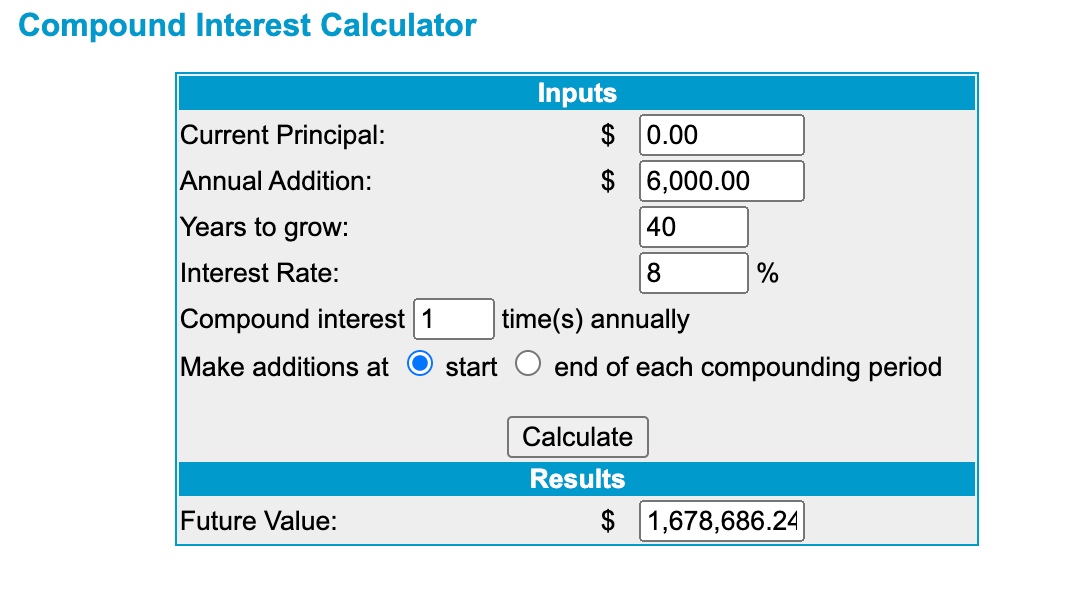
Allow me to show you something…

Image by author

This is a compound interest calculator from my friends over at Moneychimp.

You can see that if we start with $0 and contribute the current maximum annual investment of $6,000, compound it over 40 years at an average rate of 8{1b90e59fe8a6c14b55fbbae1d9373c165823754d058ebf80beecafc6dee5063a}, we end up with the princely sum of $1,678,686.24. Not bad, huh?

This assumes that we start at 20 years old and stop at age 60. Leave it in for a few more years and that account value could easily be over 3 million. That’s the beauty of compounding baby!

The Roth IRA is an epic first investment and I’m so glad I jumped on board.

Cryptocurrencies

Now that we have the stock market box checked off, we need some dirty, filthy, crypto tokens.

I’m kidding, I’m kidding. Microcap crypto coins are not my thing.

I am a big believer in blockchain, however, and I think cryptocurrencies have an immensely bright future. I’m a fan of Bitcoin, Ethereum, and a few of their other counterparts, but even these are not my saving grace in terms of financial security.

Right now, you can hold something called a stablecoin. These are cryptocurrencies that aim to hold the value of the dollar. The best part? You can earn crazy interest on them at places like Voyager. They will currently give you 9{1b90e59fe8a6c14b55fbbae1d9373c165823754d058ebf80beecafc6dee5063a} on your USDC (my stablecoin of choice). 9{1b90e59fe8a6c14b55fbbae1d9373c165823754d058ebf80beecafc6dee5063a}! Try asking your brick-and-mortar bank for that and I think they would slap you across the face.

These cryptocurrency brokers will even pay you interest on other coins like the popular Bitcoin and Ethereum. I love having crypto as my accessible money multiplier. It’s riskier than the traditional stock market which is why I hold my stocks inside my tax-sheltered retirement account. With crypto, I can have my petty cash growing while I’m out earning even more money to place inside my financial system. It has proven to be a wonderful addition!

Real Estate

This is where we commence the mental movies. I have yet to acquire a real estate property so from here on out I will be highlighting my future ambitions.

If I were to get into the real estate game, I would wish to purchase a multi-family home. These are great because if you didn’t know, you can do something the F.I.R.E. community likes to call; house hacking. House hacking is when you buy say a duplex (two-family home) and live on one side while renting out the other. The goal here is to offset the mortgage payment with the recurring rental income.

There is a lot to consider here because the deal has to be right for it to work and you may have to crunch some numbers. I never said the most profitable listicle in personal finance history would be a cakewalk. If you can pull this off — which many people do — it can prove to be one of your most valuable investments. Eventually, when you wish to move on or the house is paid off, you can realize rental income from both sides of the property and live lavishly with your money-making machine!

Side Hustle

A lot of people don’t see a side hustle or personal business as an investment option. I often fall into this category myself, while most others also believe that an investment must be a money trade. For a business, you will most likely invest some money but you will also invest another more valuable resource: Time. Investing time and money into a business is not a sure-fire way to experience financial success, but if you can manage to create a successful empire you will be far ahead of the pack.

This is essentially what I am trying to do with my online writing. Side hustles are great because they can be paired with a 9 to 5! That means double the income and double the cool points! If your side hustle becomes successful enough, you may even be able to quit that 9 to 5 and make your side hustle your main hustle!

Family Bank

This is the fifth and final component of the most profitable listicle in personal finance history.

I saved the best for last and this one is quite riveting. I recently wrote an article about the family bank, so if you would like an in-depth review of its power, check that out.

The basis of a family bank is a holding cell for your capital. It needs to have some key characteristics though. I like to look for liquidity, safety, and a good rate of return. That would make me happy if I had all three. Luckily, you can experience those traits with a family bank. The core of your bank is a whole life insurance policy. It has to be structured properly by a professional so this is something you’ll need a little help with. Don’t worry, you are still in the driver’s seat of your self-directed investments.

The insurance policy allows you to deposit funds on a schedule set by you, and it will experience a specified rate of return. The real power comes from the fine print, however. If you want to leverage this strategy to your benefit, you can take loans out against your policy and since you are the holder, you can pay yourself back at any time! The best part? You’re not even borrowing your own money. It’s technically from the insurance company and your account value will continue to earn that rate of return, doing its thing. If you never pay back the loan it will come out of your death benefit but that’s up to you (I would pay it back for maximum advantage).

If you didn’t already know, this is essentially what your brick-and-mortar bank does with the money you deposit into your savings. Why not copy them and do the same? There are tons of benefits to this strategy and I’m only beginning to realize them.

My goal with assembling this team of “financial avengers” is to find the best “holding cells” for my money.

There are many things to think about when combining different investment vehicles like diversification and potential for risk. Everyone’s ideas and situations will be different so it is up to you to figure out how you would like to play the money game.

I believe that simplicity is key but I also have a good time complicating things gunning for ample returns. We can all daydream about our future riches but it’s also important to remain in the here and now.

After all, money is technically just paper and it shouldn’t dictate our entire lives. Keep a healthy philosophy when it comes to personal finance and I think you could live a life that is wealthy and wise.

Take a good look at these investment options, and bring whichever ones you like back with you. Dive headfirst into the minutia of their unique characteristics and it may even lead you elsewhere.

Investing is a very good thing to make a habit of and can have a major impact on the lives of ourselves and our loved ones.

Now get out there and go invest!

Joseph Seifert

**Note: This is not financial advice. Just my financial thoughts and interests.