


How business insurance can help your company navigate difficult times

How business insurance can help your company navigate difficult times

We encourage insurance agents and brokers to share this article with their clients to help them decide which business insurance policies are essential to keep them protected.

One of the biggest advantages of taking out insurance for businesses is the financial protection it provides when unexpected losses occur. As they carve out the path to success, companies may face situations that can adversely impact their profitability. Mistakes can lead to costly lawsuits, while accidents and calamities can take a huge chunk out of their revenue. Having the right policies plays a crucial role in helping their business recover faster.

Carrying business insurance also boosts a company’s credibility as many stakeholders and clients prefer working with businesses that they know are financially protected.

Taking out business insurance, however, is just one facet of how companies can minimize their losses. Pairing insurance coverage with good risk management practices is often the best way businesses can protect their assets and finances.

Because each business faces their own share of unique risks and challenges, there is no one-size-fits-all policy that covers every need. The type of insurance that companies will require depends on several factors, including their business activities, size, and location.

Business insurance providers offer a range of policies that can help protect companies against the different risks they face. The selection is diverse, but according to industry insiders, these are some of the most essential coverages that businesses need to maintain their operations when accidents and disasters strike.

1. General liability insurance

General liability insurance, also called business liability or public liability coverage, protects companies against claims of bodily injury or property damage resulting from their business activities. This type of policy may also provide coverage for reputational harm and copyright infringement.

2. Professional liability insurance

Also known as errors and omissions (E&O) or malpractice insurance, this form of coverage protects the business from work-related claims, including mismanagement, sexual harassment, and discrimination. It covers legal and settlement costs arising from service-related mistakes and oversights, breach of contract, unfinished work, and budget overruns, among others.

Professional liability insurance not only covers directors and executive management but also other staff and the business itself. Although not always legally required, having this form of coverage is essential for many companies, especially for those that provide expert or advisory services.
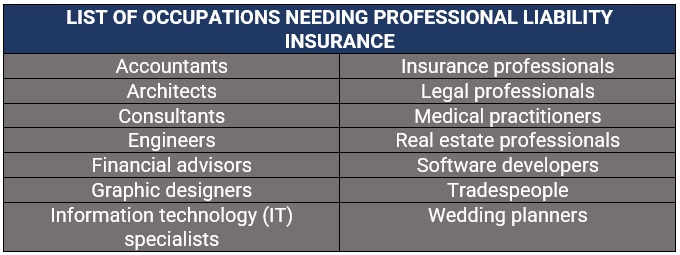
Jobs that need professional liability insurance

3. Product liability insurance

For businesses that sell products, product liability coverage may be worth considering. This protects the company against lawsuits from customers claiming losses or injury because of their product. This type of commercial insurance policy also covers legal defense costs and compensation if the business is found to be at fault.

4. Directors’ and officers’ (D&O) insurance

D&O insurance, also referred to as D&O liability insurance, is designed to protect the directors and senior management of a company against financial losses resulting from business-related lawsuits. This type of policy pays out for monetary losses from these legal actions, including defense costs, settlements, and fines.

D&O coverage comes in three main types, also referred to as insuring agreements or sides, with each offering different levels of protection:

  • Side A: Covers “non-indemnifiable loss” or situations where the business cannot indemnify its directors or officers, either due to bankruptcy or because they are not legally allowed to do so.
  • Side B: The most commonly accessed insuring agreement, this works by reimbursing a company after it has compensated a director or other senior management for a loss, including defense costs, settlements, and judgments.
  • Side C: Also called entity coverage, this provides direct coverage for a business when both the company and its directors and senior management are named in a lawsuit.

5. Commercial property insurance

Commercial property insurance, also referred to as business property or commercial building insurance, is designed to minimize disruption to a company’s day-to-day operations by providing compensation for damages or losses that happen to the following:

  • Property or building the business operates in
  • Equipment and technology the company uses
  • Inventory of products and materials the business stores and sells

Some policies also pay out a portion of lost income if the damage prevents a business from conducting its usual operations. Business property coverage is often a requirement for commercial leasing arrangements.

6. Commercial auto insurance

Commercial auto insurance is a type of car policy designed for vehicles driven for business purposes. In terms of protection, it works similarly to personal auto insurance but covers mainly company cars and commercial trucks and vans.
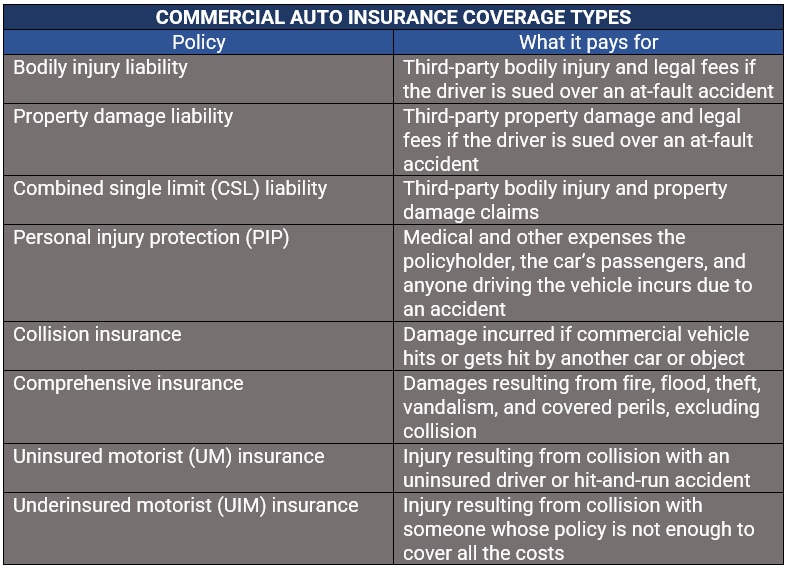
what commercial auto insurance covers

7. Health insurance

Businesses that employ more than 50 full-time staff are required to take out health insurance for their workers, according to the Affordable Care Act (ACA). For those with less than 50 employees, the ACA offers a Small Business Health Options Program (SHOP) as coverage.

8. Workers’ compensation insurance

Workers’ compensation insurance, also called workers’ comp coverage, pays out the cost of medical care and part of the lost income of employees who get sick or injured while performing their jobs. It also protects the businesses from the financial liability of having to pay for expenses arising from work-related illnesses and injuries out of pocket.

Workers’ compensation insurance policies provide several types of coverages, including:

  • Medical expenses: Covers the cost of medical treatment for the sick or injured worker.
  • Lost income: Pays out part of the employee’s wage if they need to take time off from work because of the illness or injury they sustained.
  • Ongoing care: Covers expenses incurred if the employee requires extended medical care due to a work-related injury or illness, including rehabilitation costs.
  • Disability benefits: Covers medical bills and some lost wages of employees who become disabled because of a workplace accident.
  • Death benefits: Pays out funeral and burial expenses and provides financial benefits for beneficiaries of employees who die due to a job-related injury or illness.

9. Business interruption insurance

Business interruption insurance, also called BI or business income coverage, is designed to protect companies against financial losses incurred from the disruption of their operations resulting from an insured peril. We will discuss this type of policy in detail in our coverage highlighted below.

10. Cyber insurance

Cyber insurance plans are designed to protect businesses against financial losses resulting from cyber incidents. Policies typically provide two types of protection:

First-party coverage

This type of coverage pays out for the financial losses the business incurs due to a cyber incident, including:

  • Cost of responding to a data breach
  • Cost of restoring and recovering lost or damaged data
  • Lost income resulting from business interruption
  • Ransomware attack payments
  • Risk assessment of future cyberattacks
  • Cost of informing customers about the cyber incident
  • Anti-fraud services

Third-party coverage

This provides financial protection against lawsuits filed by third parties, including customers, employees, and vendors, for damages caused by a cyberattack on the business. Policies typically cover court and settlement fees, and regulatory fines.

Every year, insurance behemoth Allianz surveys thousands of businesses from about 90 countries and territories and more than 20 industries to find out which risks these companies see as posing the greatest threat to their operations. Here are the 10 biggest risks businesses across the globe are facing, according to Allianz’s latest Risk Barometer report.

  • Cyber incidents – such as cyberattacks, IT failure or outage, data breaches, and their corresponding fines and penalties.
  • Business interruption – including supply chain disruption
  • Natural catastrophes – including storms, flooding, earthquakes, wildfire, and other weather events
  • COVID-19 outbreak – such as health and workforce issues, and restrictions on movement
  • Changes in legislation and regulation – including trade wars and tariffs, economic sanctions, protectionism, Brexit, and Euro-zone disintegration
  • Climate change – such as physical, operational, financial, and reputational risks resulting from global warming
  • Fire and explosion
  • Market developments – such as volatility, intensified competition and new entrants, M&A, market stagnation, and market fluctuation
  • Shortage of skilled workforce
  • Macroeconomic developments – including monetary policies, austerity programs, commodity price increases, deflation, and inflation

The disruption brought about by the COVID-19 pandemic has given prominence to this type of coverage, which has also been the point of contention between insurers and their policyholders. In essence, business interruption or BI cover is designed to protect businesses from loss of income and additional costs incurred if their operations are forced to shut down because of an unexpected event. Insurance companies, however, argue that the loss should result from “material damage caused to property.”

How does business interruption insurance work?

Business interruption insurance provides companies financial protection for the losses they suffer because of the disruption to their operations caused by an insured event. It pays out the operating costs while the business temporarily shuts down. These costs include:

  • Potential revenue
  • Mortgage or rent on commercial space
  • Business loan repayments
  • Employee salaries
  • Taxes 

Some policies also provide coverage for additional expenses related to the closure such as those accompanying the setting up of a temporary location or the training of staff to use new equipment.

For small and medium-sized enterprises, BI coverage is often included in a business owner’s policy, which bundles different coverages companies need, including general liability, commercial property, and workers’ compensation cover.

Business interruption policies typically entail a 48- to 72-hour waiting period to kick in. This is indicated in the policy’s restoration period, which initially lasts for 30 days but can be extended to up to a year.

What are the top causes of business interruption?

A five-year data analysis of insurance claims conducted by leading insurer AGCS has found that fire and explosion were the leading causes of business disruption globally, accounting for 30{1b90e59fe8a6c14b55fbbae1d9373c165823754d058ebf80beecafc6dee5063a}, or $6.7 million worth, of all BI losses. This was followed by storms (21{1b90e59fe8a6c14b55fbbae1d9373c165823754d058ebf80beecafc6dee5063a}), water damage (12{1b90e59fe8a6c14b55fbbae1d9373c165823754d058ebf80beecafc6dee5063a}), machinery breakdown (5{1b90e59fe8a6c14b55fbbae1d9373c165823754d058ebf80beecafc6dee5063a}), and flooding (4{1b90e59fe8a6c14b55fbbae1d9373c165823754d058ebf80beecafc6dee5063a}).

In terms of business interruption triggers, 52{1b90e59fe8a6c14b55fbbae1d9373c165823754d058ebf80beecafc6dee5063a} of respondents said cybercrime, which was driven by the recent spate of ransomware attacks, was the one they feared the most, followed by natural catastrophes (36{1b90e59fe8a6c14b55fbbae1d9373c165823754d058ebf80beecafc6dee5063a}), pandemic outbreaks (35{1b90e59fe8a6c14b55fbbae1d9373c165823754d058ebf80beecafc6dee5063a}), and transportation and shipping disruptions (30{1b90e59fe8a6c14b55fbbae1d9373c165823754d058ebf80beecafc6dee5063a}).

Does business interruption insurance cover COVID-19-related losses?

Whether business interruption policies should cover losses caused by the coronavirus pandemic has been a contentious issue between insurance companies and businesses affected by the outbreak. The insurance industry has maintained that pandemics cannot be covered because of the scale of their impact.

“Pandemics are an extraordinary catastrophe that can impact nearly every economy in the world, so it is hard to predict and manage the risk,” said Sean Kevelighan, chief executive officer at the Insurance Information Institute (Triple-I), in a 2020 statement. “Pandemic-caused losses are excluded from standard business interruption policies because they impact all businesses, all at the same time.”

This, however, has not prevented companies seeking compensation from taking their arguments to court. The University of Pennsylvania Carey Law School’s COVID-19 coverage litigation tracker has recorded more than 2,300 lawsuits over business income coverage, with the majority of lawsuits coming from companies in the food services sector.

Early last year, the UK Supreme Court dismissed appeals by insurance companies in a test case brought by the Financial Conduct Authority (FCA) on behalf of policyholders. The insurers argued that many BI policies did not cover widespread disruption resulting from the restrictions imposed by the government to curb the spread of the coronavirus in 2020. After scrutinizing non-damage insurance policy clauses, which cover disease, denial-of-access-to-business-premises, and hybrid clauses, the Supreme Court unanimously dismissed the appeals, a ruling that has massive implications for the insurance industry worldwide.

What do companies need to consider when taking out business insurance?

There are several factors that companies need to consider before taking out business insurance. These include:

  • The company’s business structure
  • The industry where the business operates
  • The types of risks the company faces
  • The company’s size or number of employees
  • Whether the company has business premises or vehicles
  • The stock, equipment, and tools the company owns

It would also be helpful for businesses to consult an experienced insurance agent or broker who can give them sound advice regarding which coverages suit their operations the best.

Do you need help finding the right coverage for your business? What types of policies do you think are essential? Use the comments box below to share your thoughts.

Impact Experience’s Business Climate Finance Initiative Applauds and Welcomes U.S. Department of Labor Final “ESG Rule” Release

Impact Experience’s Business Climate Finance Initiative Applauds and Welcomes U.S. Department of Labor Final “ESG Rule” Release

OAKLAND, Calif.–(Business enterprise WIRE)–The Company Local weather Finance Initiative (BCF), incubated by Impact Practical experience, applauds and welcomes the launch of the Office of Labor’s Ultimate Rule on Prudence and Loyalty in Picking Approach Investments and Working out Shareholder Legal rights, on November 22, 2022. The Ultimate Rule is a considerable clarification of the Employee Retirement Money Stability Act (ERISA) specifying that fiduciaries, in this scenario 401(k) or described profit plan sponsors, “may think about local climate change and other environmental, social, and governance (ESG) variables when they make investment selections and when they exercise shareholder legal rights, including voting on shareholder resolutions and board nominations.”1

As an firm that supports companies to assess and disclose the weather impacts of company funds deposits and retirement ideas, as very well as to decarbonize people assets, BCF thinks that the Final Rule will allow for retirement program sponsors to a lot more proactively account for ESG elements, which includes climate and carbon-connected dangers, in the financial investment menus they offer you to 401(k) system contributors.

There are a lot of important provisions in the Remaining Rule, including people associated to how the thought of ESG aspects may align with fiduciary responsibilities of prudence and loyalty, and how ESG factors might be considered in the application of shareholder legal rights, together with proxy voting.

In addition, the Closing Rule gets rid of exclusive, more restrictive procedures for a 401(k) plan’s Certified Default Financial commitment Choice (QDIA) that ended up used in the 2020 procedures promulgated by the prior Administration. Although the prior rules prohibited the consideration of ESG things in any investment fund specified the QDIA for a retirement plan, the Closing Rule gets rid of individuals restrictions, meaning that program sponsors can now possibly give ESG-oriented target day and other diversified fund alternatives as the default choice for new strategy contributors. Focus on day money and other “hybrid” automobiles built up about 27{1b90e59fe8a6c14b55fbbae1d9373c165823754d058ebf80beecafc6dee5063a} of all defined contribution strategy property in the first fifty percent of 2022,2 so this is a most likely major option for system sponsors to prudently deal with weather change and other ESG concerns.

Eventually, the Last Rule explicitly notes that retirement plan participants’ views on investing in ESG and related factors can be thought of by approach fiduciaries in deciding approach menu choices, perhaps paving the way for personnel to participate in an significant function in shaping the ESG techniques of the retirement plans they are saving for the future in.

Jenna Nicholas, CEO of Influence Practical experience, claimed, “With this extensive-ranging and ahead-looking Remaining Rule, the Division of Labor has obviously acknowledged that considering local climate, carbon, justice, equity, range, and inclusion (JEDI) and other ESG-similar lenses can be nicely-aligned with prevailing standards of fiduciary responsibility. In the week pursuing the summary of COP27, and the enhanced target on mitigating future local climate impacts and addressing historic injustices that it brought, this Ultimate Rule will provide to unlock billions of dollars of retirement money in direction of achieving increased alignment with international weather aims.”

ABOUT Small business Local climate FINANCE

Effects Practical experience builds bridges and deep relationships in between associates and communities to shift funds marketplaces towards more equitable practices. Influence Working experience is incubating the Organization Weather Finance Initiative. The Company Climate Finance Initiative was launched with two plans in brain: 1) evaluate and disclose the climate affect of company dollars deposits and retirement funds and 2) decarbonize bank accounts and personnel retirement ideas, beginning with a team of major US companies. Via study and convenings, the Initiative will assistance assist communities of apply between companies who will be functioning toward these targets implementing a distinctive Justice, Fairness, Variety and Inclusion lens. For more facts on this initiative, see www.businessclimatefinance.org or comply with Affect Working experience on LinkedIn, Twitter and Instagram.

1 Ultimate Rule on Prudence and Loyalty in Deciding on Plan Investments and Exercising Shareholder Legal rights (dol.gov)

2 Quarterly Retirement Marketplace Info | Investment decision Business Institute (ici.org)

Business News

Business News

Insurance-top quality rebates readily available

The application period for crop-insurance policy top quality rebates will be open up from Dec. 5 to Jan. 31. Recipients will obtain a $5 for every-acre rebate on their summer months 2023 crop-insurance policies premium for acres planted with deal with crops in 2022 in Wisconsin.

There’s $800,000 or 160,000 acres of coverage to be awarded on a 1st-come, initial-served foundation, according to the Wisconsin Office of Agriculture, Trade and Shopper Safety.

Producers who gained state or federal cost-sharing to plant deal with crops in 2022 are ineligible for the 2023 system. Candidates ought to use their Farm Assistance Agency-578 form to complete the software. There’s no restrict on acres for which an applicant can utilize.

Applicants will be notified of selection in spring 2023. Candidates really should retain seed receipts and planting documents. The Wisconsin Section of Agriculture, Trade and Client Security will conduct audits to ensure protect crops were being planted.

Stop by datcp.wi.gov and research for “crop coverage rebates” or make contact with DATCPCC@wisconsin.gov for extra data.

Meat processors awarded grants

Ninety-a person Wisconsin meat processors not long ago have been selected to acquire a total of $10 million via the Meat and Poultry Supply Chain Resiliency Grant application. The application was made in May 2022 to go on to aid the advancement of Wisconsin’s meat-processing market and increase the long-expression viability of the state’s livestock business.

Funded as a result of the American Rescue Approach Act, Wisconsin meat processors will receive funding for grant projects of as substantially as $150,000. Grants are awarded through a competitive collection approach. Chosen processors have to deliver a match of 100 percent of the grant sum.

The Wisconsin Section of Agriculture, Trade and Customer Safety received 99 grant programs requesting much more than $11 million in funding. A listing of the 91 chosen recipients that span 48 Wisconsin counties is offered. Assignments have been selected to acquire grants pending deal finalization. Check out datcp.wi.gov – and research for “meat and livestock enhancement” for additional info.

USDA invests in disease reaction

The U.S. Section of Agriculture’s Animal and Plant Wellbeing Inspection Assistance is delivering $9.4 million to 26 states and six Tribes or Tribal corporations. The purpose is to even further establish and employ continual-throwing away-disorder-administration and reaction routines in wild and farmed deer.

Point out departments of agriculture, state animal-health organizations, point out departments of wildlife or natural resources, and federally recognized Native American Tribal governments and businesses were eligible to submit proposals that even more create and apply persistent-wasting ailment-management, response, and exploration routines, such as surveillance and screening.

The Animal and Plant Wellness Inspection Assistance also enabled all those governments and organizations to aid the use of training and outreach actions to raise consciousness about the condition and how it spreads. The agency based mostly funding allocations on priorities that were being collaboratively set up with state agricultural and wildlife reps, Tribal officers and the deer field.

The agency been given 56 proposals. It executed scientific and plan-panel critiques of the proposals. It also worked with distributing entities the place required to refine the scope of the most promising assignments.

Pay a visit to aphis.usda.gov – and look for for “farmed cervid paying” – and aphis.usda.gov – and research for “wild cervid spending” – and aphis.usda.gov – and look for for “tribal wild cervid paying out” – for a lot more facts.

Responses on funding sought

The U.S. Division of Agriculture’s Natural Means Conservation Service seeks general public input on implementation of additional than $19 billion delivered by the Inflation Reduction Act. The company will use the investments provided via Inflation Reduction Act-funded conservation programs.

The company seeks responses on how to focus on system gains, quantify impact and enhance program shipping and delivery and outreach, in particular for underserved producers. Remarks are because of Dec. 21. The agency will discover speedy changes that can be made in fiscal 12 months 2023 and will continue on to identify and adopt extra variations in long term many years.

The Inflation Reduction Act provided unprecedented funding ranges for various of the current packages that the Purely natural Means Conservation Service implements. The elevated funding concentrations get started in fiscal 12 months 2023 and will make in four many years, totaling extra quantities:

• $8.45 billion – Environmental Top quality Incentives Application

Persons are also reading…

• $3.25 billion – Conservation Stewardship Program

• $4.95 billion – Regional Conservation Partnership System

• $1.4 billion – Agricultural Conservation Easement Plan

• $1 billion – Conservation Specialized Aid

The company seeks input on to how to most effective maximize benefits for local weather mitigation, which include focusing on methods and packages that present quantifiable reductions in greenhouse-gasoline emissions. It also is requesting comments to assist determine tactics and present recommendations on how to optimize, focus on, check and quantify enhancements to soil carbon, reductions in nitrogen losses, and the reduction, capture, avoidance or sequestration of carbon dioxide, methane or nitrous-oxide emissions associated with agricultural manufacturing.

Community responses ought to be submitted by Dec. 21. Take a look at federalregister.gov and research for “implementation of Inflation Reduction Act funding” or contact NRCS.IRA.Enter@usda.gov for a lot more info.

Virtual-fencing corporation obtained

Merck Animal Health not too long ago signed an settlement to obtain Vence, a developer of digital fencing for rotational grazing and livestock administration.

The engineering is created to help producers and ranchers monitor and deal with movement of cattle by a system of virtual-fencing answers. Using a pc or smartphone, customers have the ability to regulate cattle movement. Pay a visit to merck-animal-wellness-united states.com and vence.io for far more data.

Meat-slicing certification made available

A new pathway into a vocation as a butcher or in retail meat profits is now obtainable through a nine-credit score meat-chopping and butchery certification from Mid-State Technological University. The aspect-time certification can be done in 6 months. It will be offered in spring 2023 with evening courses held at Auburndale High School in Auburndale, Wisconsin.

The certification is created for people today who want to examine or grow their knowledge of meat chopping and butchery in their current roles. It is also developed for people today looking to provide retail meats immediately from their have output-agriculture procedure or open up their personal meat-processing operation.

The grant funding for the new method is provided by a collaboration from Gov. Tony Evers and the Wisconsin Division of Agriculture, Trade and Buyer Protection to tackle the long run of meat processing in Wisconsin. The grant will invest as considerably as $5 million in American Rescue Approach Act funding to develop meat-expertise improvement support. Mid-Condition will acquire $196,384 to supply small-phrase schooling aimed to make the workforce in central Wisconsin.

Method participants will encounter hands-on schooling with meat cutting and butchering, together with knife techniques and choice. They’ll also understand procedures these kinds of as portioning for retail, cigarette smoking, grinding, curing and brining. Also protected will be teaching in pinpointing meats for quality and benefit-added items. The plan involves sanitation laws and requirements.

Stop by mstc.edu/meat and search for “meat reducing” or make contact with alex.lendved@mstc.edu or 715-422-5356 for extra information and facts.

Personal loan-help instrument supplied

The U.S. Office of Agriculture recently introduced an on line tool to help farmers and ranchers much better navigate the farm-personal loan software system. The device is offered 24/7. It provides buyers a guidebook that supplements the help they obtain when doing work in human being with a USDA worker, delivering supplies that may perhaps help an applicant get ready a loan application.

The new software is the 1st of various farm-financial loan course of action advancements that will be readily available on farmers.gov in the potential, the company mentioned. Anticipated to launch in 2023 is an interactive direct-bank loan software that provides shoppers a paperless and electronic signature solution, alongside with the capability to attach supporting files this kind of as tax returns. Visit  lat.fpac.usda.gov for a lot more information.

Serious squandering ailment affects farm

A deer farm in Wisconsin’s Lincoln County recently examined favourable for long-term wasting condition. Samples were being confirmed by the Nationwide Veterinary Expert services Laboratories in Ames, Iowa.

The positive result came from a 5-yr-outdated white-tailed buck. The farm has been placed in quarantine, the place it will stay although the Wisconsin Office of Agriculture, Trade and Shopper Safety and the U.S. Division of Agriculture veterinarians and staff carry out the epidemiological investigation.

Continual wasting illness is a deadly neurological disorder of deer, elk and moose. It’s prompted by an infectious protein referred to as a prion that influences the animal’s brain. Screening for the disorder is usually executed only following the animal’s loss of life. The Wisconsin Office of Agriculture, Trade and Shopper Security regulates deer farms for registration, recordkeeping, ailment screening, motion and allow necessities. Stop by datcp.wi.gov and search for “serious wasting sickness” for far more facts.

Whole Foods decision to pull lobster divides enviros, pols | Business News

Whole Foods decision to pull lobster divides enviros, pols | Business News

PORTLAND, Maine (AP) — Environmental groups are after yet again at odds with politicians and fishermen in New England in the wake of a selection by higher-conclude retail giant Total Meals to cease offering Maine lobster.

Entire Meals lately explained that it will stop selling lobster from the Gulf of Maine at hundreds of its suppliers around the place. The organization cited selections by a pair of sustainability businesses to just take away their endorsements of the U.S. lobster fishing market.

The businesses, Maritime Stewardship Council and Seafood Watch, both of those cited concerns about pitfalls to scarce North Atlantic suitable whales from fishing equipment. Entanglement in gear is one particular of the most important threats to the whales.

The final decision by Total Foods was an “important action to shield the highly endangered” whale, reported Virginia Carter, an affiliate with the Preserve America’s Wildlife Campaign at Setting The united states Exploration & Plan Center.

“With less than 340 North Atlantic proper whales in existence, the species is swimming towards extinction except if matters transform all over,” Carter mentioned.

Whole Foods stated in a assertion past 7 days that it’s checking the problem and “committed to working with suppliers, fisheries, and environmental advocacy teams as it develops.”

The company’s selection to halt offering lobster drew rapid criticism in Maine, which is dwelling to the U.S.’s biggest lobster fishing marketplace. The state’s Gov. Janet Mills, a Democrat, and its 4-member congressional delegation said in a statement that Marine Stewardship Council’s selection to suspend its certification of Gulf of Maine lobster came in spite of many years of stewardship and safety of whales by Maine fishermen.

“Despite this, the Maritime Stewardship Council, with stores adhering to accommodate, wrongly and blindly decided to stick to the suggestions of misguided environmental teams instead than science,” Mills and the delegation stated.

Total Foodstuff was not the initial retailer to take lobster off the menu about sustainability fears. HelloFresh, the meal package organization, was amongst a lot of suppliers to pledge to halt providing lobster in September after California-based mostly Seafood Enjoy put American and Canadian lobster fisheries on its “red list” of seafoods to avoid.

Copyright 2022 The Involved Push. All rights reserved. This content may possibly not be released, broadcast, rewritten or redistributed devoid of permission.

Calling it quits: Beerbower Jewelers going out of business | News, Sports, Jobs

Calling it quits: Beerbower Jewelers going out of business | News, Sports, Jobs
&#13
&#13

&#13

Mirror photo by Walt Frank
Al Beerbower stands guiding a counter at Beerbower Jewelers. Beerbower is retiring following much more than 40 yrs at the retailer.

&#13

HOLLIDAYSBURG — A longtime staple of downtown Hollidaysburg will be closing its doorways.

Beerbower Jewelers, established by Al and Millie Beerbower in 1954, is conducting a likely out of business sale.

“We will be open as a result of the vacations and wind down early subsequent year,” said operator Don Beerbower, who options to retire.

“You operate all of your lifetime to hopefully love your remaining years on this earth with your spouse and children and friends,” explained Beerbower, who will before long be 66.

His wife, Karen, retired very last 12 months immediately after 34 decades of instructing at Penn-Mont Academy. She has been paying out most of her time dwelling in the Pittsburgh location with their daughter Meghan and a few granddaughters — with a fourth youngster on the way.

“I am more youthful (than Karen) and desired to continue to keep performing, but now is a great time to put the loved ones again jointly. Had my wife stayed below, I could have semi-retired and stored going,” Beerbower explained. “It is not for economical seasons we had a pretty profitable, lengthy run listed here in Blair County.”

Beerbower Jewelers has experienced a huge affect on the small business group more than the decades.

“It’s managed a strong status for top quality and services. You often hate to lose a enterprise which is element of the area’s custom, but it is hard to steer clear of, particularly with the issues struggling with tiny corporations. Beerbower’s will be tricky to replace,” mentioned President/CEO Joe Hurd of the Blair County Chamber of Commerce.

“Don has contributed to the location not only economically, but in creating unique occasions even better with his unique assortment of beautiful jewellery. We congratulate Don Beerbower on his retirement,” the Hollidaysburg Space Neighborhood Partnership reported in a assertion.

Don was wired for the spouse and children company mainly because “he adopted his dad close to.”

He left his career as an accountant and begun entire time in 1980. He and his sister Jane ran the day-to-day operations considering the fact that the mid-1990s. Jane remaining the business about 10 years in the past, and Don turned sole proprietor in 2012.

Beerbower said he will miss out on his clients and the daily work.

“I do custom made parts it is a new problem each individual day. I never ever imagined I required to be in organization. Remaining in organization is like an dependancy, staying an entrepreneur you are betting on by yourself, a minor like a gambler. It was a rush,” Beerbower claimed.

Beerbower is a registered jeweler with the American Gem Culture. He also holds an AGS Certified Gemologist Appraiser title and is a Graduate Gemologist with GIA, the Gemological Institute of The usa.

Beerbower stated it is important to give back to the local community.

“Cyber outlets have much more profits on line, but they don’t give back to the neighborhood like the nearby corporations. We normally tried out to give back again to the community. We are enormous advocates for modest corporations because we are one. We were being a productive modest company that lasted 68 yrs,” Beerbower mentioned. “How lots of have lasted that extended?”

Beerbower claimed he has not shown the small business for sale but hopes a person will move forward to obtain it.

“We have been here 68 a long time, they could transform the crucial and begin the enterprise. I will adhere about for consulting and schooling. I would like to offer it and have it here for our buyers about the yrs,” Beerbower said.

Beerbower said he options to shell out more time with his family members. Together with Meghan and her daughters, his two sons, Nathan and A.J., every single have a few daughters as perfectly.

“I may discover out I do not like retirement and may well uncover one thing to do, get the job done element time. I will need to hold busy. I have hobbies and I like to play golfing. The grandkids will retain me fast paced, I am searching ahead to that,” Beerbower explained.

Mirror Personnel Author Walt Frank is at 814-946-7467.

&#13 &#13
&#13

&#13
&#13

Present day breaking information and a lot more in your inbox

&#13
&#13

&#13
&#13
&#13
&#13
&#13

Do You Have the Right Insurance for Your Business? Here’s How to Understand Your Options

Do You Have the Right Insurance for Your Business? Here’s How to Understand Your Options

Opinions expressed by Entrepreneur contributors are their own.

You’ve likely pursued traditional business insurance. But when it comes to protecting your business from a myriad of outside threats in today’s complex and ever-changing environment, is traditional insurance enough — or even the right fit?

With the hardening of the insurance market and costly premiums, it’s a timely question, especially as more and more businesses are looking to alternative risk transfer. And an increasingly trending option is captive insurance as worldwide more than 100 captives formed last year as reported by Business Insider.

Related: 4 Ways to Protect Your Business From Inflation

Background of traditional and captive insurance

Traditional insurance has built up a portfolio of coverage offerings and options for businesses. Some components of traditional insurance include risk distribution, tax deductibles on premiums and many blanket insurance coverages such as general liability insurance, business income insurance and worker compensation insurance.

Captive insurance is a wholly owned subsidiary that exists to protect your business from unique threats and provide the dynamic and unique plan your business needs. Captive insurance may be right for your business if it can’t receive the insurance coverage it needs from the traditional insurance market.

For instance, business interruption insurance is a coverage that insulates your business from disasters such as floods and earthquakes. This coverage does not, however, protect businesses from fires or tornadoes — and to activate this insurance, there must be an event that “triggers” your policy.

Businesses that shut down during the pandemic lost money while they were closed, and they needed to be fully shut down to trigger their business interruption policies. With captive insurance, however, businesses can access their stored cash reserves and cover losses during instances of extended partial shutdowns that are not covered in a traditional insurance policy. Unlike this policy language with its many coverage exclusions, captive policy language is geared to protect the business owner.

Captive insurance also doesn’t penalize for other firms’ bad behavior and the cost you pay for insurance isn’t based on other similar businesses filing claims. Other considerations for possibly leaving traditional insurance are in the hardening of premiums, and companies looking to have less expensive coverage.

Keeping that in mind, companies seeking more control over their current coverages and insurance programs can craft a bespoke insurance plan built around their business’s unique risk profile with their captive plan.

Related: How Businesses Can Navigate the Treacherous Waters of Trade Wars

Premiums aren’t a sunk cost with captives

High premiums with traditional insurance providers can handcuff your business to hardening monthly rates and can leave your business feeling the impact of those high expenses. With captive insurance, however, your business can retain profits when claims aren’t paid.

These retained profits see deferment of taxes on loss reserves as well, allowing for the accumulation of a larger pool of funds for investment or unforeseen financially impactful situations such as litigation. These funds can also be utilized to insulate your business from losses during economic downturns or similarly fiscally challenging situations.

For a small business, this can help with scalability as expensive premiums paid with traditional providers can mean less money spent on expanding your business. Additionally, as your business scales in size and needs, so do the coverages required for your business to be adequately protected. Comparatively, Kiplinger pointed out that captive insurance can provide these necessary adaptive coverages as the need for them comes up along the way.

Related: 5 Trending Captive Insurance Considerations for 2022

Policy differences and FAQs

If your business faces potential cyberattacks, medical malpractice suits and many other costly risks, the deductibles associated with these protections are growing with traditional providers. Premiums for cyber insurance have increased by as much as 50{1b90e59fe8a6c14b55fbbae1d9373c165823754d058ebf80beecafc6dee5063a} and 100{1b90e59fe8a6c14b55fbbae1d9373c165823754d058ebf80beecafc6dee5063a}.

Relating back to the earlier example, flexibility in captive insurance policy language would help. As evidenced by the civil unrest of 2020, whereby areas of the country experienced protests, riots and sit-ins that destroyed neighborhoods. If the area around a business was damaged and inaccessible, but the business itself was not, again, the traditional insurance policy would not be triggered, meaning your business can be left paying out of pocket.

Related: 5 Ways to Protect Your Business Against Cyber Attacks

So how much time does it take to create a new policy?

With constant changes in what businesses need in their insurance protections, traditional insurance providers can often be behind the curve. Where new threats form, it also means new policies need to be made to cover vulnerable parts of your business.

According to Deloitte, traditional insurance takes 12 to 18 months to create and release new insurance products. With the rate at which threats arise and can potentially harm your business, that is not an acceptable timeframe.

Additionally, when buying traditional insurance coverage, startup costs are limited to the premium. Starting a captive insurance company, however, requires start-up costs and capitalization requirements with formation fees including legal costs. This is because a captive insurance company is a legally formed corporation. Additionally, with captive insurance, you are building upon your risk mitigation strategies to accrue funds for potential losses.

While forming a captive may be daunting to a non-insurance professional, there are many captive management companies that will serve as a business owner’s insurance front office, that help companies form and manage their own wholly owned captives.

Captive insurance can be a viable option for businesses large and small. Businesses best served by implementing captive insurance are those with complex, evolving, difficult or costly risks to insure through traditional plans and those who would benefit from increased cash flow, liquidity and profitability. Traditional insurance and captive insurance both have distinct features and one isn’t necessarily a better fit than the other. Regardless of what you choose, protecting your business with the right insurance plan is a necessity.