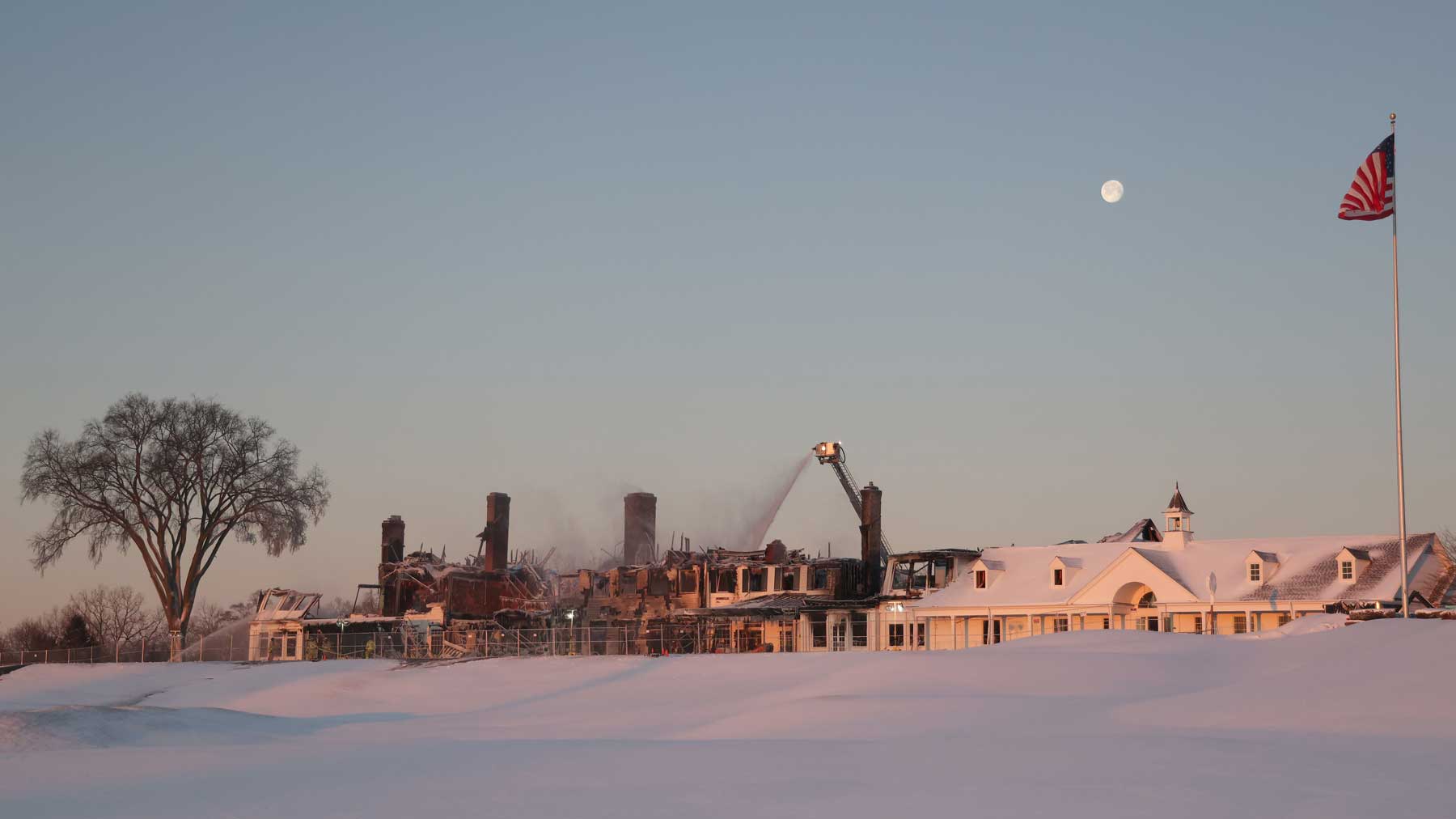
Earlier this year, a fire ravaged the Oakland Hills clubhouse.
getty images
No golf course is safe from Mother Nature or human negligence.
Take what happened in February at Oakland Hills Country Club, just outside Detroit.
Oakland Hills, the site of more than a dozen major championships — Ben Hogan famously referred to it as “the monster” when he won the 1951 U.S. Open there — was engulfed in a fire that resulted in more than $80 million of damage to its historic clubhouse. The cause has still not been fully determined.
Needless to say, Oakland Hills, or any course, can’t truly replace what is lost in a tragedy of such magnitude. But obtaining the proper insurance can provide much-needed help in an expensive rebuilding process that might take years.
Which is where insurance companies enter the picture. Many of the same insurers that offer protection for your home or automobile also serve as safety nets for golf courses.
Money Game: For today’s pros, corporate sponsorships go way beyond dollars and cents
By:
Paul Sullivan
Travelers, which has its name on a PGA Tour event, sells golf-course insurance. So, too, do smaller shops such as Philadelphia Insurance Companies, which offers coverage to courses and clubs for everything from liquor liability to pollutant clean-up and removal.
Among the newcomers to the space is Sentry, a brand with which golfers may already be familiar; the company owns SentryWorld, a Robert Trent Jones Jr.-designed course in Wisconsin, and has been the title sponsor since 2018 of the PGA Tour’s season-opening Tournament of Champions in Maui.
Based in Stevens Point, Wis., Sentry is launching a new initiative this year to sell insurance to public, semi-private and country-club courses across the country. The company has identified about 8,000 courses to approach, with the hopes of securing at least a few dozen contracts by the end of 2022.
“We are in the business of golf,” said John Hyland, the president of Sentry’s direct writing group. “We own a golf course. We’re a title sponsor of a very significant tournament. Why wouldn’t we start getting into the insurance side of this?”
The key for insurers is identifying how best to protect courses, of which there are a number of ways. One type of coverage is referred to as “tee to green,” which — just as it sounds — would compensate courses for any damages from the tee box through the fairway to the putting surface. Typically, for that kind of coverage, Sentry will offer $1 million worth of benefits, though it can be increased depending on the specific needs of the course.
Money Game: Why competing on the elite amateur golf circuit is costly in all sorts of ways
By:
Paul Sullivan
“Some courses, it may cost more to replace the damage whether it be by storm damage or vandalism,” said Mike Schmike, Sentry’s chief underwriting officer.
The premiums which courses would have to pay for the tee-to-green coverage will depend on the coverage limits that are purchased, and those will vary from state to state. “If you purchase $1 million in standard coverage, it will cost you less than if you buy $5 million worth of coverage,” Schmike said.
Courses will also be able to purchase protection for errant golf balls, meaning, for example, if a golfer breaks a window of a home or vehicle, or causes an injury, a course would generally receive $1,500 per incident, Schmike said.
Courses can even insure their most sentimental design features, like, say, a signature oak that is felled by a storm.
“We have the ability to identify that tree and provide more than just the normal coverage for it,” Hyland said. “Replacing it, you just don’t want to plant the seedling in the ground. You might want to search out a more mature tree to transplant. That comes with additional costs.”
Ultimately, Hyland said, just as good teaching pros tailor their game-improvement advice for each of their student’s swings, golf-course insurers should follow the same principle with their clients.
“It’s really working with each individual course to understand what’s unique about them and designing a program that meets their needs,” he said. “The last thing you want is a cookie-cutter approach.”
As element of its ongoing evaluation of Arizona groundwater policy, Chamber Company Information is viewing with drinking water authorities and policy leaders about their sights on groundwater and what they think are the defining challenges for just one of the state’s most urgent challenges.
Nowadays CBN visits with Todd Reeve, CEO of the Bonneville Environmental Foundation and co-director of Enterprise for H2o Stewardship.
Todd Reeve
This interview has been edited for clarity and duration.
Chamber Small business News: Inform us about the Bonneville Environmental Basis and Enterprise for Drinking water Stewardship.
Todd Reeve: BEF, the Bonneville Environmental Basis, is a nonprofit firm that is a dad or mum business for quite a few core pillars of do the job. Maybe the largest pillar of perform is Enterprise for Drinking water Stewardship. Business enterprise for H2o Stewardship is BEF’s platform wherever we collaborate with the non-public sector, with organizations, big and compact, to assist advocate for and reinforce proactive and progressive drinking water remedies. The objective for Business of H2o Stewardship is to recognize personal sector and business enterprise requirements and assistance develop out policies, projects, platforms that can enable stretch the profit of each individual drop of water to help atmosphere, neighborhood, and business desires. We’re very committed to our company associates, but we also see h2o protection as owning more than enough h2o to assistance business, community, and ecosystem.
CBN: It’s central to the premise of Business enterprise for Drinking water Stewardship that your group believes that non-public companies can make improvements to Arizona’s water standing?
Todd: Absolutely–in really, truly significant methods. Certainly, they all can do a good position of conserving drinking water in their functions and facilitating reuse and water effectiveness, which is great and really important. But I imagine the actual potential is when we feel about how Arizona has developed from a very rural variety of groundbreaking, ranching, farming, mining condition to a place the place Fortune 50 enterprises are significantly finding and escalating. Corporations are critically important. They are enormous companies in the point out, they’re bringing expenditure. And so enterprise affect has the opportunity to influence policymakers, community customers, stakeholders. So, just viewing organizations move up, make recognition all around these challenges and occur to the table has unbelievable influence. I sincerely feel that activating small business affect is 1 of the largest levers that we can force on to progress optimistic h2o coverage and action necessary to obtain very long expression drinking water protection for Arizona.
CBN: A single of the issues that we have heard as portion of these discussions with associates from field is the perception that enhancement in and of alone does not automatically will need to be a destructive for Arizona’s water placement. Would you agree with that posture?
Todd: I do concur. And I think what we’re talking about is changing the narrative to say, if we do items suitable, we have received incredible guarantee and upside in the condition of Arizona. This is not just a dire disaster and factors are likely to get worse from in this article. This is an opportunity to truly change the narrative and say, we’ve got the technological know-how, we have acquired the capacity, we’ve bought the vision. We can build the coverage and observe to genuinely aid and mature business investment and manage enough h2o for ecosystem and for communities.
I would have to point out that it can also go the mistaken way. Presumably any company use of water, any enhancement, can undoubtedly guide to adverse repercussions around h2o, but I think progress and company engagement on this is about recasting the narrative and accomplishing it in the suitable way. And there are illustrations from Las Vegas and Israel and other spots in which people today continue to do far more with fewer. I assume that’s what the chance is below.
CBN: There appears to be to be an emerging opinion that there may well be a technological solution here, that there are other arid areas in the earth that are figuring out how to even now maintain agriculture in arid locations. Is that your practical experience?
Todd: Absolutely. I assume we’re seriously at the idea of the iceberg in terms of turning the corner on better, wiser water use. There’s no dilemma that technological know-how and agriculture can deliver unbelievable gains, and we’re looking at articles or blog posts every working day and examination exhibiting that there’s new know-how that enables agriculture to do extra with a lot less h2o. In some parts of the point out agriculture is already very efficient, nonetheless, there are still large gains to be built in several areas. It is exciting to replicate on this and consider about our groundbreaking heritage. Most of our irrigation programs ended up hand-dug by pioneers a century ago, and since water flows downhill and mainly because h2o legal rights exist–if you have accessibility to it, h2o can be relatively cheap. We actually haven’t upgraded some of these programs in major means. I think that’s one particular of the alerts we’re seeing–it’s actually time to make people investments. Leverage federal funding for infrastructure, leverage point out, federal personal programs that can place income into extensive-phrase irrigation, modernization, and definitely shore up the ag sector for long-phrase profitability and achievements. I think that is at the leading of the checklist: How do we spend in and deploy engineering and infrastructure to sustain agriculture, to sustain ranching and use a lot less h2o?
CBN: You’re also declaring that about the agricultural sector as very well. We never automatically have to get rid of agricultural or ignore Arizona’s agricultural legacy. We can do it, but we could possibly want to do it in a distinct way.
Todd: I imagine that is ideal. Agriculture has advanced in lots of approaches above the very last century, and you seem at some of these basins in the West and they’ve shifted what forms of crops they plant, they’ve shifted how they use water above time. I assume we’re at that stage where we’ve been employing h2o in a specified way for a selected type of crop and we actually really do not want to modify. But I believe opportunities are just about the corner and the demographic shift that exists in ranching and farming—combined with the technology–I assume we’re correct on the cusp of earning that change. That’s the place I feel there is amazing prospect, and I’m optimistic the two in the municipal, urban setting and in the ag location that we will make that changeover and will use h2o in which it gives high value to rural communities and farming passions and be in a position to maintain our agricultural heritage.
CBN: Let us say that you experience a new legislator and they say, “Todd, I know I require to get smarter on this, but where do I get started? What do I have to have to know? Or at least what kind of guidepost really should I adhere to as I consider about groundwater?”
Todd: Provided the dialogue in Arizona these days, I would say it is definitely important to comprehend that Arizona was a pioneer in groundwater administration 40 yrs ago in a smaller portion of the state. As a outcome, about 20{1b90e59fe8a6c14b55fbbae1d9373c165823754d058ebf80beecafc6dee5063a} of the point out has demanding, lively management of groundwater, largely some of the city locations, notably Phoenix and Tucson. And I imagine the most important issue to know is that exterior of individuals places, in around the remaining 80{1b90e59fe8a6c14b55fbbae1d9373c165823754d058ebf80beecafc6dee5063a} of the point out, groundwater is open up obtain, unmanaged. And what has shifted is the demands for that groundwater have adjusted significantly since there is open up access, there is danger of overexploitation, there’s possibility of exterior functions that are far better capitalized, drilling further, pumping extra, undermining existing farmers and ranchers or ones that even were there a hundred in addition yrs back. So, for me, that’s a central difficulty suitable now: 80{1b90e59fe8a6c14b55fbbae1d9373c165823754d058ebf80beecafc6dee5063a} of Arizona’s groundwater, largely in rural spots is unprotected, unmanaged, and the resources don’t exist to allow for community communities to develop their have pathway to comprehend, regulate, defend, ensure groundwater supply, whether or not it is for businesses, small farms, huge farms, period.
Number two from my standpoint is this issues! Regardless of whether you’re a massive business or your district is in Phoenix or Tucson, the over-all notion of drinking water administration and water security in Arizona matters to everyone. Even if you’re in Phoenix and you sense that water is fairly perfectly managed in your location and you’re guarded, I don’t assume we can pay for to have articles or blog posts in the New York Periods and other countrywide shops each 7 days declaring that Arizona’s functioning out of drinking water, because I see our small business associates scrutinizing h2o risk—and community notion of hazard IS h2o hazard for companies and companies. So, knowledge that Arizona is comprised of an built-in drinking water story is crucial, and it would be quite sensible for us to be certain that we’re having care of drinking water in the rural regions in the exact same way that we’re using care of h2o in the urban areas.
CBN: Is Arizona groundwater coverage continue to carrying out its occupation or do we want to reimagine a complete new regime of groundwater coverage?
Todd: I really don’t consider we require to reimagine a whole new regime, but I do assume we want to replicate on basic variations that have happened over the previous 40 yrs. We expected that the Colorado River would be a trusted enter of renewable water source to the state that, in concert with groundwater, could be managed to maintain long phrase water availability. We’re now observing with 20 additionally decades of drought, with weather modify and aridity, that renewable freshwater provide from the Colorado will not be capable to deliver what we assumed it would. So, that places more pressure on groundwater, which boosts the stakes. That has improved how we require to reflect on extended-term drinking water source.
I imagine Arizona put a lot of really incredible management parts into the groundwater puzzle in 1980 and a lot of — probably most — of those people items are valuable and must remain. There certainly are queries about how the present-day Lively Management Regions are functioning and no matter if there could possibly be some tuneups that could enrich all those region’s capacity to maintain prolonged-time period h2o supply for business and communities. That is critical.
I consider most vital is not to toss those people devices out. They’ve labored nicely, and we need to sustain them and maintain all those devices so that they can continue on to be refined and shield these h2o sources.
CBN: Will drinking water source essentially constantly be depleting, or can we enhance h2o provide?
Todd: The remedy is indeed, we can adjust the supply photo. Some of it is by means of management actions. If we feel about aquifer storage tasks, if we believe about reuse jobs, effectiveness, that can be viewed as growing h2o provide. And from time to time we feel about if there had been federal or point out incentives for additional reuse and h2o recycling—right out of the gate, we’d have opportunity for far more h2o accessible for extra uses. And undoubtedly Arizona is exploring other pathways that could enhance water availability in the condition. And discussions about desalinization, about brackish water, there are pathways out there that have opportunity to deliver a lot more h2o.
I consider there’s a whole lot of space to do extra with significantly less, with a clearer pathway to drinking water protection and drinking water benefits at less expense for the in close proximity to expression. And there are some quite compelling pathways that perhaps could free up additional h2o. These must be explored and evaluated, however, it is essential to be aware that some of these answers could take lots of a long time to put into practice.
CBN: Received it. That’s all I have received for you. Is there a little something else I need to have asked?Todd: I individually sense like we never want to place force on everyone to bounce into some seriously challenging coverage that no 1 understands. It’s about creating consciousness so that in the end, we can make improved decisions. There are in the vicinity of-phrase chances. There are extended-time period chances. There’s growing the supply facet. There is taking care of the demand aspect. And I just think altering the narrative, that’s where by we want to be. Let’s transform the corner and get forward of this. I think what is inspiring to me.