My son loves learning – both inside his elementary school classroom and wherever his curiosity takes him. These days he’s been learning all he can about money and investing. I don’t know exactly what prompted this interest in personal finance. But he’s learning everything from what a dollar bill is made of to how the stock market works.
It’s thrilling to watch him learn and grow – and to learn and grow through his interests, too.
In fact, I’m learning how to handle questions from him like, “How much money do you and Dad make?” Here’s some more on that and about what else I’ve learned during this chapter of my son’s life.
There are a lot of great books about money matters for kids and adults.
My son enjoyed reading Investing for Kids: How to Save, Invest and Grow Money. It’s a kid-friendly take on topics like why saving money is important and what portfolio diversification is and why it matters. (It would make an excellent holiday gift, by the way.) Thanks to this book, my son can tell you what a certificate of deposit is and about the history of the stock market. When he read about the United States Mint, I told him about how Charlotte, North Carolina, where we live, was home to the first U.S. branch mint, which specialized in gold coins, some of which you can see on display at what is now the Mint Museum.
The book’s author dives into three other factors, besides showering them with gifts, toys and fancy clothes, involved in spoiling a child:
A lack of responsibilities (like chores).
A lack of rules and parameters (like having unlimited access to electronics).
And undivided attention from parents all the time (like being able to interrupt Mom on the phone over something that can wait).
Even though I think I do a pretty good job in these areas, it was a refreshing reminder that there are multiple ways to spoil a child — and how not to do that.
Also, during this month of gratitude, it occurs to me that instilling an attitude for gratitude is also a way to combat overindulging ourselves or our children. Here’s an idea: Why wait for Thanksgiving to go around the table and have everyone say what they are thankful for? Why not do it all month – or all year – long?
Spending and saving are important, but so is debt.
When I was growing up, my parents did an excellent job extolling the virtues of saving money. But they didn’t talk about how to use debt or the difference between good debt (a mortgage) and bad debt (credit card balances). I figured it out on my own, but I could have figured it out earlier with some coaching.
I want to be an active participant in my children’s education, including when it comes to learning about personal finance. My son’s and my extracurricular reading reminded me that I need to teach my children about debt so that when they are young adults with credit cards and sights on buying homes, they have a solid understanding of debt and solid credit histories to back them up.
Policies on allowance vary from family to family, and that’s OK.
Having a policy on an allowance – whether to give it at all or tying it to chores or not – is important. After all, in parenting consistency is key. And if you are trying to teach your kids how to manage money, they must know consistently what they are – or are not – working with.
The Opposite of Spoiled author doesn’t mandate that allowance be tied to chores. He advises to instead give kids a small amount each week to teach the value of wise saving and spending, and to then increase that amount as children get older.
I disagree. I think payments should be linked to services or extra contributions beyond being a participating member of the household. I take this approach from one of my kids’ preschool teachers (shout out to Ms. Sarah!) who always said, “No one pays me to unload my dishwasher.” Likewise, I don’t get paid to make my bed, clean my room, or take my plate to the sink, and neither do my children. I will gladly pay for leaf blowing, grass mowing, getting trash out of cars, and doing any extra dirty job (that I don’t want to do myself!).
Kids need financial training wheels.
Your kid probably learned to ride a bike with training wheels. Why should learning how to manage money be any different? Fortunately, I learned there are debit cards made especially for children. For example, Greenlight® debit cards allow children to set financial goals – maybe they want a new bike or skateboard – and work toward them. They can see the benefit of saving their allowance and birthday money or setting aside earnings from babysitting or extra chores. And if they blow it all on something dumb, they get to experience their buyer’s remorse as they work to ratchet up their savings again.
Meanwhile, parents have flexible control – that’s the training wheels – and are alerted when their child makes a purchase. This could be a great solution for parents who always feel they are hit up for small amounts of money – for Starbucks, concessions at the pool, movie tickets and more, because all that stuff adds up. And all those small moments can be big teaching moments.
This makes me recall my adolescence. I don’t remember all the dumb stuff I wasted money on, but I do remember at age 15 saving up for something I wanted very much: a pair of Birkenstocks. Those shoes held up, and I wore them for years. They were worth every penny.
There’s always a kid-friendly, age-appropriate answer to tough money questions.
Many parents dread questions like, “How much money do you make?” Or, “Why does so-and-so live in a bigger (or smaller) house?”
In practicing family law, I have learned that what kids need most growing up is security and consistency. This does not mean that plans, living arrangements, schedules and financial arrangements cannot and should not change. It means children need to know that life does change, but there will be constants like family, friends and after-school activities.
Kids really don’t care if you make $60,000 or $600,000. What they care about is knowing when they get to see you … or their friends. They want to know that they are safe and cared for and loved. They want to know that you want them to do well in school and pursue their dreams. So, the next time you feel yourself squirming as your child asks you an uncomfortable money question, respond with a question back: “Why do you ask?” This gets to the real root of their thoughts and usually will allow you to not disclose your entire compensation package when they didn’t care anyway.
Going with your kid to open a bank account is fun.
All this reading up on money led my son and me to the bank, where we set up his first bank accounts. It was a thrill. He pointed out the bank vault(!) with excitement. Then we discussed a strategy for him to regularly add earned money to his account so he would not incur any monthly bank fees.
I love watching how he dives into learning. I love watching him become a young man – a curious, thoughtful, skillful, interesting young man. I wonder what we’ll learn together next.
This article was written by and presents the views of our contributing adviser, not the Kiplinger editorial staff. You can check adviser records with the SEC or with FINRA.
Founder, GraserSmith, PLLC
Tonya Graser Smith is a Board Certified Specialist in Family Law, licensed North Carolina attorney and founder of GraserSmith, PLLC, in Charlotte, N.C. She focuses her practice on divorce, child custody, child support, alimony, equitable distribution, prenuptial agreements and other family law matters.
The sky is brilliant blue, the streaks of white clouds betraying no trace of the thunderstorms from the night before, when a tornado touched down near Chicago.
A group of teens huddles around a plot at Alice’s Garden in Milwaukee filled with tidy rows of onions, hot peppers and herbs. A tray of colorful petunias and marigolds sits off to the side.
“Why do we need bees?” asks Shane Woodruff, one of the group’s adult leaders that day.
Woodruff plucks bits of the herbs, rubs them between his fingers and passes them around the group, asking the teens to smell the aroma and guess what each is. After identifying thyme, rosemary and dill, the group gets to work.
Takiyah Dates, 15, and Emahriyah Jackson, 13, gently loosen purple and pink petunias from their containers and nestle them into the turned-up soil. Later this week, they’ll get their first paycheck.
“Don’t try to spend a lot at once,” Takiyah says of her approach to money. “You buy what you need before you buy what you want.”
Emahriyah Jackson, 13, plants flowers in Alice’s Garden as part of her summer job with Running Rebels Community Organization. Ashley Luthern / Milwaukee Journal Sentinel
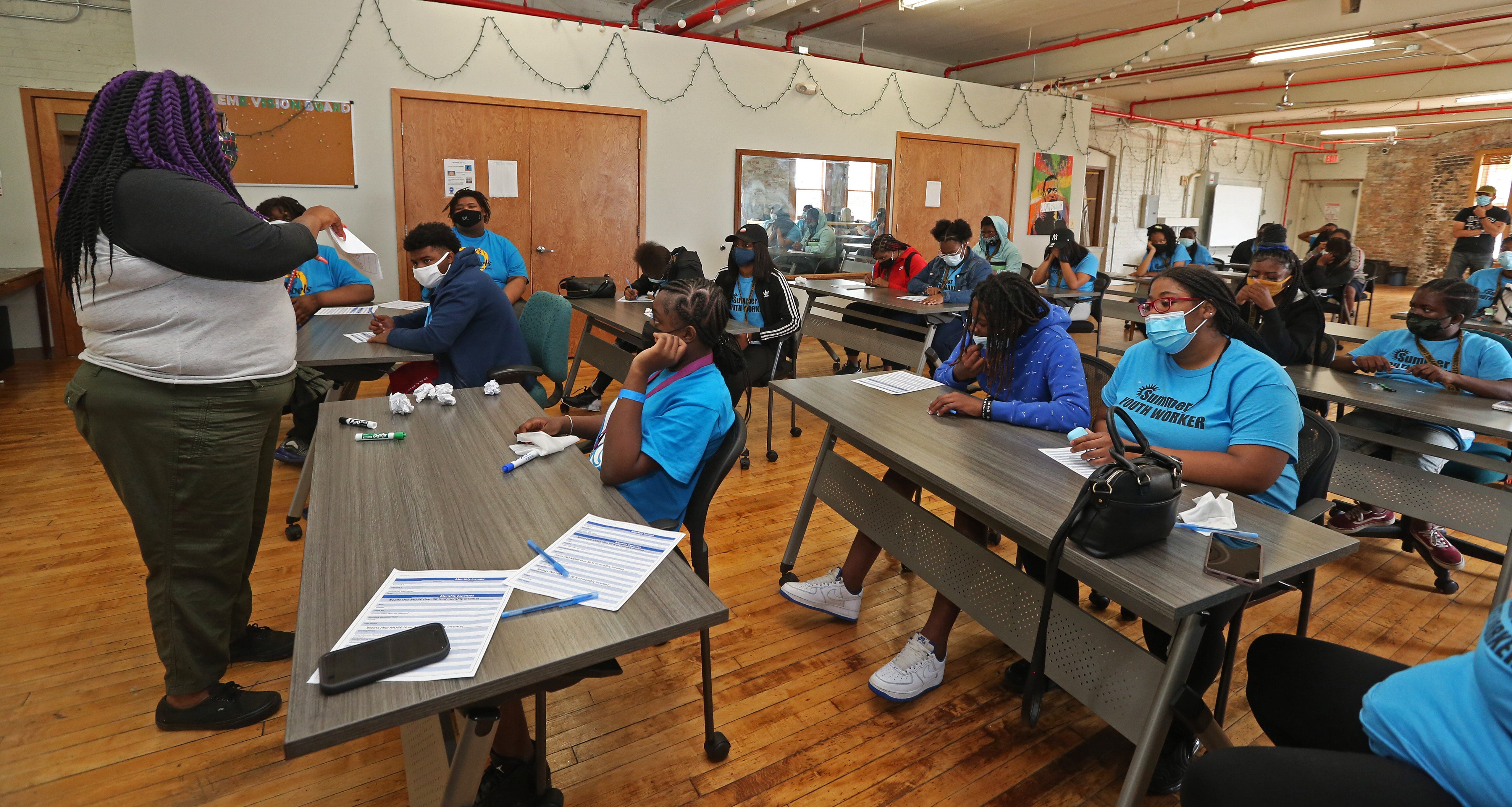
The teens are part of an expanded summer jobs program from Running Rebels Community Organization. For many, it’s their first time earning a paycheck, and their mentors want to make sure they learn how to manage money, too.
“If at the end of this, all you got is some new clothes, then we didn’t do our job,” Victor Barnett, the Rebels’ founder and co-executive director, told the group at the start of the summer.
The Rebels’ jobs program joins a growing movement in Milwaukee to boost financial education for kids and teens. Earlier this year, Milwaukee Public Schools added a personal finance course as a graduation requirement, putting it among only a handful of large urban districts in the country to do so.
Daeshawn Matthews, 15, asks Phil Krull, his team leader, if he can purchase $5 worth of bottled water for his coworkers from a friend who is selling them on the corner of West Fond Du Lac Avenue at Johnson Park in Milwaukee. Krull allows it and retrieves the waters for the boys. Ebony Cox / Milwaukee Journal Sentinel
Twenty-one states require high school students to complete a personal finance class to graduate, according to the most recent report from the Council for Economic Education.
Wisconsin is not one of them.
In 2017, state lawmakers did require school districts to adopt financial literacy academic standards. It’s up to each district to decide how to implement them, leading to a wide variation across the state.
In some districts, a teacher trained in personal finance teaches a stand-alone course. In others, the material is sprinkled in economics, business and technology, or family and consumer science classes.
It’s essential that young people get this education, said David Mancl, director of the state’s Office of Financial Literacy within the Department of Financial Institutions.
“People are going to be dealing with money sooner or later in their lives and what they don’t know about money can hurt them,” he said.
Young people can ruin their credit rating before they even know what it is. They might rely on payday lenders or take out high-interest loans without realizing the consequences. They can go online and day trade stocks in minutes, only to lose their money just as fast.
Before they know it, they can find themselves deep in debt and struggling to pay for school, buy the car they need to get to work or qualify for a mortgage.
“The stakes are really high,” Mancl said.
Young people want to learn about money.
Yet nearly one in five 15-year-olds in the U.S. struggles with basic financial concepts, such as simple budgeting and comparison shopping, according to an international financial literacy assessment released last year.
Financial and investment firms regularly release surveys showing most parents feel uncomfortable talking about money.
“Much of that is because they themselves don’t necessarily feel like they are experts in money management,” said Melody Harvey, an assistant professor at the University of Wisconsin-Madison who studies how public policies affect financial capability.
“I imagine that most parents wouldn’t want to intentionally mislead their children or give wrong information,” she said.
The result is that most of the financial education kids get comes in school, whether as part of economics or math courses, or in the form of programming from nonprofit groups that offer investment clubs, financial mentoring for students or in-class workshops.
Carly Urban, an associate professor at Montana State University, studies financial education mandates, identifying states that require students to have some personal finance content before graduation.
“There’s definitely momentum around it,” Urban said of the requirements. “Ten years ago when I started, not many states had policies or were thinking about it. As we’ve developed the research, almost every state has tried to pass something at some point.”
Research suggests those policies make a difference.
One study from economist Daniel Mangrum found that among first-generation or low-income students who had taken such a course, loan repayment was higher, which suggests those students were more likely to have finished college and found a higher-paying job.
Another study found after personal finance education is required, credit scores go up and delinquency rates go down.
A decade ago, Urban and J. Michael Collins, a professor and financial security researcher at the University of Wisconsin-Madison, were part of the team that examined outcomes in Texas and Georgia after those states implemented a financial education requirement.
J. Michael Collins, a professor and financial security researcher at the University of Wisconsin-Madison University of Wisconsin-Madison
They looked at students’ credit reports through age 22 and found students were less likely to have a negative item on their credit report. They also borrowed more — showing they could better fill out applications for things like credit cards or a car loan — and had a lower delinquency rate on those loans than their peers in states without the graduation requirement.
“We saw that those kids who had the financial education had basically fewer mistakes in their early 20s,” Collins said.
States have differing financial education mandates and various levels of support for them, which can affect outcomes, he said.
Wisconsin’s 2017 requirement did not provide widespread funding. Instead, as a way to avoid giving an unfunded educational mandate, the measure gave districts flexibility to incorporate the material based on their finances and staffing. In early 2020, the state offered $150,000 in competitive grants with a maximum $10,000 per school to encourage more personal finance education.
“I would say both Georgia and Texas had some more teeth,” Collins said. “They were much more standardized and they invested millions.”
It’s game day at Running Rebels.
But the competition isn’t in basketball or Ping-Pong. Instead, it’s financial literacy trivia.
About 30 of the youth workers, including Daeshawn, Takiyah and 15-year-old Arrion Carter, are participating. Earlier in the afternoon, they filled out a budgeting worksheet and reviewed key concepts, such as the steps of comparison shopping to find a good deal.
Britney Morgan, the Rebels’ mentor leading the sessions, calls up three boys and three girls for the first round.
“Remember your training!” she says before launching into the first questions.
What is a budget? A budget is something to tell you where you should spend your money. What are taxes? The money that you have to give to the government.
Britney Morgan, a Running Rebels mentor, who led youth financial literacy lessons
It takes 10 full business days to get a check, it takes two minutes to spend it all.
Morgan pauses, calling it a “good teachable moment.” She explains how those who worked their full 20 hours will see $400 listed on their biweekly paycheck, their gross earnings, and their check will be for a smaller amount, perhaps around $350, which is their net earnings.
“Get in the habit of really reading your check stubs and holding onto them,” she says. “You see how your money is flowing.”
Next question: What is a checking account?
Silence fills the room. Morgan calls on Arrion.
“You have a bank account. Sometimes you have a checking account, sometimes you have a savings one,” he answers.
Morgan goes further, reminding the group their checking account is where their spending money goes and is linked to a debit card, while savings accounts mostly have money coming in and staying in the account.
“If you like swiping that plastic,” she says of the debit card, “it will ruin your life if you are not careful. It takes 10 full business days to get a check, it takes two minutes to spend it all.”
Mickell Harrell, middle, brings up his hardest working group member, Raniyah Kleckley, 15, left, during their graduation ceremony at the Rebels’ Central branch in Milwaukee. The Running Rebels program helped teach students invaluable life skills, money management and the opportunity to have summer jobs. Ebony Cox / Milwaukee Journal Sentinel
These lessons are deliberate. Running Rebels has always hired young people, but this summer the organization launched its largest jobs program ever and made financial education a core component. Sixty-seven teens worked 20 hours a week for 10 weeks. Those old enough were paid $10 an hour, while those 12 to 14 years old received a stipend of $8 per hour.
They tended community gardens, cleaned up parks and staffed tables with COVID information during pop-up neighborhood events, all under the supervision of Rebels staff.
“Our goal is to use people from the community, and empower them to mentor people from their own community,” said Dawn Barnett, Running Rebels’ co-executive director.
Marti Diaz, Milwaukee Public Schools financial literacy teacher mentor
Having a personal finance course opens the gateway for financial freedom.
The challenges faced by staff are the same faced by the wider community. So when she noticed garnishments while processing payroll for a few staff members, she and Victor Barnett, her husband, organized financial education workshops for employees before the summer started.
“Being financially unhealthy seeps into your physical wellness, emotional, mental states of mind,” she said.
The teens at Running Rebels go to public and private schools across the metro area.
Those who are 12 and attend Milwaukee Public Schools will likely have the chance to take a personal finance course, under new requirements passed this year.
MPS is phasing in the new personal finance graduation requirement starting with three high schools, Riverside, Hamilton and GreenTree Prep. The semester-long course covers budgeting, checking and savings accounts, paying for college, credit management, investing, insurance, taxes and behavioral finance. Right now, the course is offered as an elective, but will be a graduation requirement for the class of 2026 at those schools and is expanding to 13 more schools next semester.
“Having a personal finance course opens the gateway for financial freedom,” said Marti Diaz, MPS’ financial literacy teacher mentor who is the course instructor.
Among the 477 students taking the class this fall, 75{1b90e59fe8a6c14b55fbbae1d9373c165823754d058ebf80beecafc6dee5063a} are considered economically disadvantaged and 60{1b90e59fe8a6c14b55fbbae1d9373c165823754d058ebf80beecafc6dee5063a} are Black, 24{1b90e59fe8a6c14b55fbbae1d9373c165823754d058ebf80beecafc6dee5063a} are Hispanic, 19{1b90e59fe8a6c14b55fbbae1d9373c165823754d058ebf80beecafc6dee5063a} are Asian, 3{1b90e59fe8a6c14b55fbbae1d9373c165823754d058ebf80beecafc6dee5063a} white and 1{1b90e59fe8a6c14b55fbbae1d9373c165823754d058ebf80beecafc6dee5063a} are multiracial.
“We talk about the history of racism in banking, the fact that there’s some predatory lending in our communities,” Diaz said.
The district plans to launch the curriculum at its remaining high schools with the last cohort starting in spring 2023. Prior to this, students “had access to personal finance education,” which had been “embedded in other courses and taught with a variety of instructional resources,” according to a presentation this fall to the board.
The district has contracted with Secure Futures, CLIMB USA and Junior Achievement to provide some personal finance lessons, but those often were units within larger courses or workshops. Fund My Future Milwaukee, which aims to open a 529 college savings account for every 5K student, also has provided financial literacy lessons at participating schools.
Now, MPS will have teachers trained on the standalone curriculum. The effort is backed by a three-year $490,000 grant from Next Gen Personal Finance, a national financial literacy nonprofit, to pay for Diaz’s salary and benefits and other program costs. The state Department of Financial Institutions with support from the Department of Public Instruction also contributed $30,000 in grant money and the district has used some COVID relief funding, too.
Marti Diaz, who teaches financial literacy at Milwaukee Public Schools, works with personal finance students, Edison Lee, right, and Mariah Jones, center, who are both seniors at Riverside High School. Mike De Sisti / Milwaukee Journal Sentinel
Tim Ranzetta, Next Gen’s co-founder, is an evangelist for personal finance education as a standalone course, rather than included in economics or other classes where teachers already have a lot of material to get through.
“It doesn’t work if it’s embedded in another course,” he said.
Others have argued it’s better to have some financial education, even if it is spread across other subjects, rather than none at all or forcing teachers who aren’t trained in the subject to teach it.
About one-third of Wisconsin’s high schools publish public online course catalogs. Using that information, Urban found about 43{1b90e59fe8a6c14b55fbbae1d9373c165823754d058ebf80beecafc6dee5063a} of those 271 schools required students take a standalone financial course in the 2020-21 academic year. Another 44{1b90e59fe8a6c14b55fbbae1d9373c165823754d058ebf80beecafc6dee5063a} offered a standalone course, while just over 10{1b90e59fe8a6c14b55fbbae1d9373c165823754d058ebf80beecafc6dee5063a} had it embedded in other courses. Fewer than 2{1b90e59fe8a6c14b55fbbae1d9373c165823754d058ebf80beecafc6dee5063a} did not offer the material.
Nationwide, about one in five high-schoolers are guaranteed to have access to a personal finance course. But for districts that predominantly serve Black and brown students, the number plummets to 1 in 14, according to research funded by Next Gen.
To Robert Wynn, a former financial education officer at the Wisconsin Department of Financial Institutions, those statistics reinforce the importance of financial education as a matter of social justice.
Robert Wynn, founder of financial literacy nonprofits CLIMB USA and Asset Builders
If we just dealt with policy issues on incarceration, inequality, or even police brutality, you really don’t get to the core issue, which is power. And power really does come from wealth in this country.
Wynn has made it his life’s work to teach young people of color about investing and stocks through Asset Builders and CLIMB USA, which has provided investment education in MPS and activities for Running Rebels.
“If we just dealt with policy issues on incarceration, inequality, or even police brutality, you really don’t get to the core issue, which is power,” Wynn said.
“And power really does come from wealth in this country.”
It’s the last day of the Running Rebels jobs program and time for awards.
Daeshawn, whose favorite work site was Alice’s Garden, is honored for having earned the most points this summer for attendance, taking part in extra activities and having a good attitude.
He’s one of four teens asked to come onstage and take a turn at the microphone. The most important thing he learned, he says, is communication.
Dawn Barnett, right, speaks to Running Rebels graduates about life lessons and how they’re one decision away from a new life during their graduation ceremony at the Rebels’ Central branch at 1300 W. Fond Du Lac Ave. Ebony Cox / Milwaukee Journal Sentinel
Of the 67 youths who started the 10-week program, 61 finished and received a bonus $150 savings stipend for their newly opened bank accounts. United Way of Greater Milwaukee and Waukesha Counties provided $100,000 in funding for wages, saving incentives and supervision.
Takiyah, who happened to be in Daeshawn’s group, also is called up for an award for her “diligence.” This summer boosted her confidence, she says.
She opened her first bank account as part of the summer program after learning about the high fees of check-cashing operations.
“I learned that it’s best to save and not to spend all at once, and that even though you might want a lot of stuff, it’s not best to get it right then and there,” she said. “It’s best to get what you need first.”
She’s saving much of her summer earnings for college.
“This shows that I can do it,” she said. “I can work, and I can make my own money and I can do what I need to do financially for myself.”
Next Gen Personal Finance offers free online games for people of all ages. Can you make it through a month living paycheck to paycheck? Find out using Spent. Want to see the consequences of 20 years of investing over 20 years? Check out Stax. All games are available online at ngpf.org/arcade.
Running Rebels Community Organization is built on mentoring. There are opportunities for young people to get involved, for adults to mentor and for supporters to donate or contribute by purchasing items off the group’s wish list. Details available online at runningrebels.org.
Asset Builders and CLIMB USA provide investment workshops inside and outside the classroom, and other opportunities for young people and adult volunteers. More information is at assetbuilders.org and climbusa.org.
Secure Futures connects educators and volunteers to provide in-class financial capability instruction with participating schools. To learn how to get involved, go to securefutures.org.
Betches, the woman launched media and amusement firm, currently announces a new personalized finance podcast, “Money Be sure to.” The podcast will be hosted by Berna Anat (@HeyBerna), a self-proclaimed “Financial Buzz Girl,” who will guideline listeners by way of cash building decisions that will reward them in the extended operate. She will contact on almost everything from how to navigate a 401k to understanding what goes into buying a dwelling. General public.com, the well-liked investing application with a community of 1M+ members, will provide as the podcast’s presenting sponsor for the initially 5 episodes of season one.
The weekly podcast will function money analysts, financial investment educators, personal debt gurus and far more along with Berna to share suggestions, guidelines and assets obtainable for listeners to expend properly. On Thursdays, Income Please will air a “Loose Change” episode, which will be a continuation of the guest interview from earlier in the 7 days, with further dialogue on that week’s matter.
“In this freaky capitalistic hellscape we’re all caught in, income treatment is self care. But we are done with finding funds information exclusively from unrelatable finance dudebros and scorching-breath Fb uncles,” says host Berna Anat. “I’m honored to husband or wife with Betches to assist make economical education and learning sense much more available, partaking, and freakin’ pleasurable — in particular for my fellow very first-gen learners starting from scratch. Honestly, I lowkey made use of this podcast as a professional justification to strike up my smartest finance buddies. I’m hyped to attribute their brilliance and amplify as numerous underrepresented financial voices as feasible.”
“Money Please” joins Betches’ podcast community slate of well-liked demonstrates which include millennial dating and romantic relationship podcast “U Up?,” wellness podcast “Diet Starts Tomorrow,” and real criminal offense podcast “Not A different True Criminal offense Podcast,” amongst other people.
“After seeing what presently exists in the financial instruction area and listening to our community’s requirements, we felt that there was a large prospect to make content material that breaks down the complex issues that young ladies are struggling with when it comes to their finances, in a fun and engaging manner,” claims Sami Sage, Co-Founder and Chief Content material Officer of Betches Media. “Pairing this observation with our 136{1b90e59fe8a6c14b55fbbae1d9373c165823754d058ebf80beecafc6dee5063a} YOY growth on @whenshappyhr Instagram account (Betches’ vertical dedicated to career & finance), it was an clear next move for us. We think it is these types of a significant conversation, and we’re proud to teach our viewers on money selections because it is a single of the key foundations for females who want regulate above their career paths and futures.”
The very first episode of “Money Please” from Betches will be out there on all significant podcast platforms on Thursday, Oct 26th. Subscribe to hear Right here.
Happy Friday and welcome to On The Money, your nightly guide to everything affecting your bills, bank account and bottom line. Subscribe here: thehill.com/newsletter-signup.
Today’s Big Deal: The September jobs report showed a labor market still struggling through a resurging pandemic. We’ll also look at the aftermath of yesterday’s debt ceiling deal.
But first, find out why Elon MuskElon Reeve MuskElon Musk announces Telsa headquarters to move to Texas Why electric F-150s will not help the climate Russian film crew beats Tom Cruise in race to shoot first movie in space MORE is moving to Texas.
For The Hill, I’m Sylvan Lane. Write me at slane@thehill.com or @SylvanLane. You can reach my colleagues on the Finance team Naomi Jagoda at njagoda@thehill.com or @NJagoda and Aris Folley at afolley@thehill.com or @ArisFolley.
Let’s get to it.
Five takeaways from the September jobs slowdown
The surge of the delta variant kept weighing on the economy in September as the U.S. added just 194,000 jobs last month. While the unemployment rate dropped sharply from 5.2 percent to 4.8 percent, it was largely due to the size of the labor force holding steady.
Economists had expected a gain of roughly 500,000 after a very disappointing August report, but saw little relief as consumer confidence, school closures and health concerns limited the labor market.
Economists are hopeful that the September jobs report, which is based on surveys conducted shortly before the peak of the delta surge, marks the worst of the slowdown. President BidenJoe BidenArkansas lawmakers advance bill prohibiting businesses from demanding workers’ vaccine status Senate approves short-term debt ceiling increase On The Money — Presented by NRHC — Senate slowly walks back from debt disaster MORE also touted signs of “steady progress,” expressing confidence in an October turnaround.
But the September jobs report highlighted just how hard it is to foster a full recovery without the pandemic under control.
The pandemic is still the primary factor
While the economy recovered much of the damage from the onset of the pandemic, the delta surge has revived several familiar problems.
Sectors hindered most by health concerns continued to struggle in September, with restaurants and bars seeing no employment growth for the second consecutive month. Employment growth in the food and beverage service industry has been a key bellwether for the recovery from the pandemic, making a second month without gains a cause for concern.
Demographic groups hit hardest by the pandemic also saw disappointing setbacks as delta put the squeeze on the labor market Smart Business.
While the labor force participation rate stayed roughly even at 61.7 percent last month and 70 percent for men, it fell from 56.2 percent to 55.9 percent for women. Women have been disproportionately more likely to both lose their jobs amid the onset of the pandemic and be unable to return to the workforce because of pandemic-related constraints.
“Nearly 200,000 left the labor force during the month, reversing the gains from August. All of the losses were women,” explained Diane Swonk, chief economist at Grant Thornton, in a Friday analysis.
“Mothers continued to struggle with childcare and the challenge of quarantines after schools reopened. We are still down three million workers from February of 2020; women make up 64{1b90e59fe8a6c14b55fbbae1d9373c165823754d058ebf80beecafc6dee5063a} of those workers.”
The Black unemployment rate also dropped by nearly a percentage point, but largely due to a steep decline in labor force participation as well.
Education skews the picture
Jobs in public education fell off a cliff in the September jobs report, declining by 144,000 at a time when the sector is expected to add jobs. But the Bureau of Labor Statistics, along with many private sector economists, attributed the drop to the pandemic’s volatile impact butting heads with seasonal adjustments.
“School staffing fluctuations related to the pandemic have distorted normal hiring patterns – such as back to school hiring that normally happens in September. Seasonal adjustments can further confound these distortions,” said Gordon Gray, director of fiscal policy at the right-leaning American Action Forum.
Gray highlighted the addition of 317,000 private sector jobs, which was in line with August’s revised gain of 332,000 jobs in non-government firms.
A MESSAGE FROM NRHC
We Believe in Rental Housing
Single-family rental home companies are helping residents experiencing economic hardship and ensuring a ready supply of quality, affordable, well-located rental housing.
FEDERAL JOBLESS BENEFITS LAPSING DID LITTLE TO SPUR THE LABOR MARKET
Policymakers were hopeful that many of the 6.2 million Americans who lost their unemployment benefits when federal aid programs expired Sept. 6 would quickly find jobs. That did not appear to happen.
Labor force participation stayed largely flat in September despite the lack of federal benefits, the number of people who would like to work but are not looking for jobs stayed even at 6 million, and 1.6 million Americans remained unable to take a job because of a pandemic-related constraint.
“The larger than expected decline in the unemployment rate should not be much comfort because it was not driven by acceleration in job finding among the unemployed,” said Aaron Sojourner, an economics professor at the University of Minnesota and former economist on the White House Council of Economic Advisors.
“The number of people coming off the sidelines to search fell by 400,000 relative to last month.”
Businesses are still scrambling for workers
Job openings have remained at record highs for several months with millions of Americans still out of the workforce. The high demand for workers has pushed wage growth higher, with average hourly earnings rising by 0.6 percent last month alone. Employees also worked more hours in September as businesses struggling to fill positions leaned heavily on existing staff.
“I suspect many employers hoped to limp through summer without boosting posted wages as fast as required to make new hires, on the hope that [unemployment insurance] cuts and [schools] reopening would lead to a surge in labor supply in the fall,” Sojourner wrote in an email.
“Corporate profits are up. Many companies can afford bigger raises but managers resist baking in higher hourly labor costs.”
This may be the worst report for a while
If you were looking for the gloomiest time to gauge the health of the labor market in September, the jobs report nailed it.
The Labor Department conducts two surveys to source data for the monthly jobs report around the 12th day of the month. The U.S. was approaching the peak of daily COVID-19 cases driven by the delta variant at the time, and millions of Americans lost their jobless benefits less than a week before.
“The September jobs report is a glimpse in the rearview mirror,” wrote Daniel Zhao, senior economist at Glassdoor, in a Friday analysis.
“Cases of COVID-19 have dropped significantly since the beginning of September and the labor market is likely to return to the same place it was before the Delta surge.”
LEADING THE DAY
House to vote Tuesday on debt limit hike
The House will interrupt a scheduled recess next week to vote Tuesday on Senate-passed legislation to extend the debt limit into December.
The House, which had been long scheduled to be out of session this week and next coinciding with the Columbus Day holiday, is expected to quickly resume its recess as soon as lawmakers clear the debt limit extension Tuesday night.
“The Speaker [Nancy PelosiNancy PelosiHouse to vote Tuesday on debt limit hike On The Money — Presented by NRHC — Senate slowly walks back from debt disaster House Democrats urge leaders to keep housing in reconciliation bill MORE] and I have both spoken with Treasury Secretary Yellen, who said that if the House fails to act next week, the country will be unable to pay its bills. This cannot happen. Therefore, the House will convene on Tuesday, October 12, to pass this stopgap measure, and I expect we will complete our work that evening,” House Majority Leader Steny HoyerSteny Hamilton HoyerHouse to vote Tuesday on debt limit hike Senate approves short-term debt ceiling increase Energy & Environment — Presented by the American Petroleum Institute — Biden leaves meeting saying ‘it doesn’t matter’ when bill is passed MORE (D-Md.) said in a statement.
How we got here:
Earlier Thursday, the Senate passed a short-term debt limit extension in a vote that divided Republicans who had previously vowed to oppose any measure to prevent a default.
While the bill passed along party lines, 50-48, 11 Republicans voted with Democrats to overcome a procedural hurdle that required 60 votes.
A MESSAGE FROM NRHC
We Believe in Rental Housing
Single-family rental home companies are helping residents experiencing economic hardship and ensuring a ready supply of quality, affordable, well-located rental housing.
Good to know
The Organization for Economic Cooperation Development (OECD) announced Friday that 136 countries have agreed to a deal on a global minimum corporate tax of 15 percent.
Here’s what else have our eye on:
On tap next week
Tuesday:
The Peterson Institute for International Economics holds a webinar on inflation at 12:30 p.m.
Wednesday:
The Bipartisan Policy Center holds a webinar on Social Security and the future of the program at 10 a.m.
The House Financial Services Committee task force on artificial intelligence holds a hearing on the ethics of AI at 12 p.m.
Thursday:
A House Financial Services subcommittee holds a hearing on the implications of a cashless economy at 12 p.m.
That’s it for today. Thanks for reading and check out The Hill’s Finance page for the latest news and coverage. We’ll see you Monday.
You have produced a little added funds with your final paycheck and have some leftover just after spending for your home loan or rent, furthermore any other important expenses. Fairly than spending the cash frivolously, you want to stash it in a price savings account or use it to knock out some of the credit card debt which is been weighing greatly in the back of your thoughts.
But which is the million-greenback dilemma: should really you conserve your funds or pay out off your debts 1st, specially when it arrives to expending further earnings extended-term?
In reality, both equally of these paths can be advantageous. But let us break down the advantages of saving your cash or paying out off your money owed initial, so you know what to do occur next payday.
Conserving Money – When Is It a Superior Idea?
Conserving money is always wise, and it’s simpler than ever, thanks to computerized conserving applications. In addition, the banking and funding sector give their individual resources thanks to AI Chatbots and comparable developments. In any circumstance, conserving income can be an great decision if you want to create up plenty of money for any of these plans.
Unexpected emergency Fund
An crisis fund is a tiny further money you stash away for the proverbial rainy working day. With an unexpected emergency fund, you won’t have to acquire out a bank loan or use your credit history card to include the price tag of vehicle repairs, residence repairs, or even small medical charges. Furthermore, an emergency fund can assistance tide you about from occupation to job if you get rid of your present-day place owing to a earth party like the pandemic or one thing else.
If you don’t have an unexpected emergency fund in spot, you could require to get out own loans that permit you to borrow money for a set period of time. Nevertheless, you’ll then need to have to pay back back the loans quicker or later, adding yet another debt to reckon with later down the street.
Help save Up for a Significant (Essential) Purchase
It’s also a great idea to help save money to make a major acquire relatively than use a credit card or mortgage any time feasible. Save up for a Tv, a new auto, or even new home furnishings for your household, and you will keep away from harming your credit score score, moreover practice good money duty.
Add to Your 401(k) Strategy
If your employer has a 401(k) system with a fantastic matching percentage, it’s a no-brainer to funnel some of your paycheck into that prepare, so you profit from utmost retirement personal savings ASAP.
Advantages of Shelling out Off Personal debt Rapidly
Even so, it may perhaps also be wiser to promptly shell out off your financial debt with a profitable technique for your funds for the adhering to causes.
Several Money owed with Independent Desire Rates
If you have many debts in your title and they every have a separate desire fee, every of those people money owed will accrue curiosity. More than time, this can seriously influence your wallet negatively and direct you to pay back considerably extra revenue for every loan more than its life span than you would or else. If this is the monetary condition for you, it could be smarter to shell out off your debts ASAP just so that numerous interest costs stop accruing.
You Have Debt Collectors Calling You
If your money owed are so bad that credit card debt collectors or other companies are hounding you constantly about generating payments, spending off your debts sooner fairly than later on may perhaps be your most effective selection.
Your Credit history Rating is Dropping
If your credit score rating has dropped considerably and is continue to plummeting, you can arrest that by paying off your debts swiftly and start off rebuilding your credit score shortly following.
How to Help you save and Pay out Off Money owed Simultaneously
In some conditions, you may well not have to save cash or spend off your debts you may well be capable to do both at around the exact same time and choose cost of your finances. Here’s how.
Fork out Off Debts Working with the Snowball System
The snowball strategy of credit card debt payments consists of shelling out off the smallest debts below your name completely as soon as possible. Then, when individuals debts are accomplished, transfer on to the upcoming maximum obligations, then the following maximum, and so on until you are debt-absolutely free.
In doing this, you’ll fork out much less money in curiosity around time and rebuild your credit rating score concurrently.
Of program, if you decide not to shell out off your debts ASAP, you might want to invest in everyday living coverage. For illustration, if you die unexpectedly, some of your debts could transfer to many others in your family, like your husband or wife. A in depth everyday living insurance policy policy that arrives with assures like loss of life gains can present your spouse or other spouse and children associates with enough funds to pay off your money owed and prevent them from becoming impacted by them for decades afterward.
Help save Following Your Debts Are Paid out
The moment your money owed are cleared, you can then start out conserving aggressively yet again. Any money you would have funneled towards your debts can be positioned in a cost savings account, in your 401(k), or otherwise saved for foreseeable future fiscal ambitions.
How A lot Must You Preserve?
Despite the fact that saving any amount of money of cash is a excellent thought, quite a few gurus suggest that you really should make up your emergency fund, so it is more than enough for amongst 3 and six months’ worthy of of your costs. To build up more than enough money for that, stash it in a price savings account, and you’ll be fairly secure in the occasion of yet another sizeable financial disruption like the COVID-19 pandemic.
Make an Unexpected emergency Fund
For starters, make an emergency fund of at the very least a handful of hundred bucks by preserving aggressively for the initially couple weeks or months of your system. Once you have this emergency fund in spot, you can transfer on to the next step. You can use an crisis fund calculator to compute funds for an ideal amount of crisis financial savings based mostly on your income, monthly bill payments, and a lot more.
Summary
Ultimately, conserving cash and spending off your money owed are both equally sensible selections – you need to be proud of by yourself for considering both of them relatively than throwing away any more funds you have.
With the proper system and some self-reflection, you can decide no matter if it is smarter to pay out off your money owed first, conserve money until eventually you have a small nest egg in a discounts account, or do both of those at the very same time, dependent on how a great deal funds you have to get the job done with.
Welcome to Personal Finance Insider, a biweekly newsletter that connects you with the stories, strategies, and tips you need to be better with money.
Rachel Mendelson/Insider
Here’s what: Books I’m currently obsessed with
I’m a book lover. You can find me reading no less than three books at any given time. Usually one is a novel and the other two are nonfiction.
Picking up a nonfiction book is one of the most cost-effective ways to mentally download a ton of information about a particular topic. And there’s no shortage of books about my favorite topic of all: personal finance.
I’ve read dozens of books about money, and many of them have been helpful in teaching me the basics — how to save, invest, and budget. But today I want to share four books with you that have given me an entirely new understanding of my relationship to money. Here are my current obsessions:
Brian Portnoy’s “The Geometry of Wealth” is full of insights that inspire me to think about how I can use money to shape my ideal life. He brings in lessons from other disciplines — history, neuroscience, and philosophy — to illustrate how everything in life is connected to money and how we can use that to our advantage.
Morgan Housel’s “The Psychology of Money” implored me to think about how we behave as investors, savers, and earners. He takes what we assume to be true about money and turns it inside out. I’m always game for new perspective.
Rachel Rodgers’ “We Should All Be Millionaires” is a new book, released this past spring, that had me hooked from the introduction. Rodgers’ financial ambition is infectious, plus her ideas are inventive and totally actionable. This book has reminded me to never sell myself short.
Ramit Sethi’s “I Will Teach You To Be Rich” has been a favorite for years. It was first published in 2009 and updated a decade later. In addition to really helpful beginner investing and money management advice, Sethi introduces the concept of building a “Rich Life” for yourself and how to identify and get over your money hangups. It’s always relevant.
Happy reading!
—Tanza Loudenback, Personal Finance Insider correspondent and certified financial planner
P.S. My time at Insider is coming to a close — it’s been a pleasure sharing my money musings with you over the past year. Going forward, senior editor of Personal Finance Insider Stephanie Hallett will be authoring this newsletter.
Insider
Ad: This startup wants to help you plan for an easy retirement
After seeing too many people miss opportunities to maximize their retirement income, SmartAsset developed a free tool that helps you find unbiased, expert advice. If you’re ready to make smarter decisions around investing your 401(k), optimizing your savings, and minimizing taxes, SmartAsset’s tool can help you accomplish your financial goals. Learn More »
Disclaimer: SmartAsset is an Insider affiliate partner. We may earn money when you use our links. Learn more.
Join the Master Your Money Bootcamp
In our first two Master Your Money Bootcamps of the year, we got organized — and then we used that mental space to start dreaming big and crunching the numbers. Now we’re taking action.
Our third Master Your Money Bootcamp: Make a plan, presented by Fidelity, is a month-long challenge broken down into simple, one-week exercises. We’ll walk you through tasks that include finding the right accounts for your goals, opening those accounts, setting up an automated system, and figuring out whether you could benefit from professional help.
You don’t even have to sign up. Just check back here for a new exercise every week, or jump in at any time, and follow along on Twitter, Facebook, LinkedIn, and Instagram.
Stories you might have missed
5 strategies an entrepreneur used to go from making $41,000 a year to being a multimillionaire in her 30s
This is a taste of the inspiring advice you’ll find from Rachel Rodgers in “We Should All Be Millionaires,” one of the books I recommend at the top of this newsletter.
Extreme frugality was so stressful it made it hard for me to save, but my new system is helping me save thousands more every year
Insider contributor Katherine McLaughlin set up two separate
checking accounts for spending after realizing that just because she was “good” with money didn’t mean she had a good relationship with it.
I travel the US full-time on $90,000 a year by following a few smart money rules
Angie Colee, a confidence coach who works with entrepreneurs, has been Airbnb hopping while working for the last nine months. She explains the financial moves she made to take the leap, and how she keeps it going.
5 challenges I did with my husband to save an extra $2,500 in 2021
If you’re looking for ways to bulk up your savings account before year’s end, here are some simple ideas that worked for Insider contributor Jen Glantz.
Enjoying this newsletter and want to recommend it to a friend? Here’s a sign-up link.
Tanza Loudenback
Correspondent, Personal Finance Insider
Tanza is a CERTIFIED FINANCIAL PLANNER™ and former correspondent for Personal Finance Insider. She broke down personal finance news and wrote about taxes, investing, retirement, wealth building, and debt management. She helmed a biweekly newsletter and a column answering reader questions about money. Tanza is the author of two ebooks, A Guide to Financial Planners and “The One-Month Plan to Master your Money.” In 2020, Tanza was the editorial lead on Master Your Money, a yearlong original series providing financial tools, advice, and inspiration to millennials. Tanza joined Business Insider in June 2015 and is an alumna of Elon University, where she studied journalism and Italian. She is based in Los Angeles.










/https://specials-images.forbesimg.com/imageserve/6164f3a9295c0fb40c160cbc/0x0.jpg "Betches Media Announces New Original Podcast, “Money Please,” Dedicated To Personal Finance For Millennials And Gen Z")

 Elon Reeve MuskElon Musk announces Telsa headquarters to move to Texas Why electric F-150s will not help the climate Russian film crew beats Tom Cruise in race to shoot first movie in space MORE
 Joe BidenArkansas lawmakers advance bill prohibiting businesses from demanding workers’ vaccine status Senate approves short-term debt ceiling increase On The Money — Presented by NRHC — Senate slowly walks back from debt disaster MORE
 Nancy PelosiHouse to vote Tuesday on debt limit hike On The Money — Presented by NRHC — Senate slowly walks back from debt disaster House Democrats urge leaders to keep housing in reconciliation bill MORE
 Steny Hamilton HoyerHouse to vote Tuesday on debt limit hike Senate approves short-term debt ceiling increase Energy & Environment — Presented by the American Petroleum Institute — Biden leaves meeting saying ‘it doesn’t matter’ when bill is passed MORE