CyberCube issues “call to action” for carriers

CyberCube issues “call to action” for carriers

“The main conclusion that I draw from the report,” she said, “is that this is a call to action for carriers to assess the cyber risk in non-affirmative policies – to quantify that risk, and then to underwrite and price it accordingly, and then to apply good portfolio management and enterprise risk management best practices to them.

“And it’s also good for policyholders to have that clarity of cover, [to know] what it is that may be covered and how their policies might respond. I think that call to action for carriers to dig into their portfolios and assess that cyber risk in them was probably the stronger takeaway for me than the actual numbers themselves necessarily.”

If recent high-profile cyber security events haven’t sharpened the attention of the industry when it comes to cyber then they ought to, Bole noted. CyberCube’s modeled one-in-100 year loss estimate suggested that the US property market is exposed to $9.5 billion of attritional losses, she said, which is in keeping with the waves of ransomware attacks being seen across the wider market where data loss is still prevalent and those types of claims are being paid.

Looking at the $3 billion of catastrophic losses, she said, it’s again around ransomware and data loss.

“The report highlights that not just catastrophic but attritional losses are being paid outside of standalone cyber policies,” Bole said. “But also that, within those catastrophic losses, the types of attacks that are occurring and could occur in today’s environment would certainly hit some of those non-affirmative policies as well.”

Exploring whether more carriers are now looking to explicitly include or exclude cyber coverage in their policies, Bole stated that the UK has led the way on this subject with work done by the LMA, Lloyd’s and the PRA calling for explicit treatment for cyber exposures in non-affirmative policies. The rest of the world is starting to follow that lead from a regulatory oversight perspective, she said, and some carriers have acted early to address cyber cover in non-standalone policies.

“It is being underwritten and priced accordingly by some carriers, whereas others are less mature in this process, and may be disproportionately exposed to cyber losses,” she said. “Like any market, there are early movers and there are some who take more time. In saying that, even where that explicit treatment is being made, I think there still remains ambiguity in the language. I think there is still a need for good cyber hygiene to be top of mind, for carriers to model their own individual portfolios, to stress-test those portfolios, to work with their own capital requirements and also risk transfer, through reinsurance, for example, to appropriately manage that risk.”

The wider regulatory framework around cyber is driving the direction of the coverage and governance plays a strong part in producing clarity and creating a robust cyber market. And, as suggested by the report, Bole said, some actions can also be taken by industry players to mitigate their own exposures.

“The definition of good cyber hygiene will differ across different market participants,” she said, “[so] I would reiterate the need to identify that cyber exposure, to model your own portfolios, to understand where that cyber exposure is and then underwrite that exposure, price it, and then manage the risk internally through portfolio management, risk transfer and capital allocation. I think through the combination of those actions, you will be able to create robust risk transfer for cyber exposures.”

Jury finds major pharmacy chains helped fuel opioid epidemic

Jury finds major pharmacy chains helped fuel opioid epidemic

(Reuters) — A federal jury Tuesday found that pharmacy chain operators CVS Health Corp., Walgreens Boots Alliance Inc. and Walmart Inc. helped fuel an opioid epidemic in two Ohio counties, in the first trial the companies have faced over the U.S. drug crisis.

After six days of deliberations, jurors in Cleveland federal court concluded that actions by the pharmacy chains helped create a public nuisance that resulted in an oversupply of addictive pain pills and the diversion of those opioids to the black market.

The verdict, which lawyers for the counties confirmed, has the potential to give state and local governments new leverage in their efforts to negotiate settlements that would resolve the thousands of other cases against the pharmacy operators.

“The judgment today against Walmart, Walgreens and CVS represents the overdue reckoning for their complicity in creating a public nuisance,” the plaintiffs’ lawyers said in a joint statement.

Jurors only assessed liability. It is up to U.S. District Judge Dan Polster to decide how much the companies owe to abate, or address, the public nuisance in Ohio’s Lake and Trumbull counties.

He has tentatively scheduled a trial on that question for May 9. The counties’ lawyers have said the costs are potentially $1 billion for each county.

CVS said in a statement that it strongly disagreed with the verdict and planned to appeal, arguing that the court misapplied public nuisance law, which other courts in similar opioid cases have recently declined to apply to drug manufacturers.

“As plaintiffs’ own experts testified, many factors have contributed to the opioid abuse issue, and solving this problem will require involvement from all stakeholders in our health care system and all members of our community,” CVS said.

Representatives for Walgreens and Walmart did not immediately respond to requests for comment.

The trial was the first that any pharmacies had faced over an epidemic that U.S. health officials say had by 2019 resulted in nearly 500,000 opioid overdose deaths over the course of two decades.

At trial, lawyers for Lake and Trumbull counties argued that the pharmacies failed to ensure opioid prescriptions were valid and allowed excessive quantities of addictive pain pills to flood their communities.

The pharmacy operators, among the largest in the United States, denied the allegations. They said they took steps to guard against the diversion of pills and blamed others, including doctors, regulators and drug traffickers, for the epidemic.  

The verdict in the Ohio trial followed recent setbacks for plaintiffs pursuing some of the other 3,300 opioid cases filed against drug manufacturers, distributors and pharmacies nationally.

Oklahoma’s top court on Nov. 9 overturned a $465 million judgment against drugmaker Johnson & Johnson, and a California judge this month ruled in favor of four drugmakers in a case brought by several large counties.

Other trials are underway in New York involving drugmakers Teva Pharmaceutical Industries Ltd. and AbbVie Inc., and in Washington state with the three largest U.S. drug distributors.


Business Insurance Market May See Big Move | Allianz, AXA, State Farm

Business Insurance Market May See Big Move | Allianz, AXA, State Farm

The ” Business Insurance – Market Development Scenario ” Study has been added to HTF MI database. The study covers in-depth overview, description about the Product, Industry Scope and elaborates market outlook and growth status to 2027. At present, the market is developing its presence following current economic slowdown and its Impact. Some of the key players considered in the study are Allianz, AXA, Nippon Life Insurance, American Intl. Group, Aviva, Assicurazioni Generali, Cardinal Health, State Farm Insurance, Dai-ichi Mutual Life Insurance, Munich Re Group, Zurich Financial Services, Prudential, Asahi Mutual Life Insurance, Sumitomo Life Insurance, MetLife. The market size is broken down by relevant regions/countries, segments and application that may see potential uptrend or downtrend.

Get Inside Scoop of the report, request for sample @: https://www.htfmarketreport.com/sample-report/3692724-business-insurance-market-1

“Keep yourself up-to-date with latest market trends and changing dynamics due to Economic Slowdown globally. Maintain a competitive edge by sizing up with available business opportunity in Business Insurance Market various segments and emerging territory.”

Market Overview of Business Insurance:

The Study covers exploration of all necessary data related to the Business Insurance market. All phase of the market is analyzed thoroughly in the Study to provide a review of the current market working. The estimates of the revenue generated of the market includes opportunity analysis using various analytical tools and past data. To better analyze the reasoning behind growth estimates detailed profile of Top and emerging player of the industry along with their plans, product specification and development activity.

With qualitative and quantitative analysis, we help you with detailed and comprehensive study on the market. We have also focused on SWOT, PESTLE, and Porter’s Five Forces analyses of the
Business Insurance market.

Buy Single User License of Business Insurance Market – Global Outlook and Forecast 2021-2027 @ https://www.htfmarketreport.com/buy-now?format=1&report=3692724

Scope of the Report

On the Basis of Product Type of Business Insurance Market: , Commercial Property Insurance, Commercial Health Insurance & Other

The Study Explores the Key Applications/End-Users of Business Insurance Market: Large Corporations, Small and Medium-Sized Companies & Personal

On The basis of region, the Business Insurance is segmented into countries, with production, consumption, revenue (million USD), and market share and growth rate in these regions, from 2014 to 2025 (forecast), see highlights below

** North America (USA & Canada) Market Revenue (USD Billion), Growth Analysis ({1b90e59fe8a6c14b55fbbae1d9373c165823754d058ebf80beecafc6dee5063a}) and Opportunity Analysis
** South Central & Latin America (Brazil, Argentina, Mexico & Rest of Latin America) Market Revenue (USD Billion), Growth Share ({1b90e59fe8a6c14b55fbbae1d9373c165823754d058ebf80beecafc6dee5063a}) and Opportunity Analysis
** Europe (The United Kingdom., Germany, France, Italy, Spain, Poland, Sweden, Denmark & Rest of Europe) Market Revenue (USD Billion), Growth Share ({1b90e59fe8a6c14b55fbbae1d9373c165823754d058ebf80beecafc6dee5063a}) and Opportunity Analysis
** Asia-Pacific (China, India, Japan, ASEAN Countries, South Korea, Australia, New Zealand, Rest of Asia) Market Revenue (USD Billion), Growth Share ({1b90e59fe8a6c14b55fbbae1d9373c165823754d058ebf80beecafc6dee5063a}) and Opportunity Analysis
** Middle East & Africa (GCC, South Africa, Kenya, North Africa, RoMEA) Market Revenue (USD Billion), Growth Share ({1b90e59fe8a6c14b55fbbae1d9373c165823754d058ebf80beecafc6dee5063a}) and Opportunity Analysis
** Rest of World

Know more about of Business Insurance market report , review synopsis and complete toc @: https://www.htfmarketreport.com/reports/3692724-business-insurance-market-1

Business Insurance Competitive Analysis:

The key players are aiming innovation to increase efficiency and product life. The long-term growth opportunities available in the sector is captured by ensuring constant process improvements and economic flexibility to spend in the optimal schemes. Company profile section of players such as Allianz, AXA, Nippon Life Insurance, American Intl. Group, Aviva, Assicurazioni Generali, Cardinal Health, State Farm Insurance, Dai-ichi Mutual Life Insurance, Munich Re Group, Zurich Financial Services, Prudential, Asahi Mutual Life Insurance, Sumitomo Life Insurance, MetLife includes its basic information like company legal name, website, headquarters, subsidiaries, its market position, history and 5 closest competitors by Market capitalization / revenue along with contact information.

There are 15 Chapters to display the Business Insurance market
Chapter 1, to describe Market Definition and Segment by Type, End-Use & Major Regions Market Size;
Chapter 2, to analyze the Manufacturing Cost Structure, Raw Material and Suppliers, Manufacturing Process, Industry Chain Structure;
Chapter 3, to display the Technical Data and Manufacturing Plants Analysis of , Capacity and Commercial Production Date, Manufacturing Plants Distribution, R&D Status and Technology Source, Raw Materials Sources Analysis;
Chapter 4, to show the Overall Market Analysis, Capacity Analysis (Company Segment), Sales Analysis (Company Segment), Sales Price Analysis (Company Segment);
Chapter 5 and 6, to show the Regional Market Analysis that includes United States, Europe, China, Japan, Southeast Asia, India & Central & South America, Business Insurance Segment Market Analysis (by Type);
Chapter 7 and 8, to analyze the Business Insurance Segment Market Analysis (by Application) Major Manufacturers Analysis of Business Insurance;
Chapter 9, Global Production & Consumption Market by Type [, Commercial Property Insurance, Commercial Health Insurance & Other] and End-Use[Large Corporations, Small and Medium-Sized Companies & Personal];
Chapter 10, Production Volume*, Price, Gross Margin, and Revenue ($) of Business Insurance by Regions (2020-2027). [* if applicable]
Chapter 11, Regional Marketing Type Analysis, International Trade Type Analysis, Supply Chain Analysis;
Chapter 12, to analyze the Consumers Analysis of Business Insurance.;
Chapter 13,14, to describe Business Insurance sales channel, distributors, traders, dealers, Research Findings and Conclusion, appendix and data source.

Enquire for customization in Report @ https://www.htfmarketreport.com/enquiry-before-buy/3692724-business-insurance-market-1

Thanks for reading this article; you can also get individual chapter wise section or region wise report version like North America, Oceania, LATAM, South America, NORDIC, West Europe, Europe or Southeast Asia.

See Campaign: http://htfmarketreport.com
Contact Information:
Contact US : Craig Francis (PR & Marketing Manager)
HTF Market Intelligence Consulting Private Limited
Unit No. 429, Parsonage Road Edison, NJ
New Jersey USA
– 08837
Phone: +1 (206) 317 1218
[email protected]

Vaccine mandate deadline looms for employers despite challenges

Vaccine mandate deadline looms for employers despite challenges

It took just one day before the first lawsuit was filed against the U.S. Occupational Safety and Health Administration’s emergency temporary standard mandating COVID-19 vaccinations and testing by employers.

There are now more than 30 lawsuits filed across the 12 federal circuit courts challenging the authority of OSHA over states and the legality of the ETS. On Nov. 12, the 5th U.S. Circuit Court of Appeals in New Orleans granted a motion to stay the ETS, temporarily halting its enforcement.

Since then, OSHA has suspended activities related to “the implementation and enforcement of the ETS pending future developments in the litigation,” and the collection of challenges against the ETS have been assigned by lottery to the 6th U.S. Circuit Court of Appeals in Cincinnati.

Despite the uncertainty hanging over the mandate, employers should still be prepared to implement the ETS, which imposes significant administrative burdens on companies, legal experts say.

The long-awaited mandate was finally introduced on Nov. 4. It requires that employers with 100 or more workers enforce COVID-19 vaccinations or testing of their workforces by Jan. 4, 2022. Employees will have to submit proof that they have been vaccinated or comply with weekly COVID-19 testing.

With the flood of legal action that followed its introduction, the mandate’s fate is unclear.

The 6th Circuit is considered conservative, which may make it more likely to rule against the mandate, said Kelley Barnett, vice president of corporate counsel-labor & employment at AmTrust Financial Services Inc. in Cleveland.

Several challengers to the ETS have asked the court to bypass the initial panel process and put the cases to the full court via an en banc review, Ms. Barnett said.

“Requests for an initial en banc review are rarely granted, but given the unprecedented nature of the ETS, and the fact that the outcome of these challenges will impact tens of millions of workers and potentially their right to make personal decisions about their health, it should not be a surprise if the court grants the request for an en banc review,” she said.

An en banc review could also fast-track the cases to the U.S. Supreme Court.

Regardless of the legal process, attorneys say employers should prepare to implement the mandate.

“Employers don’t want to be caught in a position in which they’re not ready to implement the ETS if all or even part of it survives these legal challenges,” Ms. Barnett said.

“The ETS is a huge administrative burden,” said Gary Pearce, chief risk architect at Aclaimant Inc., a risk management consultancy based in Chicago. “It depends on the industry, but some employers are going to get crushed by this thing.”

There is a fair chance that if the ETS survives, the deadlines will be extended, he said, but it will take weeks, if not longer, for employers to prepare to implement the ETS, and they should take some steps now.

“Employers need to plan on the dates not being pushed back,” Mr. Pearce said, noting that there are many avenues for either parts of or a revised ETS to prevail.

“The emergency temporary standards serve as the basis for permanent rules,” he said. “I don’t think OSHA is really looking past the next few months, but they’ll make a determination later whether to withdraw this, issue a new rule, try to make it permanent with modifications.”


Rate relief for some in excess and surplus lines

Rate relief for some in excess and surplus lines

SAN DIEGO – Excess and surplus insurance buyers will see continued rate increases in 2022, after several years of rate hikes, but there will be some pricing relief as an influx of capacity in the market brings more competition.

Cyber liability and property catastrophe risks remain particularly challenging as insurers reduce limits, according to attendees at the Wholesale & Specialty Insurance Association’s Annual Marketplace in San Diego last week.

Uncertainty over Jan. 1, 2022, reinsurance treaty renewals, developing losses from Hurricane Ida, winter storm Uri and the Astroworld music festival tragedy — in addition to emerging risks from wildfire, ransomware losses and the Florida condominium market — are among factors contributing to the overall continued firming, executives said.

Loss cost trends from so-called social inflation and nuclear verdicts are also showing no signs of abating, as courts reopen out of the pandemic, while rising inflation is adding to insurer claims costs, they said.

Davis Moore, president of WSIA, and vice chairman with Amwins brokerage in Los Angeles, said the E&S market is growing and submissions are still increasing as the standard market continues to reevaluate its business and rates continue to firm across most lines.

“We continue to see markets right-size their capacity at a time when exposures are rising, which creates a little bit of a supply and demand challenge,” Mr. Moore said.

“The good news is we’re seeing new capacity enter the market to fill some of the voids that are being created when carriers reduce their capacity,” he said.

Surplus lines premium reported to U.S. surplus lines stamping and services offices totaled $24.04 billion in the first half of 2021, up 21.9{1b90e59fe8a6c14b55fbbae1d9373c165823754d058ebf80beecafc6dee5063a} from the year-earlier period, the Kansas City, Missouri-based WSIA said in July.

Alan Jay Kaufman, chairman, president and CEO of H.W. Kaufman Financial Group Inc. in Farmington Hills, Michigan, said ongoing losses from catastrophic events due to wind, water and wildfires will continue to drive property rate increases.

Insurers have “retrenched which means they’re holding back capacity or not using capacity to write business, which means the market gets harder,” Mr. Kaufman said.

“In the casualty area, rates also continue to go up because of jury verdicts. It’s a very difficult environment,” he said.

However, except in catastrophe areas, next year’s rate increases will not be “even close” to where they were last year due to the influx of capacity, he said.

Reduced limits, price variations

Years ago, a broker could put together a large tower, be it property or casualty, with just a handful of insurers, said Joel Cavaness, president of Rolling Meadows, Illinois-based Risk Placement Services Inc., a unit of Arthur J. Gallagher & Co.

“Today you’re piecing deals together with very small limits, stacking them on top of each other, which takes a lot of time. It also puts compression on pricing where people aren’t getting paid for the capacity they’re providing,” Mr. Cavaness said.

Pricing increases will continue, but not at the levels seen over the past couple of years, he said. Single-digit rate increases for better risks are in order, with some exceptions, he said.

Rate increases have decelerated, except in cyber liability due to rising attacks and in fiduciary liability because of excessive fees claims, said Christopher J. Cavallaro, executive chairman of Jericho, New York-based wholesaler ARC Excess & Surplus LLC. To some extent, coastal property rates have accelerated, too.

“It’s a mixed bag. Not everything is going in the same direction. Rates generally on a blended basis for insurers are going up 7{1b90e59fe8a6c14b55fbbae1d9373c165823754d058ebf80beecafc6dee5063a} to 9{1b90e59fe8a6c14b55fbbae1d9373c165823754d058ebf80beecafc6dee5063a} risk to risk,” Mr. Cavallaro said.

For E&S property underwriters, catastrophic property losses arising not just from hurricanes but from convective storms, wildfires and freezes are hitting hard.

It’s been a rough four years, said Ed Mazman, Boston-based executive vice president of the U.S. property unit of Ironshore Insurance Ltd., part of Liberty Mutual Insurance Co. “We’re getting compounded rate increases and still profitability is challenged because of all the different events,” Mr. Mazman said.

Property insurers are placing greater focus on limit size because “if you’re in the primary layers, you’re going to get hit by the smaller losses,” he said. Ironshore offers $5 million to $10 million in limits, sometimes higher, he said.

Health care, wildfire, SPACs, cyber, excess transportation, certain classes of real estate are among the most challenged areas, said James Drinkwater, Atlanta-based president of Amwins brokerage division.

“There is plenty of capacity out there, it’s just at a price,” Mr. Drinkwater said.

Insurers are putting out much smaller limits. “It used to be that layers of $25 million were the norm. Now it is $10 million and oftentimes you have to build a program with layers of $5 million today in certain more difficult classes,” he said.

Moderating rate increases

Casualty rates are still increasing, just not as steeply as they were in the first half of 2021 and in 2020, said Mike Brennan, CEO of CRC Group’s commercial solutions business, based in Chicago.

“We don’t see any carriers ready to come in and deploy big limits in casualty, especially on lead umbrellas; $15 million is still uncommon on specialty business, and $25 million is virtually non-existent,” he said.

Social inflation is real, and the reopening of the courts will continue to generate “significant verdicts,” Mr. Brennan said.

Excess general liability rate increases are still in the double-digit range, said Daniel Smyrl, executive vice president of underwriting at Admiral Insurance Group, a Berkley company, in Mount Laurel, New Jersey. “There’s a need for capacity and limits, so people are willing to pay for that on the excess liability side.”

Professional liability rate increases, depending on the area, are still close to double-digit, he said.

From the primary casualty standpoint, the market is still very firm, but not as firm as it was last year, said Rebecca Gitig, Los Angeles-based head of U.S. primary liability at Aspen Insurance Group.

“We’re seeing decelerating rate increases and expect it will remain firm moving forward into 2022 but just at a slower pace,” Ms. Gitig said.

It’s the same on the excess side, said William McElroy, New York-based portfolio director, casualty, at Aspen. “Our global casualty portfolio is up about 15{1b90e59fe8a6c14b55fbbae1d9373c165823754d058ebf80beecafc6dee5063a} over last year, which is much less so than was the case in 2020. That’s an indication of how underpriced some of the business was previously,” Mr. McElroy said.

Aspen writes $25 million in excess liability capacity but hasn’t been deploying it very often. “It’s more like $10 million max,” he said.

Capacity in the E&S excess casualty sector has reduced in the last few years, said Adrien Robinson, head of global specialty at Hartford Financial Services Group Inc. 

“We’ve always limited judiciously capacity grants and attachment. There is new opportunistic capital coming into the space that will bring additional capacity to the sector,” Mr. Robinson said.

Cyber remains an outlier

The cyber market is “extraordinarily hard,” and prices are going up anywhere from 60{1b90e59fe8a6c14b55fbbae1d9373c165823754d058ebf80beecafc6dee5063a} to 100{1b90e59fe8a6c14b55fbbae1d9373c165823754d058ebf80beecafc6dee5063a}, Mr. Cavallaro said.

Some insurers are trying to sublimit ransomware coverage, but there are other markets that aren’t sub-limiting it. “There are ways around that,” Mr. Cavallaro said.

Cyber is the fastest-growing line of insurance, and “for many insurers they are interested in the future and want to get market share first and understand it later,” said Rotem Iram, CEO and co-founder of cyber risk specialist At-Bay.

That has made volatility in cyber even bigger, Mr. Iram said. “Ransomware has increased significantly and changing rates in 2021 makes sense,” he said.

However, to an extent there’s been an overcorrection in the market to help cover for last year’s losses. “There’s an overcorrection compared to where the risk is. Most underwriters are going to have a strong performance,” Mr. Iram said.

Every primary insurer has reinsurance and it also plays a role in dictating pricing and terms, he said.




Insurers tout benefits of diverse workforces

Insurers tout benefits of diverse workforces

The excess and surplus lines insurance market has an opportunity to increase diversity in the industry, executives said during a panel discussion Thursday at the Wholesale Specialty Insurance Association’s Annual Marketplace in San Diego.

The industry needs to be diligent and understand that a diverse workforce is going to bring more diversity of thought, said Carlton Maner, CEO and global property practice leader, U.S. division, for Axis Capital Holdings Ltd. in Atlanta.

Diversity and inclusion efforts increase productivity, and “profits at companies with a diverse background and diverse staff are much better than companies that lack diversity,” he said.

Mr. Maner is chair of the WSIA Diversity Foundation’s board of directors. WSIA established the foundation in 2020 to promote and attract diversity in race, gender, sexual orientation and disability and to influence progress in the diversity of the wholesale, specialty and surplus lines insurance industry.

Working in a diverse environment is both challenging and rewarding, said Cristi Carrington, Seattle-based principal, director of underwriting, at Brown & Riding Insurance Services Inc.

“It’s a challenge because when you’re workshopping a problem or doing a think tank, not everyone works like you,” Ms. Carrington said.

Everyone has their own biases in how they approach a problem, she said. “But to sit there and listen and have empathy for someone else, their background, life or their approach, is rewarding,” she said.

To drive diversity, equity and inclusion within organizations executives need to slow down, said Erin Dolan, senior vice president, analytics and communications, at RSUI Group Inc. in Atlanta.

“We talk about the unintentional bias that comes into all the decisions that we make, and I think that is going to be most prevalent when we’re going fast,” Ms. Dolan said.

“You were hired to go fast, to make decisions fast, so it’s important to slow down and be very intentional about what we do,” she said. Reaching out to people you wouldn’t normally reach out to for recruiting or ideas around a topic, is also critical, she said.

There is an opportunity to educate oneself and others when it comes to understanding the benefits of having a diverse workforce, said Bryan Clark, Los Angeles-based president of Gorst & Compass Insurance.

“We are not changing, we are evolving as a society, and we need to look at the world differently. … A lot of people still don’t get it and we’re here as leaders to show them it’s a big world out there full of amazingly talented people,” Mr. Clark said.

Increasing diversity in the industry will bring more talent to the industry, he said.

There is an internal pool of talent to be tapped to increase diversity within insurance organizations, Mr. Maner said.

“When we started our training program at Axis years ago, I said one-third of our trainees (should) come from college, one-third were people with more experience but not in the insurance industry, and one-third were from promotions from within. That has worked well for us,” he said.

The WSIA Diversity Foundation has started a speakers bureau with a goal of 18 campus visits to historically Black colleges and universities this academic year at which WSIA members will speak about their careers in the industry.

It will also focus on non-HBCUs with diverse student populations to increase the talent pipeline.

“We want to bring awareness to schools about our industry,” Mr. Maner said.

The panel was moderated by Adam Care, Austin-based business segment leader, vice president of CAD IoT, at Hartford Steam Boiler Inspection and Insurance Co.

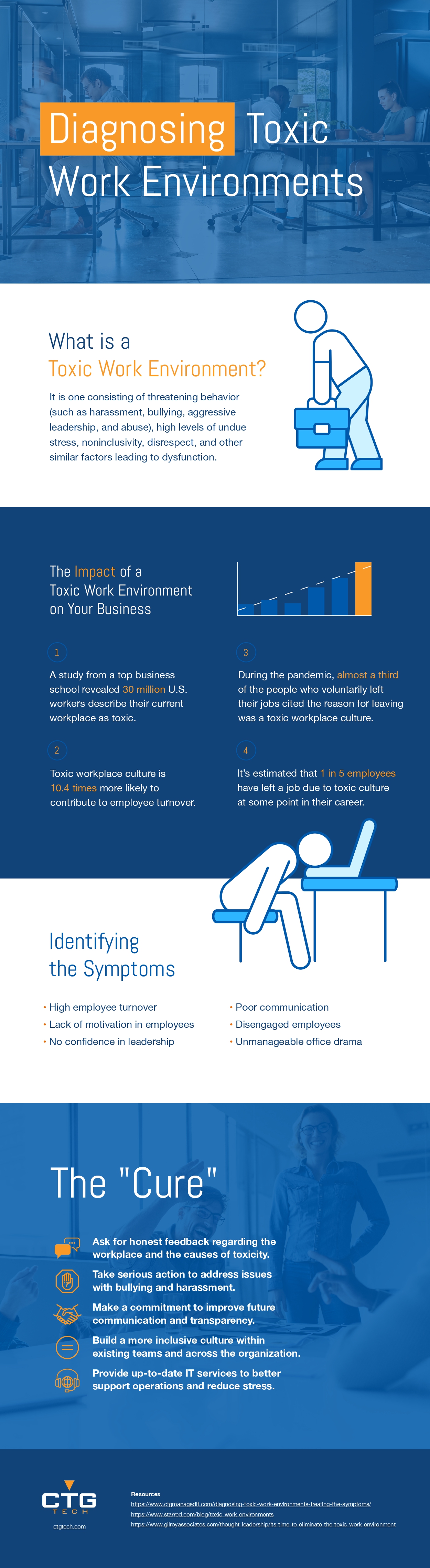
Good leaders should create and maintain a positive and diverse workplace. Please see the tips below for more help avoiding a toxic work environment and creating an inclusive one.


managed it services Texas

Provided by CTG Tech – managed it services Texas