Citibank Partners Yahoo to Enhance Public Literacy on Personal Finance

Citibank Partners Yahoo to Enhance Public Literacy on Personal Finance
yahoo

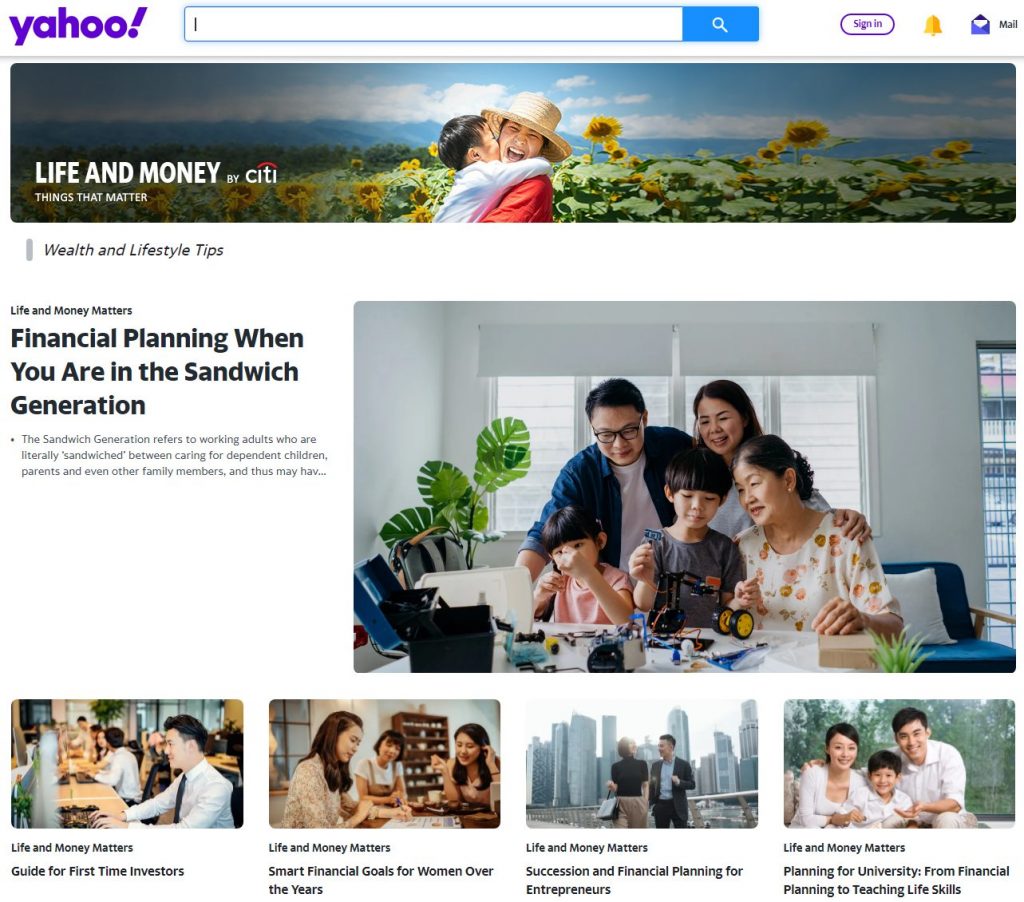
Yahoo and Citibank have teamed up to start Everyday living and Income, a devoted private finance hub geared in the direction of various audiences, providing refreshing perspectives on money, and equipping them for their economical journey across different everyday living phases. Hosted on Yahoo Finance in Singapore – the #1 source for enterprise and finance news in the state – Life and Income will see Citibank share specialist insights and suggestions on private finance with readers.

While financial literacy in Singapore is the greatest in Southeast Asia, swift modifications in the fiscal landscape, technological advances, as perfectly as switching life-style behaviors and lifetime expectancy keep on to gasoline developing fascination in particular finance as they develop their aspirations. While there is no lack of information and facts accessible online, Singaporeans are significantly discerning with their finances and on the lookout for sources and information they can have confidence in.    

Seeking to empower audience as they regulate their funds and assume about their potential, Daily life and Dollars will function a specially curated variety of original information contributed by and jointly with Citibank, as very well as pertinent aggregated material from Yahoo Finance. With insightful explainers accessible in several multimedia formats this kind of as content, films, and podcasts, the hub will include a extensive array of topics all over own finance and way of life. These involve conserving, investing, advancing careers, attaining operate-daily life harmony, sustainable residing, parenting, and other individual finance and life style pursuits. 

With a aim on enabling readers to live richly – economically, bodily, and emotionally – the written content will deal with misconceptions, encourage new lifestyle habits, and deliver actionable tips for viewers of different lifetime stages. Between them are first jobbers searching for economical independence, starter family members purchasing their aspiration residences, mid-vocation professionals progressing by means of milestones, and seasoned achievers organizing their suitable retirement.  

“As a foremost source for finance news, Yahoo is concentrated on giving information and info that will assistance give our visitors the self confidence to make intelligent economic conclusions. We are thrilled to associate with Citibank and establish empowering content on private finance, and enable drive meaningful connections with audiences trying to get rich insights that will help them reach monetary empowerment and lead their wanted lifestyles,” explained Carol Tay, senior director sales Southeast Asia, Yahoo.

“Our partnership will give viewers the chance to obtain Citibank’s hottest particular finance insights and tips, as very well as better provide our purchasers with an additional supply of trustworthy finance-related content material. We hope to offer a fresh and trustworthy economic point of view to those navigating life’s milestones, leveraging Yahoo’s strong editorial experience and sizeable organic and natural database,” mentioned Mylene Ong, head of digital product sales and marketing and advertising, Citibank Singapore.

An economist studied popular finance tips. Some might be leading you astray : Planet Money : NPR

An economist studied popular finance tips. Some might be leading you astray : Planet Money : NPR

Individual finance smackdown

Pixabay


hide caption

toggle caption

Pixabay


Personal finance smackdown

Pixabay

Controlling your cash is clearly an significant part of remaining a liable adult. But how should really you do that? It turns out that there is a significant gulf amongst the information given by the authors of well-liked finance textbooks and academic economists.

In a new research titled “Well-known Private Fiscal Tips versus the Professors,” the Yale financial economist James Choi rummages by way of 50 of the most well-known textbooks on particular finance to see how their tips sq. with regular economic thinking. It is like a cage match: Finance thinkfluencers vs economists dueling in excess of what you ought to do with your income.

And, sure, Choi is an economist, but he may well be a more neutral referee of this smackdown than you’d think. That is since he’s a behavioral economist who will not swallow the canon of aged-university economics hook, line, and sinker. Classic financial designs portray individuals as hyper-rational, disciplined creatures, who constantly make optimum fiscal decisions for them selves. Behavioral economics, which has fairly much taken over the discipline, emphasizes that men and women are quirky, typically irrational, and susceptible to faults.

In a way, Choi says, behavioral economists like him try out to assistance people defeat their shortcomings and reach their money targets as if they have been the savvy creatures of outdated-school concept. And so, he says, classic economic idea could nonetheless offer a excellent over-all guidebook for how to improve your economical properly-currently being. But, Choi states, the information of well-known finance thinkfluencers, who are likely to concentrate on helping us get over our flaws and foibles, might basically be more successful in some scenarios.

So, who’s right in this monetary royal rumble? The authors of self-aid finance textbooks or the stalwarts of common economic principle? When Choi won’t generally offer definitive answers, this debate may possibly spark some suggestions on how you can much more correctly deal with your finances.

How Need to You Conserve Cash?

When it comes to saving money, quite a few economists supply relatively counterintuitive — and, dare I say, possibly irresponsible — information: if you happen to be younger and on a strong job track, you may possibly contemplate investing far more and saving less suitable now.

Which is mainly because you’re most likely going to receive a bigger paycheck when you are older, and to definitely squeeze the enjoyment out of lifestyle, it may well make feeling to live a little bit past your usually means at the moment and borrow from your long term, richer self. Economists connect with this “usage smoothing,” and it is really a attribute of standard financial styles of how rational men and women preserve and commit more than their life span. The strategy, Choi claims, is “you don’t want to be starving in just one period and overindulged in the upcoming. You want to easy that about time.” The sort of perfect state of affairs: you begin off adulthood saving very little or almost nothing or even using on financial debt, then you conserve a whole lot through your primary-age earning decades, and then you devote all those discounts when you retire.

“I convey to my MBA learners, ‘You of all folks should really feel the minimum sum of guilt of having credit rating card debt, since your earnings is rather low suitable now but it will be, predictably, quite superior in the really around long run,'” Choi suggests. As soon as they commence generating funds, he states, they should probably pay down that credit card debt rapidly due to the fact credit history card companies charge large fascination charges.

Looking through by well-known finance guides, on the other hand, Choi finds that the large the vast majority of well-liked authors provide guidance that contradicts this technique: in the course of your existence, the thinkfluencers say, your intention need to be to are living in just your means and help save a constant share of your income. It would not matter if you happen to be 20 or 30 or 50 they implore you to stash cash away immediately and spend it for your future.

In arguing this, the thinkfluencers frequently cite the energy of compound interest. The more time you preserve money, the more curiosity it accrues. As a end result, wealth snowballs in excess of time, so conserving a huge share earlier could make a ton of feeling.

Of training course, economists also figure out the energy of compound fascination. Exactly where thinkfluencers and aged-school economics actually depart from just about every other, Choi states, is “the usefulness of setting up preserving consistently as a willpower,” Choi says. This commitment, he states, “is nearly normally missing from economic types of ideal preserving — [and is] a likely vital oversight.” In other terms, some of us could possibly have to have to adopt challenging-and-quickly preserving rules at a younger age to create the self-control desired to guide more affluent life, even if which is much less than optimum from a regular financial viewpoint.

So who wins on this point? “I am in fact agnostic about it,” Choi states. “On the one particular hand, I do have a ton of sympathy for the perspective that you might be unnecessarily depriving you in your twenties and even thirties when, really predictably, your revenue will likely be substantially increased in later decades. That being reported, I do assume that there is one thing to this notion of currently being disciplined and understanding to reside in your indicates at a younger age.”

How Should You Consider About Your Price range?

In aged-university economics, funds is dollars. It really is fungible. There is no motive to put labels on it. Absent some economically advantageous purpose to do so (like the potential to get subsidies or a reduced tax fee), it will not make perception to established apart price savings for precise purposes, like a new car or truck or a future holiday vacation or a down payment on a property. A greenback is a dollar.

Of study course, several people today you should not believe this way. They often do what behavioral economists get in touch with “mental accounting,” earmarking particular revenue for this and that. “In much more severe versions of mental accounting, you can’t use the cash that you’re conserving for your Hawaii holiday for the down payment on your potential household,” Choi suggests.

Choi finds that 17 of the 50 textbooks he study by advocate for some type of psychological accounting training. And, he suggests, this information could possibly really make sense. It helps make financial calculations easier for people and may well encourage them to execute their targets.

Need to You Be “Dwelling Abundant, Dollars Bad”?

Quite a few Us residents are living in huge properties and are stretched skinny paying for them. When their home is a beneficial asset, and they are technically rather abundant, they are just squeaking by, living paycheck to paycheck. People today commonly refer to this as “property loaded, hard cash weak.”

Choi claims both equally popular fiscal advisers and most economists are very crystal clear: don’t do this! Do not acquire a property you are not able to truly find the money for. That can be super nerve-racking and perhaps ruinous.

How Considerably Of Your Revenue Should Be In Shares?

Choi says that common advisors and economists also typically concur that when you are younger, you need to commit most of your money in shares and only a little little bit in bonds. In addition, Choi says, each camps concur that as you get more mature, you should really get far more conservative, rebalancing your portfolio away from shares and extra toward bonds simply because shares are riskier than bonds. But, Choi states, even though both of those of these teams recommend people today to do the same factor with their investments around time, their reasoning for accomplishing so is quite diverse.

Usually speaking, well-known financial advisers say that, while stocks are dangerous in the limited run, you should really devote primarily in them when you are youthful for the reason that they gain larger returns than bonds around the long operate. “The well-liked belief is that the inventory industry is form of certain to go up if you just maintain on to it for long adequate,” Choi says. “Now, this is just not correct. And you can see this in Italy and Japan. In Japan, the inventory market place still has not recovered to the level it was again in 1989. So it truly is not accurate that stocks will usually gain about the extended run. Negative points can take place.”

But while well-liked authors may well discount this danger in excess of the long expression, their advice recognizes that keeping shares is risky in the brief phrase. Which is why they argue that, as you get closer to retirement, you should get out of shares and go into bonds, which are normally fewer risky. A preferred rule of thumb: 100 minus your age is the share of your portfolio that ought to be in shares. The remainder should be in bonds. So if you are 30, you need to be 70 per cent in stocks and 30 p.c in bonds.

Though economists concur that you must get a lot more conservative above time with your financial portfolio, Choi claims, their reasoning is extra nuanced.

“For nearly all doing the job people, the key financial asset they have is their future wage income,” Choi claims. In other words and phrases, think of your work competencies (your “human funds”) as element of your economical portfolio. It’s like the largest sort of prosperity you personal, and it can be usually safer than stocks or even bonds. When you happen to be young, this safer sort of wealth is a big portion of your portfolio, so you can balance it with risky stocks. Guaranteed the inventory marketplace could possibly crash, but you still have the security of getting capable to receive income at your career for a lot of extra a long time. As you get closer to retirement, this safer asset, your labor, represents a a great deal more compact portion of your portfolio — and that tends to make it a lot extra frightening to be all-in on dangerous stocks. “Which is why you should come to be much more conservative in your economical portfolio allocation around time,” Choi claims.

Ought to You Treatment No matter whether Stocks Fork out Dividends?

Choi claims there are some well known money publications that suggest people today to acquire shares that pay out dividends. For the uninitiated, dividends are checks that businesses mail to their shareholders generally each quarter. “There seems to be this fascination with making ‘income’ from your investments,” Choi states.

Economists, frequently talking, believe this is dumb. “If I want to devote some money from my prosperity, I do not need to have to wait for the firm to mail me a check out,” Choi says. “I can just provide some shares and use the proceeds from that sale to finance my expenditure wants. And so there ought to be no rationale why I desire shares that pay out dividends versus shares that will not fork out dividends. And in truth, dividends are tax-deprived. So, a inventory that pays dividends is heading to put a larger tax load on you, all else equivalent, than a inventory that doesn’t fork out dividends.”

Choi is with Workforce Economist on this 1.

Really should You Invest In International Inventory Markets?

Economic concept stresses the significance of diversifying your investments. This, Choi states, is true of diversifying the international locations you commit in, too. Theoretically, the more international locations you make investments in, the a lot less risky your financial commitment portfolio will be. Some international locations will do very well. Other folks will do improperly. “So economic theory would say you want a diversified portfolio that retains a bit of every single country’s stock sector in the earth,” Choi says.

But folks will not do this. They show what economists connect with “house bias.” The French are extra most likely to make investments in French firms. The Japanese are far more likely to invest in Japanese providers, and so on. This has extensive been a puzzle to economists. The answer may possibly lie in the pretty much common help for ‘investing at home’ among the thinkfluencers. “The placing thing about the preferred authors is that they all recommend home-biased portfolios,” Choi states. Choi just isn’t definitely positive whether or not this will make a lot feeling. “It just would seem to be a little bit of jingoism, the place folks just like the stocks that they are acquainted with.”

Should really You Make investments In Actively Managed Cash or Passive Index Resources?

Actively managed resources are those in which you shell out an expert to decide and choose shares for you. These fund managers demand big service fees with the promise of increased returns. Index funds have nobody actively finding and deciding upon investments for you. These resources simply just passively keep a little piece of every single big corporation in the inventory market, thereby earning the general typical current market return.

Economists and thinkfluencers concur on this a person, too. “Most people generally claims you should really go with index money,” Choi states. “The information are quite compelling. On average, passive funds outperform actively managed money.”

Choi’s Significant Takeaway

So who wins? The thinkfluencers or the economists? Economists, Choi implies, could know a ton about how people ought to act. But, as an empirically minded behavioral economist, Choi recognizes that men and women normally never act this way. And that is exactly where he has a degree of sympathy for the common authors. “Provided that we have all these quirks and frailties, we could have to vacation resort to approaches that are fewer than fantastic.”

“I assume of it in terms of diet regime,” Choi says. “The best diet regime is the one that you can adhere to. Financial concept might be saying you will need to be taking in skinless hen breasts and steamed vegetables for the relaxation of your daily life and nothing at all else. Which is likely to be the finest for your well being. And, truly, really couple folks will truly do that.”

He certainly has that right.

Nearly Half a Million High Schoolers will Receive Life-Changing Personal Finance Education Funded by a Grant from Michael Jordan and Jordan Brand and Implemented with Next Gen Personal Finance |

Nearly Half a Million High Schoolers will Receive Life-Changing Personal Finance Education Funded by a Grant from Michael Jordan and Jordan Brand and Implemented with Next Gen Personal Finance |

PALO ALTO, Calif., Sept. 14, 2022 /PRNewswire/ — An astounding 498,000 mostly Black and Hispanic students who go to 639 superior universities across the United States will have accessibility to a private finance class thanks to a 1-time grant to nonprofit Subsequent Gen Personalized Finance (NGPF) from Michael Jordan and Jordan Brand.

The grant is modeled immediately after NGPF’s Economic Fairness and Empowerment (Fee) Grant program, which began in 2020 as part of the organization’s determination to improve obtain to financial training in university districts serving greater part Black and Hispanic college students.

Via the Cost Grant system, NGPF partners with the largest U.S. general public college programs who share a determination to growing the money capacity of their pupils. Resources guidance a committed Individual Finance Expert, who will perform regionally to provide curriculum aid and skilled enhancement to academics in their district with ongoing help from NGPF.

Furthermore, the Jordan grant delivers for extras such as an enlargement of NGPF’s on line curriculum choices and the development of college student investment clubs coordinated by way of the private finance specialists in cooperation with lecturers.

Monetary Equity and Empowerment (Price) Grant recipients supported by the 2022 Jordan grant incorporate the Fund for Community Educational facilities, which supports New York Town Public Educational facilities Philadelphia Economic Scholars, which supports public substantial colleges in Philadelphia Charlotte-Mecklenburg Universities Fulton County Educational facilities (Atlanta, Ga.) Guilford County Schools (Greensboro, N.C.) and Detroit Public Educational facilities Neighborhood District.

These faculty programs were decided on not only simply because of their large selection of college students, but also for the reason that the share of Black and Hispanic students ranges from 56-95 per cent, furthering the affect of the grant.

“This grant has the chance to change the economical trajectory of traditionally excluded communities throughout the United States,” stated Tori Mansfield, NGPF’s Senior System Manager, who qualified prospects this grant initiative. “College students will graduate comprehension how to maintain good credit, spend in the stock industry, and put together fiscally for daily life right after large university.”

A review executed by Montana Point out University’s Dr. Carly Urban of practically 12,000 general public substantial faculties serving additional than 12 million superior schoolers demonstrates accessibility to fiscal schooling classes to be inequitable, specially for Black, Hispanic and low-profits students.

Excluding the eight states that have absolutely executed a 1 semester superior faculty personal finance training course ensure for all learners, she identified that just 1 in 9 college students in the rest of the nation will obtain money education prior to graduation.

Having said that, this quantity dips to a single in 20 college students in educational facilities with much more than 75 per cent of students qualified for free of charge or lessened-priced lunch or far more than 3-quarters Black and Hispanic scholar populations.

1 review from economist Daniel Mangrum observed that between 1st-era or reduced-income students who experienced taken these a class, loan compensation was bigger, which implies those students were much more possible to have completed faculty and found a bigger-shelling out occupation. A further research discovered following private finance education and learning is essential, credit rating scores go up and delinquency premiums go down.

“We are stunned by the generosity of Michael Jordan and the Jordan Brand name, which will enhance entry to this important class and create monetary capability for the future technology,” mentioned NGPF Co-Founder Tim Ranzetta.

This institutional grant to NGPF was designed via Michael Jordan and Jordan Brand’s 10-12 months, $100 million Black Neighborhood Commitment (BCC). Founded in 2020, this joint determination is intended to drive sustainable remedies and systemic adjust for Black communities by investments centered in financial justice, education, narrative adjust and social justice. The BCC’s institutional grantees are top the way to create a planet in which Black people can prosper.

About Upcoming Gen Personal Finance

Next Gen Private Finance is a nonprofit corporation with a mission to assurance that by 2030 ALL pupils will consider a just one semester personal finance course just before graduating significant school. To help that mission, NGPF gives center and superior school educators with everything they want to train economical capabilities with self-confidence, at no price tag. This is composed of completely ready-to-use financial literacy curricula—including particular finance, math, and economics collections with Spanish translations—as very well as absolutely free qualified improvement teaching. Understand additional at www.ngpf.org.

Media Speak to:

Tori Mansfield

Senior Method Supervisor

Following Gen Own Finance

Tori@ngpf.org

Cision Check out primary articles:https://www.prnewswire.com/information-releases/just about-50 {1b90e59fe8a6c14b55fbbae1d9373c165823754d058ebf80beecafc6dee5063a}-a-million-higher-schoolers-will-obtain-everyday living-modifying-personal-finance-education-funded-by-a-grant-from-michael-jordan-and-jordan-brand-and-executed-with-following-gen-particular-finance-301623825.html

Source Following Gen Private Finance

All the Personal-Finance Books Are Wrong

All the Personal-Finance Books Are Wrong

James Choi, a professor at Yale College, was intrigued in educating a distinct type of personal-finance system. He required his curriculum to combine the conclusions of specialized economics papers with the takeaways from glitzy very best-providing guides.

Numerous many years back, he started off poring around dozens of common personalized-finance titles, which experienced offered tens of thousands and thousands of copies, in buy to get a sense of the counsel they ended up dispensing. “I obtained definitely fascinated in this universe of assistance and how was it distinctive from the guidance that we teachers ended up offering about personal savings and investment,” he informed me. He realized that the most well known books tended to offer you finance suggestions that were both noticeably distinctive from tutorial research or, in his words, “just lifeless wrong.”

Choi distilled 50 ideal sellers’ classes in preserving, expending, and investing and lined them up in opposition to the takeaways of mainstream economics investigation. This thirty day period, he printed the results in a new paper: “Popular Personal Fiscal Assistance Vs . the Professors.” His summary: Economists have a tendency to offer you extra rational suggestions, due to the fact they are working with quantities very best sellers are inclined to provide more realistic tips, simply because they are grappling with human behavior—with all of its mess and irrationality.

Possibly the starkest illustration of the variation involving economists and popular authors was the information for shelling out down financial debt. In financial idea, Choi stated, households must always concentrate on prioritizing the payment of their best-curiosity personal debt. Each and every other system is extra costly, considering that you’re just permitting larger-desire prices linger on your every month bill.

But common authors this sort of as Dave Ramsey have proposed a just about reverse strategy. According to Ramsey’s “debt-snowball” approach, you should pay back off debt from smallest to premier, gaining inspiration and momentum as you zero out your accounts. This is far from the most inexpensive system for doing away with debt—Ramsey admits as significantly. But his debt-snowball technique isn’t about complex effectiveness. It is about creating willpower. When people overwhelmed by their financial debt see a lesser account hit zero, it’s so gratifying that they’re motivated to keep on spending down their greater balances.

Choi emphasized that he does not always think Ramsey’s strategy is strategically completely wrong, even however it is technically fallacious: “I imagine of it like diet and physical exercise. You can inform persons to try to eat broccoli and steamed hen for their whole existence. Or you can notify people about cheat foods to get their purchase-in so that they’re enthusiastic to stay on the food plan.”

The very best sellers’ emphasis on setting up momentum and inspiration occasionally strategies into less sensible solutions. For case in point, preferred publications often insist that people today must save at least 10 percent of their earnings no make any difference what. You can believe of this technique as “smoothing” your financial savings fee: Rain or glow, you’re recommended to inventory away a dependable share of profits to establish a discounts pattern in excess of time.

But everyday living is not clean. It’s spiky. A lot of individuals who hardly receive ample to afford to pay for rent at 25 grow to be wealthy ample to effortlessly afford to pay for a suburban home at 40. Some mother and father deluged with working day-treatment bills obtain a massive chunk of money freed up when their little ones transfer on to general public college. For this cause, Choi explained, academics are additional likely to protect low or even adverse price savings fees for youthful folks in anticipation of better discounts prices in midlife. This is the opposite of smoothing your price savings amount it is usage smoothing.

These solutions are far more than competing private-finance tactics they’re pretty much like competing life philosophies. Smoothing your personal savings pays homage to a psychological actuality: Behavior demand discipline and practice. If most people today are bad at out of the blue changing their discounts actions in center age, then advising them to sacrifice even though they are young is acceptable.

But consumption smoothing pays homage to an existential fact: Everyday living by itself is the greatest scarce asset. The foreseeable future is unknowable, and religiously keeping a double-digit personal savings charge as a result of the worst squalls of everyday living is not of the utmost importance. Possessing that specific evening meal with close friends at 23 is, for occasion, a lot more beneficial than getting a few hundred more bucks in your retirement fund at 73. By this logic, constructing a budget that will make you comfortable and delighted in the small phrase, even if that usually means varying your price savings level from ten years to 10 years (or 12 months to calendar year), is the greater approach.

This may be the deepest takeaway of Choi’s paper. Individual-finance ideal sellers be successful by mixing theory and psychology in a way that requires human nature critically and thus justifies the regard of economics professors. But those people who invest a life span delaying gratification could just one working day obtain them selves wealthy in personal savings but lousy in recollections, possessing sacrificed way too significantly joy at the altar of compounding interest.

Possibly several of the most common individual-finance publications could take a webpage from economic theory: There is far more to lifestyle than optimized personal savings patterns.

Opinion | Good personal finance gurus might give less than great advice. So?

Opinion | Good personal finance gurus might give less than great advice. So?

What can make great personalized-finance tips? This must be an straightforward problem. As College of Chicago professor Harold Pollack as soon as shown, the basic principles are so essential, they could suit on an index card — a thought we eventually turned into a e-book.

But significantly of what the well-known finance gurus and the general public look at common-feeling steering is significantly less than best, in the look at of Yale College economist James Choi, who examined some of the discrepancies involving that suggestions and what is recommended by economic concept in a the latest doing the job paper revealed by the Countrywide Bureau of Financial Investigation.

Choi’s summary: Economists can be like Mr. Spock, rational to an intense, while gurus are far more attuned to the psychology and minimal monetary literacy of audience — in other words, providing assistance they will understand and adhere to as a substitute of improved, additional difficult and considerably less emotionally desirable steering.

Is he ideal? Absolutely. But as a person who has worked in the particular finance trenches, I suspect the trouble of suboptimal guidance also displays equally a society that confuses dollars-administration tactics with morality, and the money incentives of information-offering.

With gross sales at a 10-calendar year substantial, the own-finance ebook business is booming, driven by visitors looking for monetary know-how and independence. Numerous, it is stated in book publishing, are repeat customers. And apparently, several want to hear the exact same matter about and above.

Take the concerns of paying, conserving and getting out of financial debt — all places the place Choi finds disconnects in between the gurus and the PhD-licensed economic theorists.

Choi, who surveyed the 50 most well known private-finance guides on the Goodreads web page, claimed the well-known financial guidance givers are likely to push the tortoise system: Gradual and steady wins the economic race. Preserve at minimum 10 percent of your profits, from your initially career onward. Sustain an sufficient unexpected emergency fund. When you fork out down personal debt, put the greater part of your assets not toward the optimum-desire monthly bill initially, but relatively the smallest monthly bill, no matter the desire rate, even if it is a drastically decreased volume — for the reason that the “snowball strategy,” as it is termed, will give you a motivational enhance. Never gamble on adjustable home loans a preset amount is greatest.

Choi points out that this usually contradicts what economic idea advises. Several men and women will generate larger salaries as they age, enabling them to turbocharge price savings. Trying to keep huge sums of wet-day funds in safe and sound, lower-interest accounts isn’t usually best. And, of course, remember to do consider desire prices into thought when it comes to credit card debt: You’ll pay back it down a lot quicker if you pay back the best-interest invoice to start with, whilst the snowball approach can expense a good deal of money in accumulated desire. And, uh, sometimes an adjustable amount house loan is finest. (A disclosure: Choi precisely singles out the e-book I co-wrote with Pollack as supplying fewer than “optimal” home finance loan suggestions.)

Depend me mainly on the aspect of the preferred gurus. (I have also been arguing in opposition to the “snowball method” for several years.) Negative matters can materialize to good men and women (even Ivy League graduates!), and numerous never make up for shed time, instead supercharging their shelling out with each elevate. Misfortunes ranging from sick wellness to a misplaced task can be economically catastrophic.

But it’s also accurate that American modern society — and a lot of a financial guru — conflates personal savings habits with moral virtue. Personal debt is seen as a personalized failing: It is “stupid” in the terms of leading economic expert Dave Ramsey, who also tells individuals that needing to depend on federal government support — say, a federal stimulus check in the course of a pandemic — is a sign they messed up. We should eat “rice and beans” right until we can pay out off our costs.

There are no goal specifications for economic guru standing, other than a willingness to opine and the ability to get eyeballs, be it via a ebook or TikTok article. And there is revenue to be designed listed here. Ramsey’s empire, for illustration, encompasses every thing from a countrywide radio demonstrate to in-human being get-out-of-financial debt seminars.

Nonetheless, Choi says, in most instances, having the preferred guidance is far better than not taking action, and their steerage may even be “more virtually helpful to the regular individual” than the specialist advice of economists. “Even where I imagined, ‘This is improper,’ it would not get persons to a terrible put,” he informed me.

Choi tends to make an exception for Robert T. Kiyosaki of “Rich Dad, Very poor Father” fame, who urges folks to leverage up and get rich swift in real estate, one thing Choi explained to me as “horrifying.” It is well worth noting that Kiyosaki’s tips is enormously well-known — his most well known guide was on the New York Occasions bestseller checklist for the improved part of a ten years — and people today have compensated tens of 1000’s of pounds to show up at seminars bearing his identify.

Choi himself teaches a private finance course. When I questioned no matter if he advises learners to adhere to the economists or the gurus, he demurred. “I convey to my pupils all I want them to do is have a prepare,” he informed me. “Ask yourself, ‘Am I heading to close up someplace which is acceptable?’ ”

In other phrases, we all will need our have particular person index playing cards — knowledgeable by greatest techniques, but also by our individual individuality, priorities and luck.

The Impact Of Technology On Personal Finance

The Impact Of Technology On Personal Finance

The technological advancements that technology has introduced are sensitive at quite a few degrees: institutional, industrial, but also at the non-public stage. This phenomenon addresses various sectors this sort of as digital leisure, well being, transportation, communication … Naturally, the economic system of the individuals, or much more precisely, the way to take care of it, these innovations launched new possibilities for has benefited from.

The Web age suggests extra advantage for lots of citizens, even with the point that adaptation has been fairly uneven and a lot easier for digital natives. Also in the monetary sector, specifically exemplified by digital banking, a software that has now been followed by a very considerable part of society. Lots of procedures have been simplified and delivered ease and comfort and urgency for many common tasks, this kind of as transfers, stability enquiries, resolution of uncertainties as a result of several procedures or specific supervisors who can be contacted on line.

Logically, this digitization has been pretty beneficial for these entities as well, as it has managed to lessen expenses and enrich their provider offerings. Nonetheless, it is not the only banking organizations that have taken this route. Broker-sellers and brokers also want to be associated in this modernization method and have provided their electronic selections to their customers to be in a position to function.

But this progress has introduced anything else. It is a democratization of prospects for buyers. Entities, let us connect with them, “classic” have noticed the emergence of a sequence of new businesses that, with the wind in favor of technological advancements, have appeared to the basic community, giving a wide range of services that are now Till now only founded companies ended up reserved. Fintech businesses are presenting essential products and services these types of as loans, distribution of economic items, investing in foreign exchange or stocks, among the other illustrations.

With up-to-the-moment information and facts and the probability of taking action in a snug and rapid way, the actuality of remaining equipped to commit from the choices offered by know-how has been extensively approved, not only by those who There are currently additional traditional techniques to do this right before, but also for several new individual investors. In addition, the most superior Spanish investing platforms, such as NAGA, offer you the likelihood to get coaching in this regard or other impressive alternatives these as “copy trading”, which allows you to copy some of the most knowledgeable traders of your selection. Is.

The impact of technology on personal finance

A further device that has demonstrated a effective advance is that of payment techniques, which include things like new formulation and customization of quite a few other classics. Debit playing cards are no more time a typical legacy of banking companies. Now, some platforms, this sort of as the aforementioned NAGA broker, offer you their have products and solutions, such as NAGA Fork out, one particular of the aspects of the app, with which, you can control your have dollars and make numerous investments. The ones that we have discussed higher than and many others are relevant to the order of fx or cryptocurrencies.

Of system, there are other providers that these businesses can provide depending on their specialty. For example, some of them are centered on mentoring and revenue administration. Some others have opted for alternate funding, occasionally through microcredit or other options such as “crowd equity”. Be that as it may, it is crucial that these corporations adhere to privateness, dependability and security requirements. Luckily, Key has the hottest technological products and a great complex workforce behind them to guarantee these elements are of great worth to the customers and ensure a easy experience.

In limited, we are chatting about a technology that has facilitated various each day tasks and delivered new choices to other customers which, on many occasions, they ended up not made use of to utilizing. Clearly, growth and advancement will go on, so we will see new options in a small time.