
This Father of Four Just Quit His Job for TikTok. How Much He Saved Before Making the Leap

This Father of Four Just Quit His Job for TikTok. How Much He Saved Before Making the Leap

For Sal Farzin, leaving a 20-year career in tech to become a TikTok influencer seemed completely out of the question.

Online, he’s a celebrity. But offline, Farzin is the sole income provider for himself, his wife and four children. For professionals who have home and family responsibilities, the employee-to-entrepreneur transition is easier said than done, and fraught with financial risk.

Sal Farzin pointing to an Amazon box with a bookshelf in the background

Sal Farzin

Still, there’s no denying the Austinite has struck social media gold in recent years. Farzin’s TikTok account SimplySalFinds, an Amazon product recommendations channel, began in 2020 as a side hustle to offset a pandemic-induced furlough. Since then, the account has attracted 2.8 million followers and morphed into a money-making machine, producing tens of thousands of dollars in affiliate link commissions and brand deals per month, per financial documentation reviewed by CNET.

Amid Great Resignation fever and a flurry of recent tech layoffs, many Americans are re-examining what they want out of their careers and lives, as well as what it will take financially to pivot. Farzin transitioned to full-time influencer last December, but not before reaching certain personal finance benchmarks first, such as setting up a self-employed retirement account, paying down debt and stashing away a whopping three-year emergency fund.

If you’ve thought about going all-in on a side hustle or career pivot, but are intimidated by the instability, here’s how one family mitigated that risk, along with what financial experts say you should have in place before making the leap.

@simplysalfinds How to work remotely from anywhere! 💼 Shoutout to @worky_life for sponsring this vid! #worky_partner#amazonfinds#amazontiktok#officefinds#officehacks#wfhlife#salfinds♬ original sound – Simply Sal Finds

The side hustle of a lifetime wasn’t supposed to happen

Farzin’s initial foray into TikTok began as a result of being teased by his kids.

“‘You’re too old for TikTok, dad!’ They told me when I saw them on the app at the dinner table,” Farzin said. The spring of 2020 saw temporary furloughs for many Americans, with Farzin being one of them, and the family needed to look into supplementary sources of income. Curious, the playful TikTok jab led him and his wife down a rabbit hole as they began to study which videos were going viral on TikTok — and why.

They also researched various online business ideas that could be managed without a huge time commitment, as Farzin’s furlough was temporary. As shoppers who loved discovering unique finds on Amazon, a recommendations channel that earned money from affiliate links via Amazon’s Associates progam emerged as a potential strategy. 

The research paid off. SimplySalFinds’ first video, published on July 1, 2020, immediately went viral, attracting 50,000 followers to the account in the first month alone, according to data from SocialBlade, a social media analytics company. The meticulously edited videos, which often pack over 20 clips into about 15 seconds, eschew common TikTok practices like dancing and pointing, instead using sped-up footage and rapid transitions to create visually irresistible content.

@simplysalfinds The last one saves me so much time!#amazonfinds#tiktokmademebuyit#amazonhome#kitchenhacks#showertok#organizedhome#salfinds♬ original sound – Simply Sal Finds

SimplySalFinds became a family effort, with dad doing the voiceovers and video clips being filmed by the kids, who were paid for their time out of the channel’s earnings. Thanks to killer content, brand sponsors came knocking, but Farzin said the balancing act was a struggle. “I just wasn’t able to maximize potential earnings by balancing a corporate job, which was pretty demanding at times, with opportunities that Amazon or other brands were approaching me with. I couldn’t do a lot of the stuff that I really wanted to do during the day because I had a full-time job,” he said.

Eventually, the social media star signed on with a creator management company to offload contracting and brand deals, a move he says diversified his income streams and led to more overall business. “About 35{1b90e59fe8a6c14b55fbbae1d9373c165823754d058ebf80beecafc6dee5063a} of the revenue we do comes from brand deals now,” Farzin said.

The channel’s content is “a really fantastic example” of someone who’s found success without using typical TikTok gimmicks like green-screen effects, said Hilary Billings, co-founder of The Attentioneers, a consulting agency that specializes in short-form video, and is not affiliated with Farzin.

“He’s not pushing anyone to buy anything. All he’s doing is being a trusted resource, which makes people want to follow him even more,” Billings said. “When users are scrolling through their feeds, they have an expectation as to what they’re going to see. You have to work harder to create that pattern interrupt [in short-form video] in order to grab attention in a very short amount of time.”

@simplysalfinds How to power nap like a pro 😴#amazonfinds#tiktokmademebuyit#sunglasses#fashiontok#salfinds♬ original sound – Simply Sal Finds

Salary + side hustle: The new normal

In an inflationary economy, more people are supplementing their day jobs with side hustles to make ends meet. 

Two out of five Americans have a side hustle, according to a Harris poll commissioned by Zapier, a marketing automation company. Respondents in that study said their secondary jobs generated an average of $12,589 per year, but respondents in a separate study conducted by Qualtrics and commissioned by LendingTree reported average earnings of just under $5,700 per year, indicating a wide range in top-line revenue.

Sal Farzin stands in front of a sign that says Amazon Creator Summit

Farzin was a featured speaker at the Amazon Creator Summit last fall, an appearance he said accelerated his decision to take TikTok full-time.


Sal Farzin

Farzin’s earnings from TikTok helped the family save enough money to move into a bigger home in Austin, Texas, a goal of theirs as their children enter adolescence. “Over the last few months, it’s really blown up in terms of the opportunities and brand deals that have come in,” Farzin said. He notes that the flat-fee upfront payments of brand deals were a welcome diversification from affiliate link revenue, which depends heavily on algorithmic distribution. They positioned him to seriously consider exiting his corporate career, particularly after appearing with Amazon as a speaker at its creator summit last fall.

How to navigate the employee-to-entrepreneur transition

Making the jump from employee to entrepreneur can feel scary at times. Here are actions you can take now to ease the transition.

1. Rewire how you think about money

Often, taking a risk in your career means overcoming persistent and/or unproductive thought patterns about money, which are often deeply ingrained, according to credentialed psychologists and financial therapists.

“If we have a 9-to-5 job, it’s difficult to transition from that career to a non-traditional one because historically we don’t have very many models that tell us we will be safe and secure,” said Traci Williams, a board-certified psychologist and certified financial therapist.

“A lot of people have thoughts about the worst-case scenario. If you can counter those thoughts by focusing on what your reality is — that you are making enough money for this transition and have prepared enough for the future — you’ll be able to better manage that anxiety,” Williams said.

Farzin says the passion he developed for building SimplySalFinds also revealed career fatigue with an industry he had been in for decades. “Once we were settled into our new home, my wife and I had a heart-to-heart conversation about what the future was going to look like,” Farzin said. “Despite the fact that I’d been in the ad tech space for nearly 20 years, I think my aspiration to continue on that path had taken a backseat.” 

Conversations with loved ones can help you plan your next money move, and you want to include them in your decision when the result may be a change in day-to-day life, said Megan Ford, financial therapist and an advisor for Stackin, a financial wellness app.

“It’s always advisable to think carefully and have conversations with people who will be impacted by this change,” Ford said. “A partner or spouse who will be impacted by a change in employment direction may have to maneuver differently within the household.” 

@simplysalfinds How to stay cool during a heatwave 🥵 #amazonfinds#tiktokmademebuyit#icemaker#hacks#salfinds♬ original sound – Simply Sal Finds

2. Stack cash to build confidence

The future is uncertain, and belts remain tight as recession fears persist. Typical personal finance advice advocates for three to six months’ worth of expenses in liquid cash as a safety net, but if you’re removing your day job from the picture, consider padding your savings with extra funds. Farzin and his wife decided they wanted a 36-month emergency fund in the bank, a number he reached in late 2022, before walking away from a corporate paycheck.

“Establishing this emergency fund was top-of-mind for me at the beginning of last year. Whatever funds we were making, whether it was through my work or the SimplySalFinds channel, we always made sure to tuck away at least 20{1b90e59fe8a6c14b55fbbae1d9373c165823754d058ebf80beecafc6dee5063a},” Farzin said. “This is something we needed to do. I realized the only way we were going to do it is if we set up an auto draft.”

3. Set up accounts and systems properly

You can recreate most of the financial perks of your day job as an entrepreneur, but to do so effectively you need to know what they are.

First, register your business as a limited liability company or corporation. This gives you an extra layer of legal protection. If your business were to ever be sued or face a financial judgment, your business assets will be up for grabs, but your personal assets will remain safe.

Then, if you haven’t already, set up separate business checking accounts. Doing so will make it easier to keep personal and business expenses separate. If you manage income or expenses through a third-party payments app like Venmo, Cash App or PayPal, be sure to classify expenses as business or personal activity accordingly. This will make it way easier to take deductions when filing your taxes, which will save you money. 

You may need an Employer Identification Number to set up a business bank account. Once your LLC or corporation is official, you can request an EIN from the IRS for free. Also consider setting up a self-employed retirement account, such as a SEP IRA, and automating contributions. 

Lastly, if you think you’ll want to tap retirement funds in the future before the age of 59.5, consider initiating a Roth IRA conversion, in which you transfer funds from a pretax retirement account like a 401(k) to a Roth IRA. You’ll pay taxes on this money when you transfer it, since you hadn’t yet done so, but money that has been contributed to a Roth IRA can be pulled back out without penalties if you hold it for at least five years.

All of this can feel, well, overwhelming at first. Keep your eyes on the future and what you want to cultivate for yourself and your family. 

“My oldest, Neela, is 17,” Farzin said. “She’s going to college, and planning for college for the kids is another important piece that we had to think about, because that’s going to come sooner rather than later. Future-proofing those types of financial decisions have been really top of mind for us overall.”

@simplysalfinds BEST way to cool down in the summer! #amazonfinds#tiktokmademebuyit#amazonhome#hacks#salfinds♬ original sound – Simply Sal Finds

Pursue your next career move in a mindful, intentional way

The employee-to-entrepreneur transition can feel intimidating at times. However, if your current career situation is no longer workable, the best time to start taking matters into your own hands is now.

“When I used to work my corporate job back in Los Angeles, I commuted 90 miles each way,” Farzin said. “I lost valuable time with my wife and kids as they grew up. My wife and I agreed that we owe it to ourselves to start investing back in our family and health. SimplySalFinds helps us do that.”

Sal Farzin, his wife and four kids posing for a family photo in a park

Sal Farzin

More money stories

4 Things to Know Before You Take Financial Advice From TikTok

4 Things to Know Before You Take Financial Advice From TikTok
A smiling person sitting on their couch and looking at the phone in their hand.

Picture resource: Getty Visuals

TikTok is enjoyable, but also ripe for creators operating a fraud.


Important factors

  • Everyone can make a TikTok movie, and it’s up to the viewer to vet the reliability of the online video creator.
  • Some creators are perfectly-intentioned with their assistance, but they could not have a complete comprehension of a money matter.
  • Guidance that will work for a person person will not automatically work for everybody.

If you’re a TikTok fanatic, you surface to be in superior company. TikTok officially has much more than 1 billion regular consumers. What is far more, 83{1b90e59fe8a6c14b55fbbae1d9373c165823754d058ebf80beecafc6dee5063a} of TikTok consumers have also posted at minimum 1 video clip, proving the idea that everyone can be an influencer.

From make-up tutorials to lip-syncing films, TikTok has it all. And that consists of a lot of finance films. Some of the movies are respectable, with assistance available by industry experts with yrs of knowledge in the private finance area. Other people are what we may possibly generously call “iffy.”

Right before you just take economical information from anybody on TikTok, right here are some points to hold in thoughts.

1. Creators are not vetted

There are no programs to fill out or necessities to fulfill to post a online video to TikTok. That means any person (basically, any one) can contact themselves a economic specialist. TikTok does not vet its creators, which means you have to. If you would not choose financial information from some guy you meet at the bus cease, why consider it from a stranger you see on the net?

A simple Google look for should be enough to give you an notion of how capable a particular person is to supply monetary advice. Once you’ve got searched for the person’s name, discover out:

  • Wherever they’ve worked. Do they have working experience in the fiscal sector?
  • If they maintain a experienced certification, like Qualified Economic Planner (CFP)
  • How a lot of years of expertise do they have less than their belt? Someone who’s been in the company for a prolonged time does not automatically give improved advice than a beginner, but they have knowledgeable additional ups and downs in the economical markets.
  • If they are striving to sell you a thing. Be careful of any individual who wishes you to purchase their book, invest in a distinct solution, or if not element with your money. It’s okay if a financial advisor has penned a ebook. Nevertheless, if the vast majority of their video consists of trying to get you to purchase anything, they are almost certainly not hunting out for your most effective interests.

2. Wild claims catch the attention of sights

As a society, we’ve learned that outrageous conduct and wild promises bring in attention. If a TikTok creator attracts attention by promising one thing like, “With my approach, you can be a millionaire by this time next calendar year,” they are making an attempt to lure you in. Both they’re carrying out it to maximize their views (and earnings), or they are jogging a scam.

Let’s say someone grabs your focus by saying they’ve observed the key to individual wealth. In their videos, they tout a unique low-executing inventory. We are going to connect with it “Acme Brick.” By the time the video is more than, you happen to be certain that Acme Brick is undervalued, and if you open up a brokerage account to make investments now, you can enjoy massive rewards when the community figures out how valuable the company is.

The benefit rises as you (and other viewers) acquire Acme Brick inventory. And which is when the TikTok creator cashes out, selling their inventory at a tidy revenue. It is really a fraud, usually referred to as a “pump and dump.” The scammer’s task is to influence others that a so-so investment is worthy of considerably a lot more than its latest benefit. At the time new traders press the benefit of the inventory up by shopping for in, the scammer cashes out.

3. A small know-how can be harmful

Not all lousy assistance on TikTok is the end result of a scammer. Occasionally, a particular person is very well-intentioned but not monetarily savvy enough to understand how the route they’re giving impacts men and women.

For case in point, an individual could counsel you attract money from your home by refinancing, then use that funds to pay out off credit score card personal debt. At initially blush, it won’t seem like terrible advice. The dilemma is that it can place you in monetary jeopardy. Below are just two causes why:

  • The charges and closing costs to refinance your property could price tag you extra than the desire you’re paying out on credit history playing cards.
  • Credit cards depict an unsecured debt, which means no 1 can arrive to your property and repossess something if you fall short to make payments. Your mortgage loan is a secured credit card debt. If you miss payments, the loan company can repossess the house, promote it, and use the proceeds to recoup its decline. Buying and selling an unsecured personal debt for a secured personal debt might not be the correct money move for you.

Even if you might be struggling to make credit rating card payments, greater solutions are out there. For a single, the Countrywide Foundation for Credit Counseling (NFCC) is a person of the country’s oldest nonprofit monetary counseling services. NFCC has decades of practical experience serving to people uncover their way out of personal debt and develop a much more secure monetary long term.

4. There is no a single-dimension-fits-all respond to

There are normal items of economical information that can implement to any person. For instance, “Dwelling under your means can lower your economic pressure,” and “The previously you get started to devote for retirement, the much better.”

Nonetheless, there is certainly almost nothing nuanced about the guidance provided on TikTok. By their incredibly nature, TikTok video clips can’t communicate to the certain fiscal conditions of millions of viewers. A greater guess is constantly to satisfy with a professional economic advisor who will look at your condition and support you devise a program centered on your circumstance.

TikTok is a whole lot of enjoyable. Who hasn’t loved watching a husky “chat” to its owner or a 4-12 months-previous belting out a Mariah Carey tune? The trick with TikTok (as with all social media) is to meticulously discern the distinction involving what’s genuine and what is actually entertainment.

Notify: optimum funds back card we have noticed now has {1b90e59fe8a6c14b55fbbae1d9373c165823754d058ebf80beecafc6dee5063a} intro APR till nearly 2024

If you’re working with the wrong credit history or debit card, it could be costing you really serious money. Our qualified loves this major select, which features a 0{1b90e59fe8a6c14b55fbbae1d9373c165823754d058ebf80beecafc6dee5063a} intro APR until approximately 2024, an crazy money again charge of up to 5{1b90e59fe8a6c14b55fbbae1d9373c165823754d058ebf80beecafc6dee5063a}, and all someway for no annual payment. 

In fact, this card is so fantastic that our qualified even employs it individually. Simply click here to browse our total critique for totally free and use in just 2 minutes. 

Read our free critique

How to Tell If a Personal Finance Influencer on TikTok Is Legit

How to Tell If a Personal Finance Influencer on TikTok Is Legit
  • A lot of individuals switch to TikTok and Instagram Reels for money literacy content.
  • It really is hard to know who to trust on the internet, so we questioned a former economical advisor how to location real professionals.
  • Humphrey Yang suggests there are 3 eco-friendly flags to appear out for.

Many Gen Zers and millennials 1st change to TikTok and Instagram Reels for money literacy right before getting in touch with a specialist, like a financial advisor or economic planner. On TikTok alone, video clips that use the hashtag #MoneyTok have collectively attained 12.7 billion sights (and counting).

There are ordinarily two teams of personalized finance influencers: Very first, there are economical gurus who have remaining the subject to make a greater affect on the internet. Then, there are men and women who have obtained significant fiscal milestones, like paying out off all of their scholar loans or setting up a 6-determine investment portofolio in a limited total of time.

Personal finance influencer, former economic advisor, and TurboTax investing expert Humphrey Yang belongs to the initial team. After building a adhering to of 3.3 million on TikTok and 508,000 on Instagram, Yang is familiar with how to spot an influencer who actually is familiar with what they are chatting about.

Yang tells Insider there are three environmentally friendly flags to glimpse out for when examining irrespective of whether or not a personal finance influencer is respectable.

1. They answer to their community’s feedback

“A green flag is really listening to their viewers and comprehension their troubles,” claims Yang. On TikTok, it’s comparatively easy to see if influencers are creating new films to answer to usually requested thoughts in the opinions. On TikTok and Instagram, you can just scroll down to see if the influencer has responded to some or most of the comments.

On the other hand, Yang warns, “There are some money creators who just use an company to submit a bunch of material for them. They are going to chop up the articles and that creator will not even be replying to the feedback.” 

2. They have a very long-expression mindset

Yang states that an influencer claiming they know how to get loaded rapidly is a main purple flag. He adds, “Make absolutely sure they’re not attempting to provide you a item, like, ‘Check out my profits funnel, my class, my just one-on-one consultations!’ There are also persons who claim, ‘This is how you might be gonna make 10x your dollars currently!'” 

Influencers with a prolonged-expression mindset are far more probably to describe bigger financial principles, like Roth IRAs or 401(k)s, or every day behaviors that can enable you grow to be far better with income.

3. Their past activities match their experience

Yang encourages men and women to Google personalized finance influencers and discover out what their previous encounters are. He suggests, “The 1st issue I might do is probably glimpse at their get the job done background on LinkedIn.” 

For money planners or financial advisors who have left the field to serve a bigger viewers, it must be rather straightforward to come across irrespective of whether or not they are lying about their know-how and credentials. On the other hand, influencers who have paid out off massive amounts of personal debt or are higher-earning, self-taught buyers ordinarily post screenshots of their accomplishments to establish they’re genuine.

Personal finance is a hit on TikTok

Personal finance is a hit on TikTok

34{1b90e59fe8a6c14b55fbbae1d9373c165823754d058ebf80beecafc6dee5063a} of Gen Z Is Learning Personal Finance From TikTok and YouTube, Survey Finds

34{1b90e59fe8a6c14b55fbbae1d9373c165823754d058ebf80beecafc6dee5063a} of Gen Z Is Learning Personal Finance From TikTok and YouTube, Survey Finds

pressureUA / iStock.com

Generation Z has grown up in an age of low commissions and high technology, which has greatly influenced how they invest and learn about money in general. This generation that is between 6-24 years old right now is trying to use what they grew up with — things like social media — to their advantage instead of just for fun. While previous generations might’ve relied on family, financial advisors or other sources to learn about money management, Gen Z appears to be modernizing personal finance education in a way that works for them.  

Read: 51 of the Biggest Money Influencers on TikTok and YouTube
Check Out: The 10 Best Stocks for the Gen Z Investor

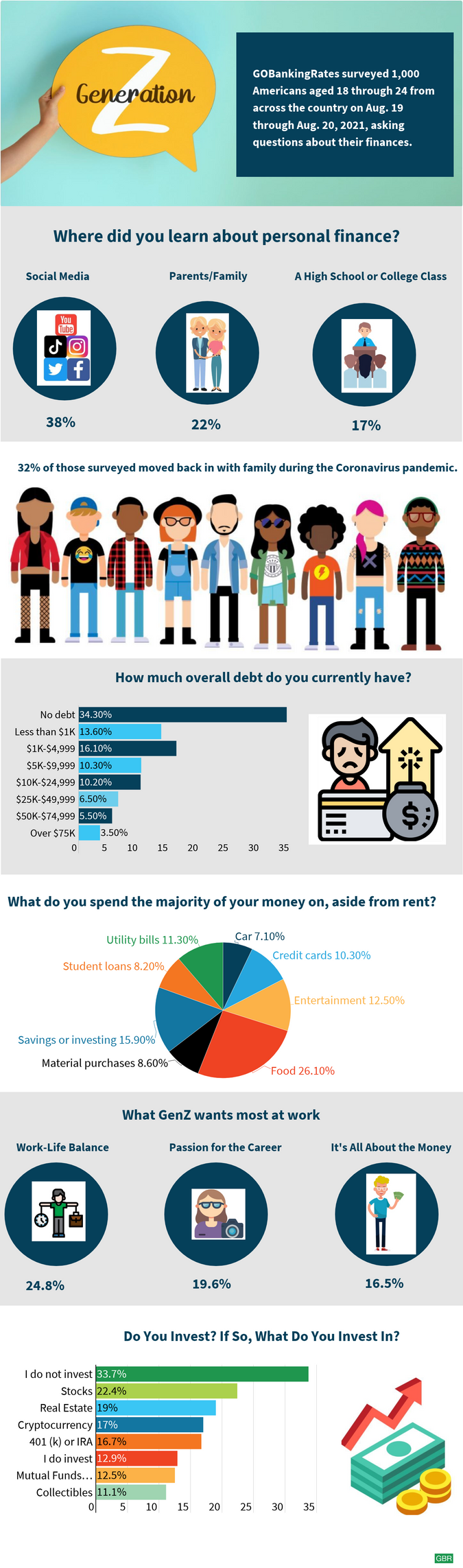
To find out about Gen Z’s approach to personal finance, investing and more money issues, GOBankingRates commissioned a six-question study of 1,000 Americans ages 18 to 24. Here are some of the most interesting results from that survey.

Gen Z Learns Personal Finance From TikTok and YouTube

Perhaps the most notable result from the survey is that the younger generation gets a lot of its financial information from a source that didn’t even exist two decades ago. A whopping 38.8{1b90e59fe8a6c14b55fbbae1d9373c165823754d058ebf80beecafc6dee5063a} of Gen Zers responded that they learned about personal finance from TikTok, YouTube or other social media outlets, like Twitter or Instagram — 34.3{1b90e59fe8a6c14b55fbbae1d9373c165823754d058ebf80beecafc6dee5063a} answered TikTok and YouTube specifically. An additional 7.20{1b90e59fe8a6c14b55fbbae1d9373c165823754d058ebf80beecafc6dee5063a} responded that they get their information from personal research and/or online forums like Reddit. Combined, that’s far more than the 22.70{1b90e59fe8a6c14b55fbbae1d9373c165823754d058ebf80beecafc6dee5063a} who reported learning from parents or family. 

A lot can be inferred from this statistic. For starters, it reflects how much social media and online information dominates the lives of Gen Zers. However, it also raises questions about the quality of information that Gen Zers are getting about personal finance. While there is certainly some valuable information to be found online, there aren’t many restrictions as to who can post online and what they can say. If Gen Zers aren’t vetting the information they’re receiving, they could be susceptible to financial misinformation. It also means they might be missing some of the fundamental principles about personal finance along the way, as only 17.60{1b90e59fe8a6c14b55fbbae1d9373c165823754d058ebf80beecafc6dee5063a} indicated they learned their financial information from a high school or college class.

Find Out: 5 Financial Steps Gen Z Should Be Taking Now
See: Surprising Ways Gen Z and Millennials Are Worlds Apart Financially

A Surprisingly High Percentage of Gen Zers Invest in Real Estate

For the purposes of this survey, only those ages 18-24 were included. Typically, people in that age range are either finishing up their education or working their first jobs. In either case, Gen Zers haven’t had a lot of time yet to build up their savings and investment portfolios. Yet, a surprising 19{1b90e59fe8a6c14b55fbbae1d9373c165823754d058ebf80beecafc6dee5063a} of respondents indicated they were invested in real estate, which traditionally requires higher levels of investment and/or a good credit history. This was the second-most popular investment category of survey respondents, just behind the 22.40{1b90e59fe8a6c14b55fbbae1d9373c165823754d058ebf80beecafc6dee5063a} indicating they were invested in stocks. 

Although a large number of Gen Zers in the survey indicated they were invested, 33.70{1b90e59fe8a6c14b55fbbae1d9373c165823754d058ebf80beecafc6dee5063a} indicated that they were not invested in anything. This represented the single largest individual response to this question. While many Gen Zers may not yet be earning a lot of money to invest, it would benefit them to begin saving and investing as young as possible to take advantage of the power of compound interest.

More: Crypto and 5 Other Groundbreaking Investing Trends for Gen Z
Find: How Will Teens and Gen Z Invest Their Money? Think Low-Risk, ESG and Roboadvisors

Debt Levels Are Generally Under Control for Gen Z

While it might be more encouraging to see a higher level of investment from the survey respondents, the good news is that most of the Generation Z survey respondents indicated they had control over their debt. More than 34{1b90e59fe8a6c14b55fbbae1d9373c165823754d058ebf80beecafc6dee5063a} of survey participants didn’t have any debt at all, including student debt, and nearly two-thirds had less than $5,000. However, 9{1b90e59fe8a6c14b55fbbae1d9373c165823754d058ebf80beecafc6dee5063a} of respondents had at least $50,000 in debt. 

Find Out More: Life Events That Millennials and Gen Zers Are Choosing To Go Into Debt For

Many Gen Zers Still Rely On Their Parents

From the survey results, it appears that Gen Zers aren’t quite ready to completely stand on their own in times of trouble. During the pandemic, around two-thirds of respondents indicated that they lived with their parents. Although 13.90{1b90e59fe8a6c14b55fbbae1d9373c165823754d058ebf80beecafc6dee5063a} indicated they have since moved out on their own, a full 49.30{1b90e59fe8a6c14b55fbbae1d9373c165823754d058ebf80beecafc6dee5063a} indicated they either have always lived with their parents or moved back home during the pandemic and are still there.

Read: Gen Z Feels Financially Unprepared for Adulthood — But Has Hope for the Future
More
: 4 Industries Gen Z Might Save — and 4 It Might Destroy

There Are Some Notable Differences Between Male and Female Gen Zers When It Comes to Personal Finance

When it comes to money and finance, there were some relatively significant differences between male and female respondents to the Gen Z survey. For example, 26.13{1b90e59fe8a6c14b55fbbae1d9373c165823754d058ebf80beecafc6dee5063a} of women indicated they learned personal finance from their parents or family vs. just 16.53{1b90e59fe8a6c14b55fbbae1d9373c165823754d058ebf80beecafc6dee5063a} of men. Men vastly preferred YouTube as a source of financial information, at 27.17{1b90e59fe8a6c14b55fbbae1d9373c165823754d058ebf80beecafc6dee5063a} vs. 11.98{1b90e59fe8a6c14b55fbbae1d9373c165823754d058ebf80beecafc6dee5063a} for women. 

Women were also more likely to have zero debt, at 36.08{1b90e59fe8a6c14b55fbbae1d9373c165823754d058ebf80beecafc6dee5063a} vs. 31.09{1b90e59fe8a6c14b55fbbae1d9373c165823754d058ebf80beecafc6dee5063a} of men, but they were also less likely to be invested: Only 25.77{1b90e59fe8a6c14b55fbbae1d9373c165823754d058ebf80beecafc6dee5063a} of men indicated they were not invested vs. 38.10{1b90e59fe8a6c14b55fbbae1d9373c165823754d058ebf80beecafc6dee5063a} of women. About 52{1b90e59fe8a6c14b55fbbae1d9373c165823754d058ebf80beecafc6dee5063a} of men indicated they were invested in cryptocurrency and/or stocks vs. just 32.50{1b90e59fe8a6c14b55fbbae1d9373c165823754d058ebf80beecafc6dee5063a} of women. 

More From GOBankingRates

Last updated: Sept. 15, 2021

Methodology: GOBankingRates surveyed 1,000 Americans aged 18 through 24 from across the country on Aug. 19 through Aug. 20, 2021, asking six different questions: (1) Where did you learn about personal finance?; (2) How much overall debt do you currently have? (Including student loan debt); (3) Do you invest your money? If so, what do you invest in? Select all that apply:; (4) If you had to pick one, what do you prioritize/value the most in a potential job?; (5) Did you move back in with your family during the coronavirus pandemic?; and (6) What do you spend the majority of your money on, aside from rent?. GOBankingRates used PureSpectrum’s survey platform to conduct the poll.

About the Author

After earning a B.A. in English with a Specialization in Business from UCLA, John Csiszar worked in the financial services industry as a registered representative for 18 years. Along the way, Csiszar earned both Certified Financial Planner and Registered Investment Adviser designations, in addition to being licensed as a life agent, while working for both a major Wall Street wirehouse and for his own investment advisory firm. During his time as an advisor, Csiszar managed over $100 million in client assets while providing individualized investment plans for hundreds of clients.

TikTok Schools Gen Z on Personal Finance

TikTok Schools Gen Z on Personal Finance

Alicia*, an art student in her late teenagers, commenced making dollars through her site late very last 12 months. The only difficulty? She did not know what to do with it. 

She is not by itself. A rising variety of teens and younger grownups have started off generating funds on-line. Which is wherever TikTok, the absolutely free-to-entry micro-video-sharing system, arrived in.

Some commenced understanding about their finances on TikTok accessing a hugely individualized and seemingly never-ending feed. This seems fantastic in concept, but complications crop up when they never know how to shell out, save or commit that income correctly. 

“Should I use it all for faculty costs? Should I spend a section of it? If so, exactly where? Had been the couple of hundred pounds I attained taxable? My faculty never formally taught us about taxes, investments, or budgeting, so I felt misplaced,” Alicia explained to YR Media. 

TikTok’s private finance neighborhood, utilizing hashtags like #FinTok and #StockTok, has millions of consumers and has turn into an crucial resource for learners like Alicia. 

“I arrived throughout an ‘Investing 101’ type publish on my feed by prospect, and I understood: I have to understand how to control my money. If colleges will not instruct it, TikTok will,” she mentioned. 

Professionals consider TikTok’s structure may possibly also have a position to enjoy. 

“Due to the recognition of brief-kind video clip initial via YouTube, then Instagram, and now TikTok, Gen Z is habituated to eat information in tiny chunks, as opposed to extensive types,” reported Robb Hecht, a marketing and social media professor at Baruch Higher education. “We are in a scenario where a whole lot of creators are creating revenue and want to find out investing, but not from an old school financial analyst, but from somebody who is keyed into the recent tendencies, teaches fast, and receives straight to the point.”

There’s also the inherent hazard issue when instructing investments to younger small children. They can make mistakes and lose money. Who’s responsible for that reduction then? Colleges and faculties really do not want to consider that risk, in accordance to Hecht.

Andrew Selepak, a social media professor at the University of Florida weighed in on the awareness remaining filtered down to long term generations. 

“Universities and K-12 education and learning typically do not train necessary everyday living abilities, so college students really do not master how to do their taxes, make investments or stability a checkbook,” stated Selepak. “Schools have historically appeared at these existence expertise as factors pupils would in a natural way study above time. But with each new technology, persons are not finding out these techniques and not passing them on to their youngsters.”

Like any other social media trend, “FinTok” comes with its have established of challenges, in accordance to Dr. Natalie Pennington, a communications experiments professor at the University of Nevada, Las Vegas.

“When you are talking about cash and expenditure, possibility and reward go hand in hand and if you do not have that skill established or know-how to balance the two, you could depend on a person recommendation and reduce it all. If a prime CPA or economic planner (with qualifications!) is sharing content material and assistance, that could possibly be an account really worth adhering to,” explained Pennington.

*Title improved to guard privacy.